Private Label, White Label, Wholesale partnerships available - EU, USA and UK - Free shipping from €75
How to Buy Sterile Water for Research in 2026
A researcher has a reconstitution run scheduled, the lyophilized material is ready, and the lab needs a dependable diluent before the next shipment arrives. A quick search for where to buy sterile water often produces a long list of sellers, vague product pages, and prices that appear easier to compare than the underlying quality systems.
That approach creates avoidable risk. Sterile water for injection is a regulated pharmaceutical input, not ordinary purified water. U.S. guidance defines it as a sterile, nonpyrogenic, solute-free preparation used only as a sterile solvent or diluent vehicle for parenteral drugs, while labeling standards describe it as a product for dilution or dissolution rather than direct therapeutic administration. The FDA guidance on water for pharmaceutical use explains why water specifications, monitoring, and documented controls matter.
The right purchase decision starts with product identity, lot documentation, supplier credentials, vial format, and shipping controls. A low unit price means little if the supplier can't prove what was filled, how it was tested, or how the shipment was protected.
Table of Contents
- Start With What You Are Buying
- Check Supplier Credentials Before Price
- Match Vial Format and Pack Size to Your Workflow
- Verify Storage, Shipping, and Dispatch Practices
- Confirm RUO Use and Required Lab Documentation
- Decide If Private Label or Wholesale Fits Your Model
- Avoid the Most Common Sterile Water Buying Mistakes
Start With What You Are Buying
A reconstitution run can stall when a buyer orders the wrong diluent. Sterile water for injection and bacteriostatic water are different regulated products, with different handling requirements and workflow implications. Sterile water for injection is preservative-free and intended for single use. Bacteriostatic water contains 0.9% benzyl alcohol and supports multi-dose access only when the product labeling and laboratory protocol allow it. Use the DailyMed labeling for sterile water and bacteriostatic water to verify ingredients, handling, and stated use before comparing suppliers.
Run these checks before placing an order:
- Confirm the product type. The product page, vial label, and COA must identify the same formulation, whether preservative-free sterile water for injection or benzyl-alcohol-preserved bacteriostatic water.
- Verify the intended-use statement. RUO labeling must fit a non-clinical laboratory workflow. Research-use-only status does not authorize human administration, clinical use, or activity outside the documented label.
- Inspect the lot-specific COA. A generic quality statement does not establish batch control. The certificate should identify the purchased lot and report applicable release testing, including sterility and endotoxin results where stated.
- Confirm the quality system. Ask for the manufacturing site, applicable ISO or GMP credentials, release process, and traceability records. A badge on a sales page is not evidence that the specific lot was controlled and released properly.
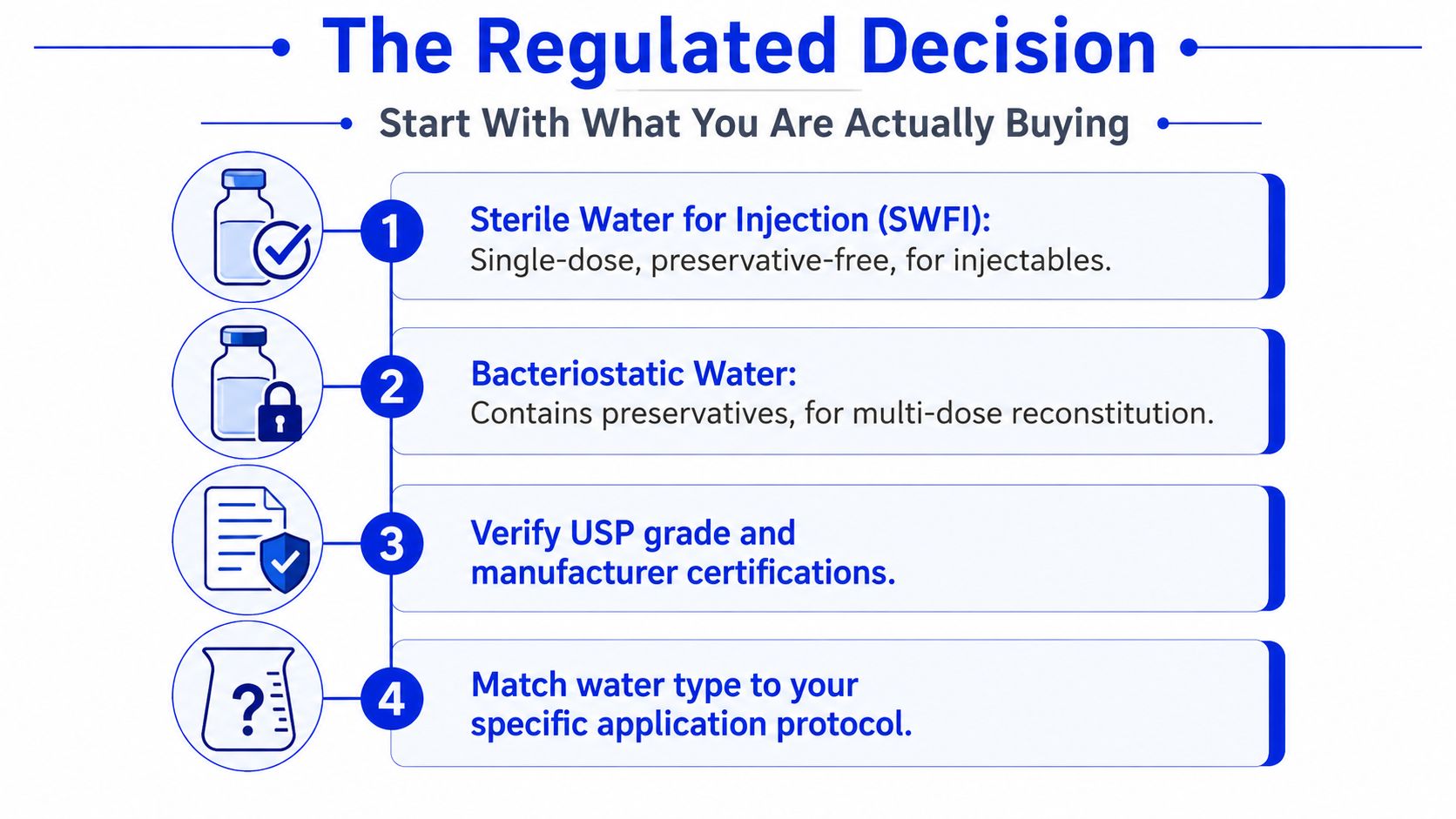
Why classification changes the purchase
Sterility and nonpyrogenicity affect reconstitution work, injectable drug preparation, and quality-control records. The water becomes part of the preparation, so contamination, endotoxin, particulates, or poor storage can compromise the material and weaken the record supporting its use.
Treat the supplier's response as part of qualification. Require documents, not assurances. If a vendor cannot answer the four checks promptly during a serious procurement inquiry, pause the order and review another source. Buyers comparing formats and documentation can review sterile non-pyrogenic water for research workflows alongside competing suppliers.
Practical rule: Do not check out until product identity, intended use, lot COA, and quality credentials are clear.
Check Supplier Credentials Before Price
A low quote can hide weak batch control. Before comparing prices, require evidence that the supplier connects manufacturing, testing, release, and traceability to the exact lot you will receive. ISO language, GMP terminology, and polished packaging do not replace batch documentation.
GMP or cGMP manufacturing deserves the closest review because it covers controlled production and documented release practices. ISO 13485 adds useful assurance when procedures address traceability, corrective actions, records, and staff training. ISO 9001 supports a general quality management framework, but it does not prove sterile pharmaceutical processing on its own. Procurement teams can review GMP principles for AU operations to understand why documented process control matters beyond a certificate on a sales page.
The credential stack that matters
| Credential | What It Covers | Priority for RUO Buyers |
|---|---|---|
| Batch-specific COA | Lot identity, test results, specification, and QA release | Highest |
| GMP or cGMP system | Controlled manufacturing, documentation, and batch release | Highest |
| ISO 13485 | Quality management with strong traceability and corrective-action structure | High |
| Third-party audit history | Independent review of facility controls and records | High |
| ISO 9001 | General quality management processes | Moderate |
| FDA registration or listing | Regulatory establishment information where applicable | Context-dependent |
| DEA registration | Controlled-substance handling where relevant | Usually not relevant to sterile water |
The certificate of analysis must identify the lot number, test methods, applicable grade designation such as USP, EP, or ACS, sterility results, endotoxin results, and approval by a qualified QA reviewer. It must match the vial label and packing documents. A certificate without a lot connection is a marketing attachment, not a release record.
Ask for an audit summary or current facility assessment if the purchase supports regulated R&D, resale, or an internal quality review. The supplier should identify the manufacturing site and provide batch-level records without delay. Refusal, vague stock certificates, or missing lot documentation are reasons to remove that vendor from the shortlist.
Teams assessing supplier paperwork can compare the claims against ISO 9001 quality systems and documentation expectations. Keep the review focused on documents that affect receiving, release, and traceability.
Use this ranking: certificate legitimacy first, manufacturing standard second, audit record third, and price last. Sterile water is a regulated pharmaceutical input for procurement purposes, not a commodity selected from a price table. Require enough evidence to show that the delivered lot was made, tested, approved, and documented under a controlled system.
Match Vial Format and Pack Size to Your Workflow
Choose the vial format from actual consumption, not a supplier's preferred inventory. A small team performing occasional reconstitution work needs a different setup from a research lab opening containers throughout the day. An oversized vial increases leftover material and can pressure staff to use it beyond the period permitted by the label.
| Vial Size | Typical Pack Sizes | Best Fit Workflow |
|---|---|---|
| 3 mL | Small multi-packs, including 10-vial kits | Portable work, small batches, and low-volume preparation |
| 10 mL | Multi-packs such as 10-vial kits | Routine bench work with predictable single-use demand |
| 20 mL | Small or larger case configurations | Reconstitution workflows needing more working volume without moving to bulk handling |
| 30 mL | Larger cases or bulk-oriented packs | High-throughput work with controlled consumption and storage |
| Multi-pack kits | 10-pack, 25-pack, or 100-pack cases | Teams balancing continuity, storage capacity, and purchasing frequency |
For daily reconstitution, 10 mL or 20 mL single-use vials usually offer better control than a larger container. They suit a repeatable bench routine while limiting unused material. A high-throughput lab can choose 30 mL vials or bulk kits, provided its receiving, storage, and opening procedures support the larger inventory.
Small-batch and field users should choose 3 mL vials when portability and waste control matter more than per-unit pricing. A 100-pack case may reduce the purchase price per vial, but it also uses more storage capacity and increases expiry-management work if demand changes. Set pack size against consumption rate, available storage, and reorder lead time.
Closures and multi-dose controls
Flip-top closures support routine handling. Crimp-sealed vials offer a clearer visible tamper-evidence signal. Closure type comes after product identity and COA quality, but damaged caps, loose seals, or compromised inner cartons should place the shipment on receiving hold.
Bacteriostatic water supports multi-dose access because its formulation contains a preservative. The labeled in-use period must govern discard decisions, starting at first puncture rather than when the remaining volume becomes inconvenient to use. Larger vials create compliance pressure when a team cannot consume them within that period.
Use a simple purchasing rule: low consumption suits 3 mL or 10 mL formats, steady bench demand supports 10 mL or 20 mL, and high controlled consumption can justify 30 mL or larger cases. Review available sterile water vial formats against the lab's opening schedule, storage capacity, and expected reorder pattern before approving a case size.
Verify Storage, Shipping, and Dispatch Practices
A sterile product can arrive unusable even when filling was performed correctly. Delayed dispatch, weak packaging, temperature exposure, or crushed cartons can compromise the order and leave the buyer without evidence that handling followed the product's requirements.
Before payment, require the supplier's written shipping conditions. The response should distinguish ambient from refrigerated transport, state the accepted temperature range from the label or stability documentation, and explain how the packaging protects the vials in transit. “Ships safely” is not a procedure.
Questions to send before payment
- Storage range: Confirm whether the warehouse uses temperature-controlled storage and which range applies before dispatch.
- Packaging design: Verify insulated liners, gel packs where required, inner vial protection, and tamper-evident seals.
- Dispatch timing: Get the same-day or next-day cutoff in writing, including the handling of orders placed after it.
- Shipment records: Require tracking, a packing slip listing lot numbers and expiry dates, and any chain-of-custody or temperature record included with the order.
- Excursion handling: Ask for the SOP covering temperature excursions, delays, and damaged packages.
| Checkpoint | What to Verify | Minimum Acceptable Standard |
|---|---|---|
| Warehouse storage | Temperature controls and monitoring | Documented conditions aligned with the label |
| Transit packaging | Insulation, packs, and vial protection | Packaging appropriate to the stated shipping range |
| Dispatch | Cutoff and fulfillment timing | Clear, written dispatch commitment |
| Traceability | Lot and expiry information | Lot data on the packing slip and shipment record |
| Excursion response | Evaluation and replacement process | Written SOP and defined disposition decision |
At receiving, place shipments on hold if data loggers show warm conditions, promised temperature records are missing, inner cartons are crushed, seals are broken, or lot traceability is absent. Do not accept a supplier's general assurance in place of a documented release decision. The receiving team should record the condition, quarantine affected stock, and request the supplier's evaluation before use.
Storage and transport controls should match the product's defined specifications. The FDA's water-for-pharmaceutical-use guidance reinforces that pharmaceutical water quality depends on specified requirements and monitored controls, not informal assurances. A supplier that cannot explain how a 10 mL vial will be protected during a 48-hour transit has not provided enough evidence for approval.
Confirm RUO Use and Required Lab Documentation
A product labeled research use only belongs inside a documented non-clinical workflow. It mustn't be repackaged, relabeled, or administered to humans, and the buyer owns the compliance trail after delivery. A supplier's RUO disclaimer doesn't remove the lab's responsibility to control receipt, use, storage, and disposal.
The receiving file should contain the lot-specific COA, Safety Data Sheet, clear label image, country of origin, sterilization method, endotoxin specification, and the exact RUO disclaimer supplied with the product. The sterilization method should be stated accurately, such as autoclaving or 0.2 micron filtration, and the buyer should avoid assuming that one method is equivalent to another for every application.
Build the records into the receiving SOP
The receiving technician should compare the delivered vial against the purchase order, photograph the label when required by the internal procedure, record the lot and expiry information, and attach the COA to the receiving record. The SOP should also define what happens when the label, carton, COA, or shipment condition doesn't match.
Quality reviewers and auditors typically need a traceable chain from supplier release to laboratory use. During a deviation investigation, the relevant file may include the purchase order, packing slip, receiving inspection, storage entry, COA, label version, temperature record, and disposal record. Without lot-level traceability, the lab may be unable to determine which preparations used the material or whether other work requires review.
A clean receiving file turns a questionable delivery into a controlled decision. A missing lot-specific COA turns a routine receipt into an open deviation.
The sterilization and endotoxin information should match the supplier's stated specification and intended research application. If a supplier offers only a generic COA, a copied label, or a product-page statement without the actual lot record, the buyer should pause the order. Reluctance to share lot-specific documentation signals the wrong quality culture, regardless of the quoted price.
Decide If Private Label or Wholesale Fits Your Model
Private label and wholesale solve different commercial problems. Private label means placing a buyer's brand on a third-party-manufactured sterile water product for resale or internal distribution. Wholesale means purchasing larger quantities in standard packaging, usually to reduce unit cost for internal use or established distribution.
Private label is a volume and compliance project, not a quick packaging upgrade. Manufacturers commonly set private-label minimums in the 500 to 5,000 vial range, while wholesale programs may require pallet-level commitments. These thresholds, along with lead times and artwork approval, must be confirmed in writing because they determine cash exposure, storage requirements, and launch timing.
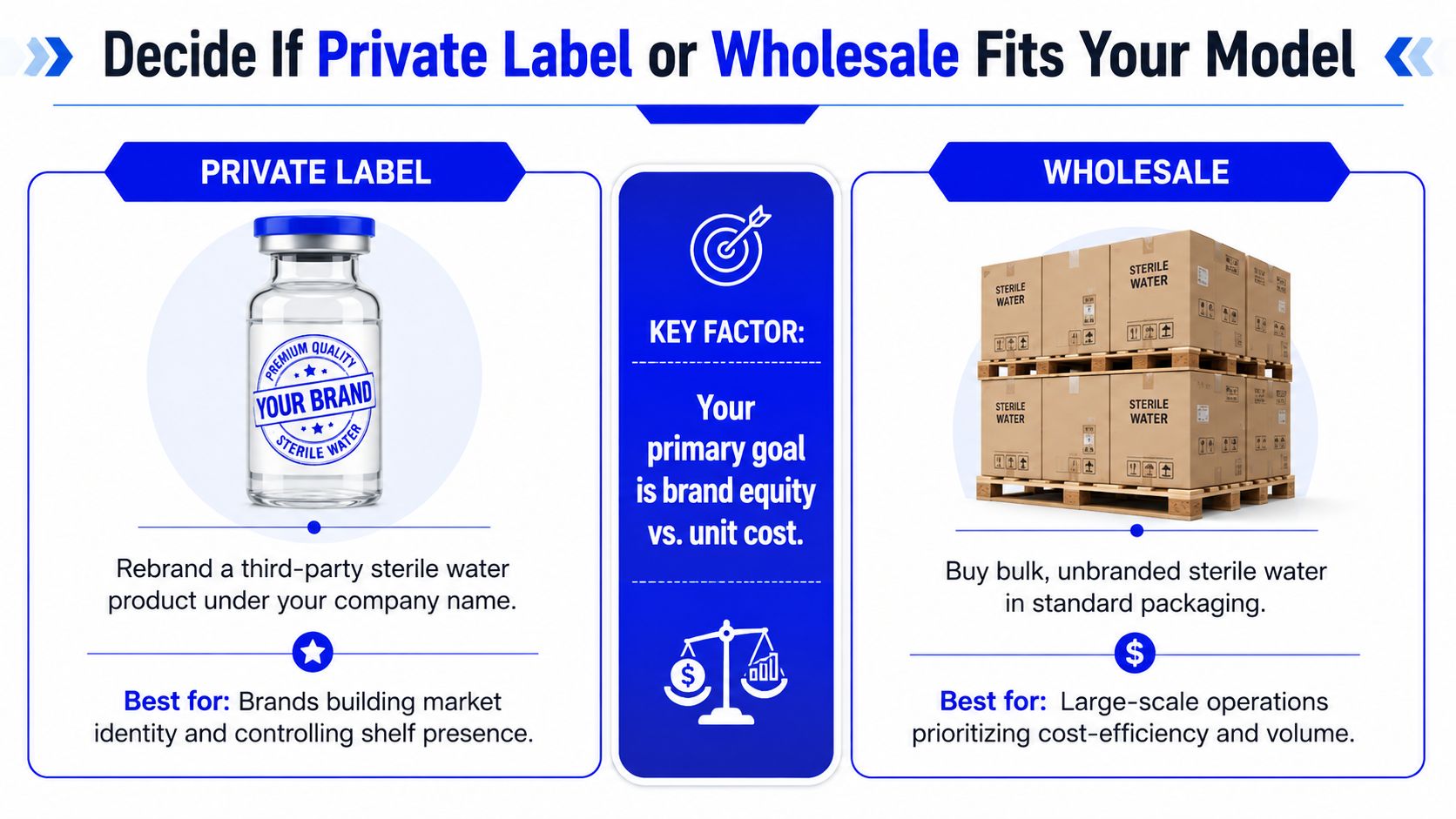
Private label requires ownership of the label
A private-label buyer needs approved artwork, product naming, ingredient and use statements, lot and expiry placement, country-specific compliance review, and an agreed process for future label changes. The buyer also becomes responsible for ensuring that the finished label is accurate and that each distributed unit remains linked to the manufacturer's lot records.
The model makes sense only when a registered brand, established sales channel, and recurring demand justify that overhead. A brand with recurring monthly demand above roughly 1,000 vials may have a commercial reason to evaluate private label, but that decision should be tied to confirmed forecasts and the manufacturer's written MOQ, not optimism.
Wholesale is the cleaner path when the material is for internal lab use or when resale branding isn't part of the plan. Pallet-level purchasing can improve continuity and unit economics, but the buyer must still manage receiving inspection, controlled storage, expiry rotation, and lot segregation. Wholesale doesn't remove quality obligations. It increases the consequences of weak inventory control.
The decision rule is direct. Choose private label when brand equity and recurring demand justify artwork, registration, and traceability ownership. Choose wholesale when internal consumption supports a substantial commitment and standard packaging is acceptable. If neither condition exists, standard multi-packs are usually the more disciplined purchase.
Avoid the Most Common Sterile Water Buying Mistakes
A rushed order can leave a lab with the wrong diluent, incomplete records, or unusable stock. Sterile water for injection and bacteriostatic water aren't interchangeable. Sterile water is preservative-free and intended for single-use dilution or dissolution, while bacteriostatic water contains benzyl alcohol and supports multi-dose access. Let the product label and approved protocol determine the purchase.
After a bacteriostatic vial is punctured, the applicable labeling and aseptic-use conditions set a 28 days discard benchmark, as described in the DailyMed labeling. Repeated septum entries raise contamination, particulate, and handling-error risks. Treating sterile water as a multi-dose product breaks its single-use sterility model. Adding bacteriostatic water to a protocol requiring a preservative-free diluent also changes the formulation without approval.
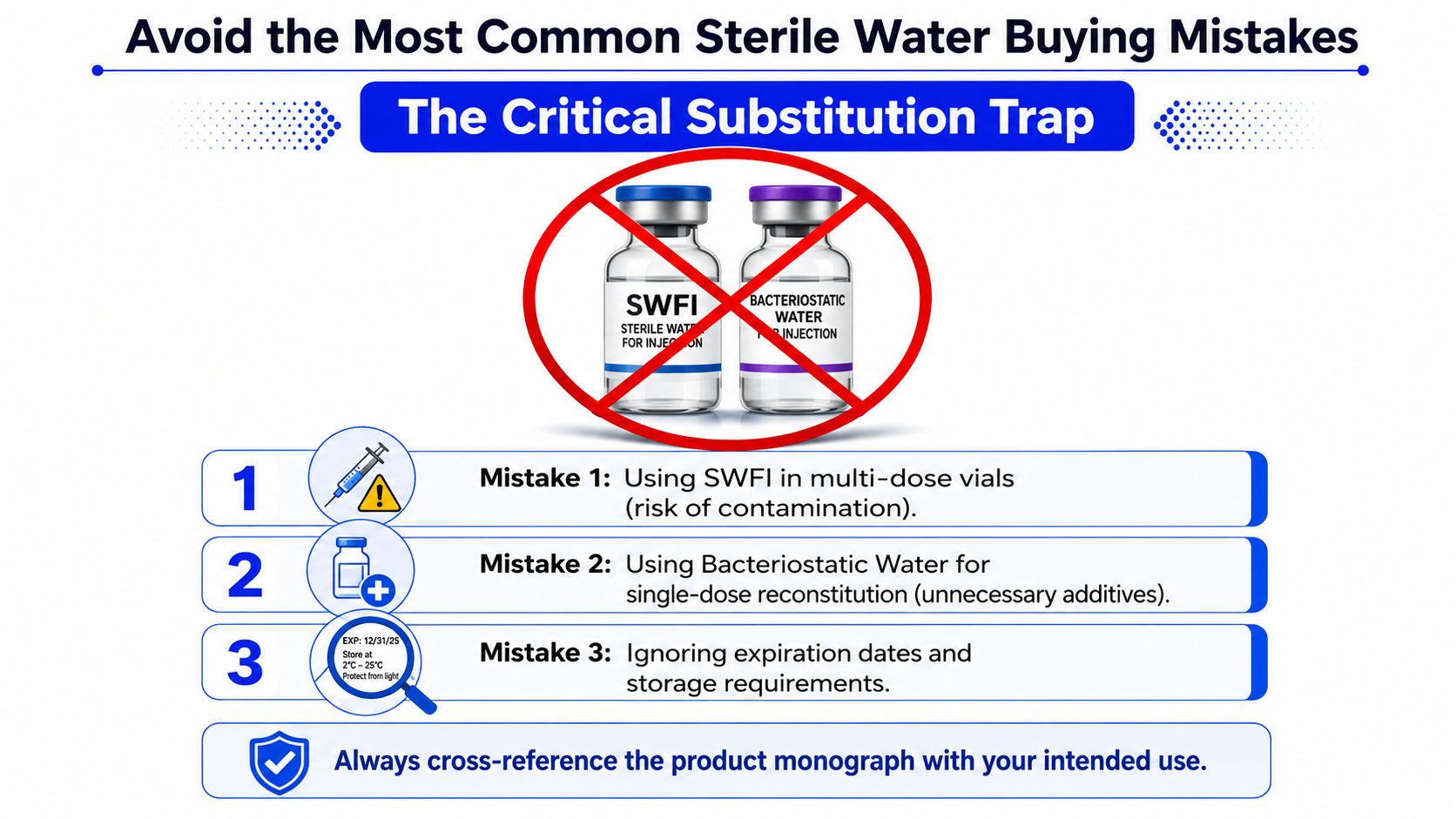
Procurement errors that should stop an order
Stop the order when any of these gaps appear:
- Missing temperature evidence: The supplier cannot provide the promised logger, excursion record, or storage explanation.
- Incomplete COA panels: The lot certificate omits relevant sterility or endotoxin results and offers only a generic conformity statement.
- Damaged closure components: Flip-tops, crimp seals, cartons, or vial bodies arrive compromised.
- Unwritten wholesale terms: The quotation lacks documented MOQ, lead time, or replacement terms.
- Unclear product identity: The product page, label, and COA use different names or fail to state preservative status.
Use this pre-shipment review before releasing payment or accepting stock:
- Confirm that the RUO label matches the intended non-clinical application.
- Match the COA lot number with the packing documentation.
- Check the expiry window and reject stock that leaves insufficient usable time.
- Inspect the shipper, seals, cartons, and temperature record.
- File chain-of-custody documents with the receiving record.
The ASHP sterile water shortage detail illustrates why substitution decisions can become urgent when bacteriostatic water is difficult to obtain. Shortage pressure does not permit an unqualified substitute. Qualify an approved alternative in advance, document the protocol decision, and retain the same lot-level controls.
Herbilabs supplies RUO bacteriostatic water and reconstitution solutions in 3 mL, 10 mL, 20 mL, and 30 mL vial formats, with lot-specific COAs and private-label, white-label, and wholesale arrangements. Buyers can visit Herbilabs to compare formats and request documentation before placing a controlled sterile-water order.