Private Label, White Label, Wholesale partnerships available - EU, USA and UK - Free shipping from €75
Bottled Sterile Water: Types, Uses, and Selection Guide
A researcher reaches for a diluent halfway through a reconstitution and finds only a nearly empty vial. The next bottle sits on another shelf, the label is partly obscured, and the protocol calls for an exact volume. The experiment hasn't failed, but the workflow has already become harder to control.
Bottled sterile water often gets treated as background inventory. That's a mistake. Its container, fill volume, preservative status, sterility claim, endotoxin specification, and handling instructions all influence what happens after the cap or stopper is opened. In peptide and protein workflows, the diluent can affect whether a sample is reconstituted once under controlled conditions or accessed repeatedly across a longer working period.
The practical question isn't whether the water looks clear. It's whether the product's formulation and container format match the access pattern. The following guide helps researchers read the label, interpret quality signals, manage punctures, and choose between single-dose sterile water and a controlled multi-draw option for research-use-only work.
Table of Contents
- Why Bottled Sterile Water Deserves More Attention in the Lab
- What Bottled Sterile Water Is
- Sterile Water vs Bacteriostatic Water in Practice
- Common Research and Laboratory Uses
- Handling, Storage, and the 28-Day In-Use Window
- Regulatory and Quality Signals to Look For
- Choosing the Right Vial for Your Workflow
- A Practical Checklist Before You Order
Why Bottled Sterile Water Deserves More Attention in the Lab
A sterile water vial tells researchers more than the identity of its contents. The label and packaging indicate how the manufacturer expects the product to be used, how much handling it can reasonably tolerate, and which quality attributes were controlled before release.
Modern bottled sterile water for injection is generally supplied as a sterile, nonpyrogenic, solute-free product in single-dose containers. Product labeling explicitly identifies it as a solvent or diluent vehicle, rather than as a complete buffer or growth medium. The same labeling states that it contains no bacteriostat, antimicrobial agent, or added buffer, with common labeled pH ranges of 5.0 to 7.0 or a stated value of 5.5 within a 5.0 to 7.0 range (FDA DailyMed labeling).
What the container reveals
Before opening a vial, a bench scientist can check several practical signals:
- Product identity: The label should distinguish sterile water from bacteriostatic water, distilled water, saline, or a buffered solution.
- Intended use: A clear solvent or diluent statement helps prevent substitution with a product containing salts, preservatives, or other excipients.
- Container type: Glass or plastic affects handling, breakage risk, extractables, and compatibility with the intended workflow.
- Fill volume: A vial that is too large can create avoidable waste, while one that is too small can force unnecessary handling.
- Traceability: Lot information, expiry, storage instructions, and a Certificate of Analysis support investigation if replicates behave unexpectedly.
Sterility also isn't the same as protection after opening. A sealed single-dose container can meet its release requirements, yet the product still offers no antimicrobial barrier once researchers introduce a needle or otherwise breach the closure.
Practical rule: Treat sterile water as a controlled reagent from the moment it enters inventory, not as interchangeable shelf stock.
A single contaminated diluent vial can compromise several preparations or make replicate differences difficult to interpret. Recording the lot, checking the seal, and matching the vial format to the protocol takes little time compared with repeating an assay whose source of variation is no longer clear.
What Bottled Sterile Water Is
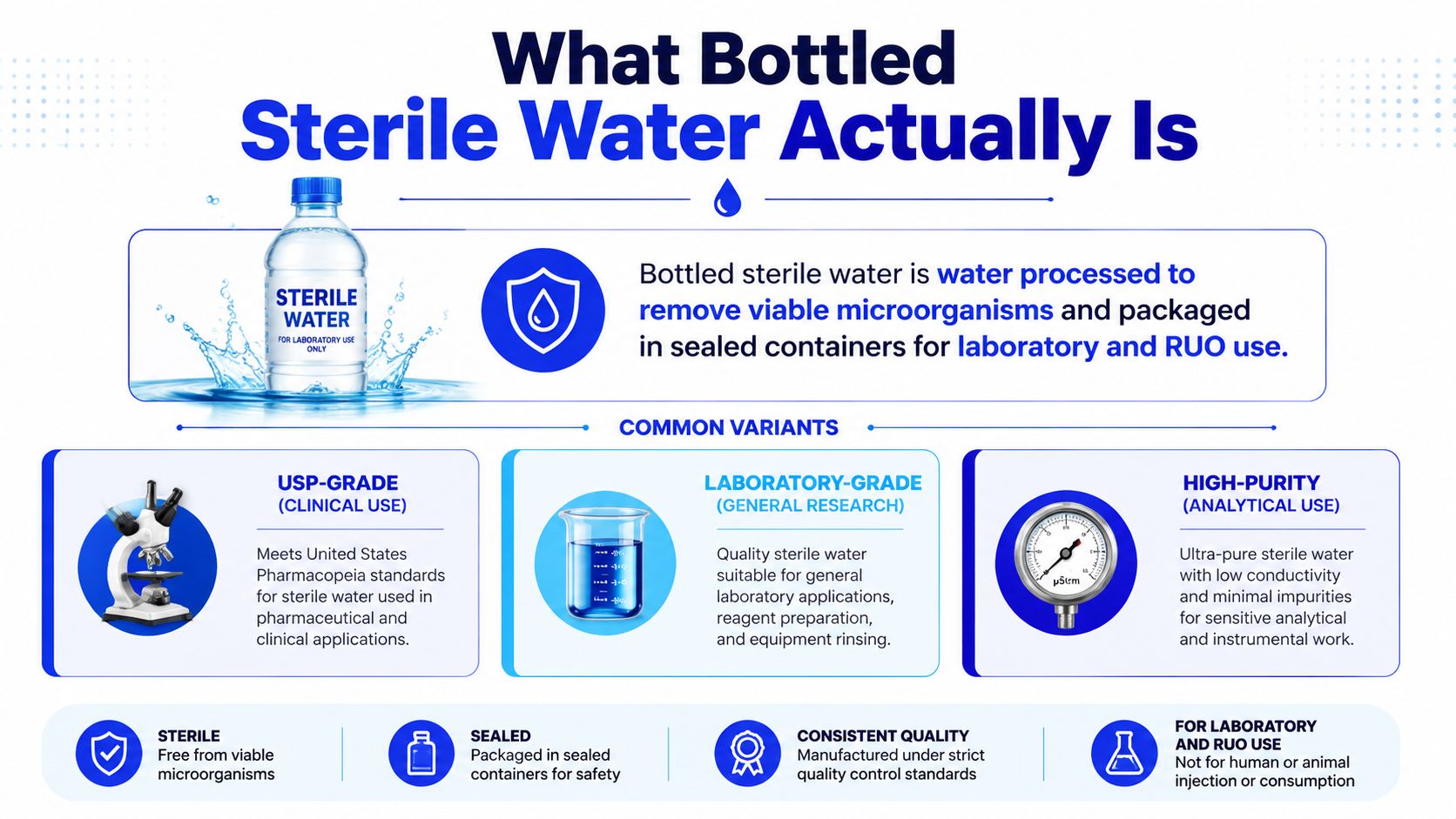
A researcher may open a vial expecting a neutral diluent, only to discover that the label describes a different formulation or access pattern. Bottled sterile water is water processed to control viable microorganisms and sealed for a defined laboratory or research use. The term covers products with different purity profiles and different expectations after opening, so sterile alone does not settle every procurement question.
The formulation and container workflow must be read together. Sterile water contains no antimicrobial additive and is generally supplied for one puncture and prompt use. Sterile-distilled water has undergone distillation before sterilization and sealing. Distillation can reduce dissolved minerals and some impurities, but “distilled” by itself does not establish sterility. Bacteriostatic water includes an antimicrobial preservative that supports controlled repeated access, subject to the product label and aseptic technique.
Three labels that cause confusion
Sterile water without preservative is the plainest formulation. It contains water prepared to a sterile standard, without an antimicrobial additive or buffer. That suits protocols requiring a plain diluent, provided the vial is used promptly after opening.
Sterile-distilled water combines distillation with sterilization. The finished product still needs a clear sterility claim and suitable packaging. A bottle labeled only “distilled” should not automatically enter a sterile workflow.
Bacteriostatic water contains sterile water plus a preservative, commonly 0.9% benzyl alcohol in labeled products (DailyMed bacteriostatic water labeling). The additive can inhibit microbial growth during repeated access, but it does not replace aseptic handling and may conflict with preservative-sensitive protocols.
For RUO peptide or protein reconstitution, the practical distinction is the vial's access pattern. A single-dose vial fits one preparation and prompt disposal. A multi-dose workflow returns to the same closure repeatedly, increasing the importance of puncture control, storage, and label instructions. Choose the formulation and container together, not by the word sterile alone.
Sterile Water vs Bacteriostatic Water in Practice
A vial can be chemically suitable and still be a poor match for the bench workflow. One researcher may puncture the container once, finish the preparation, and dispose of it. Another may return to the same closure repeatedly while working with a RUO peptide or protein. Those workflows carry different contamination and handling risks.
Sterile water contains no antimicrobial additive and is labeled for single use. Bacteriostatic water contains 0.9% benzyl alcohol and is intended to support repeated access over a limited in-use period, commonly 28 days under proper technique, when the product labeling and laboratory procedure support that practice. The preservative can help limit microbial growth, but it does not replace aseptic technique.
| Attribute | Sterile Water, single-dose | Bacteriostatic Water, multi-dose |
|---|---|---|
| Formulation | Sterile water without preservative | Sterile water with benzyl alcohol preservative |
| Intended access pattern | One puncture and prompt use | Controlled repeated withdrawals |
| Main operational concern | Contamination after opening | Preservative compatibility and aseptic handling |
| Suitable workflow | One-off reconstitution or immediate analytical preparation | Multi-draw research workflows where repeated access is justified |
| In-use reference | Follow the product label and laboratory procedure | A 28-day window may apply when the product label and aseptic procedure support it |
| Assay consideration | No preservative-related interference | The preservative may be unsuitable for sensitive assays or certain cell-based applications |
Match access behavior, not just solvent chemistry
Selecting preservative-free sterile water for a plain-diluent protocol makes sense only if the container can be used promptly. Repeatedly puncturing that opened vial creates a container-management problem, even when the original contents met a sterile specification. The closure, needle practice, storage conditions, and written procedure all affect the risk after first entry.
A bacteriostatic product changes the handling model, not the assay requirements. Its preservative may affect sensitive assays, cells, protein behavior, or downstream measurements. Review the sterile water vs bacteriostatic water comparison alongside the protocol, then ask:
- Will the vial be punctured once or repeatedly?
- Will the reconstituted material require multiple withdrawals?
- Is benzyl alcohol compatible with the assay and sample?
A single-dose vial fits a one-time preparation. A multi-dose vial can fit a documented, repeated-draw workflow when its formulation is compatible and each entry follows the laboratory's aseptic procedure. Choose the container and formulation together, rather than treating sterile as the only decision point.
Common Research and Laboratory Uses
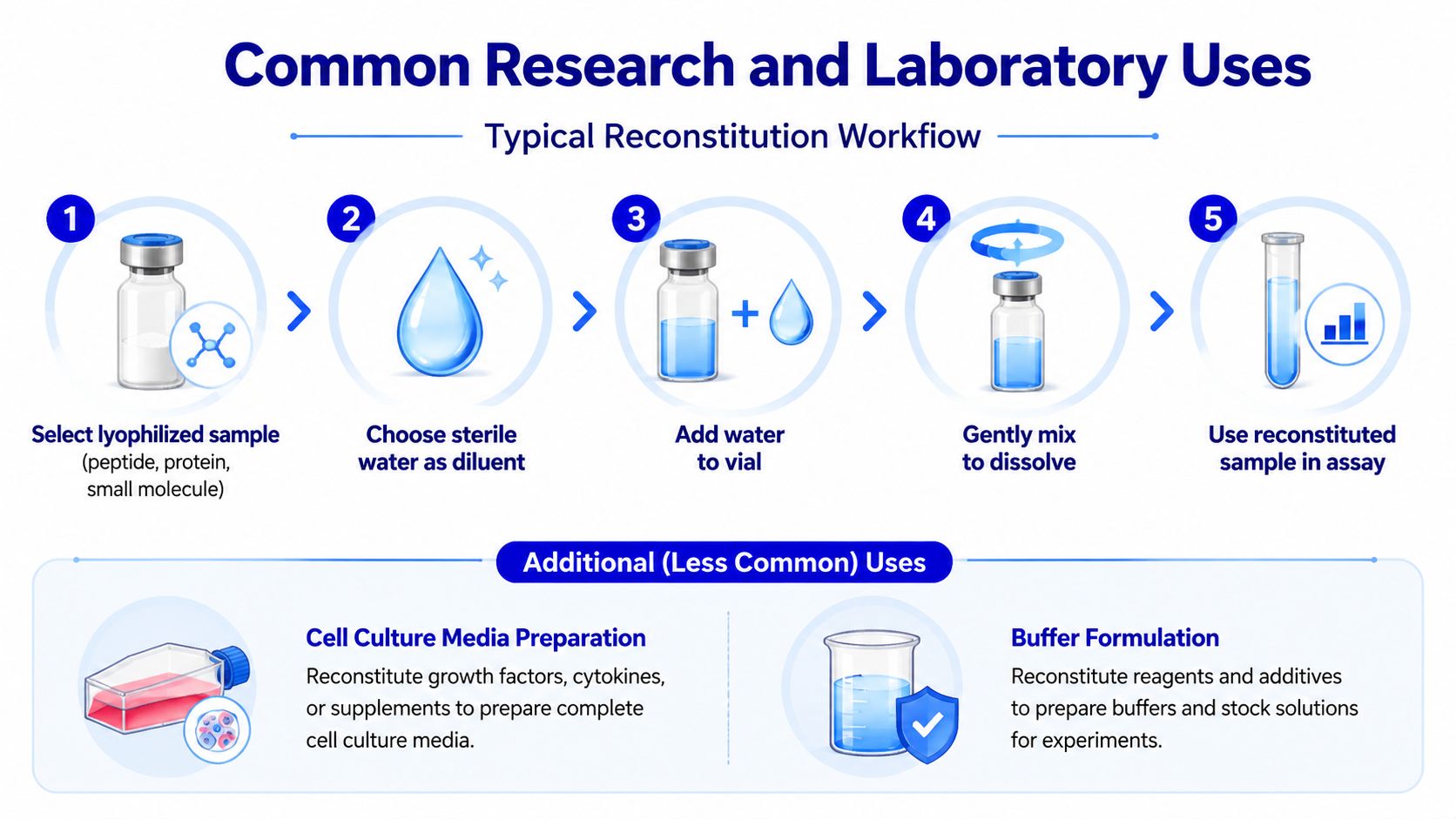
At the bench, a reconstitution may look routine: a lyophilized peptide or protein, a specified diluent, and a vial that must be entered correctly. The researcher first confirms the sample identity, reviews the sterile water label and lot, inspects the closure, and calculates the volume. After the water is added, the material is mixed according to the method and transferred into the planned assay workflow. Each puncture is part of that workflow, because it determines whether the container is being used once or managed across repeated withdrawals.
A bench example
A scientist preparing a lyophilized protein for an immediate analytical run needs a plain diluent. A single-dose sterile water vial matches that access pattern. The researcher withdraws the required volume, reconstitutes the material, completes the preparation, and discards the opened remainder according to the laboratory procedure.
A different setup involves a reconstituted research sample that will be withdrawn more than once. A bacteriostatic product may fit that workflow when its preservative is compatible with the assay and the laboratory can document aseptic access. The decision follows the number and timing of vial entries, not the fact that the sample is a peptide or protein. The formulation and container work together, like a key and its lock. The diluent must suit the assay, while the vial must suit how often the closure will be entered.
Uses beyond reconstitution
Bottled sterile water can serve as a controlled diluent or preparation component in several settings:
- Blank matrix preparation: Plain sterile water may suit a low-background aqueous blank when the protocol accepts its pH and quality profile.
- Calibration standards: Researchers can use the specified water grade to prepare standards consistently with the analytical method.
- Buffer or media make-up: Water may be combined with separately supplied salts and components. The protocol determines whether sterile, distilled, or higher-purity water is appropriate.
- Final rinsing: Suitable low-contaminant water can reduce residual ions or particulate carryover from glassware and instruments, provided the method validates the rinse step.
- Working solutions: Sterile water can provide the starting vehicle for lyophilized reagents when the formulation does not call for a preservative or buffer.
The final-rinse example clarifies why sterile and high purity describe different properties. Sterility addresses viable organisms. It does not define every ionic, particulate, chemical, or endotoxin attribute relevant to an analytical method.
Select the water against the full method, including the sample, assay, container, and planned number of withdrawals.
Handling, Storage, and the 28-Day In-Use Window
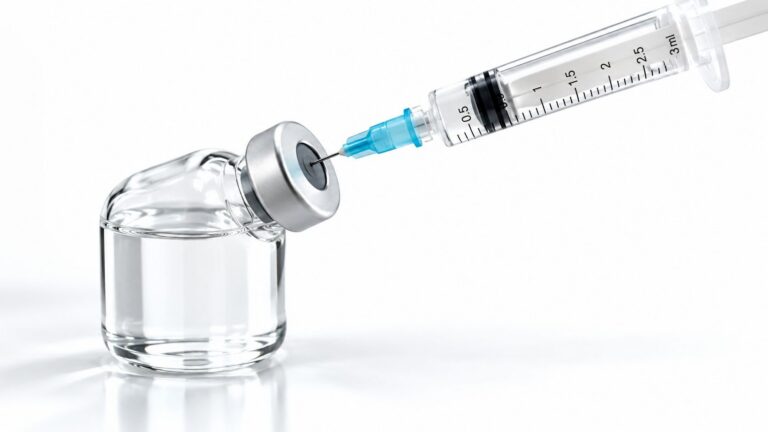
A vial may look untouched while its risk changes with every puncture. In a RUO peptide or protein workflow, the operator must manage the closure, the solution, and the time since first entry as one control process. Before each withdrawal, inspect the vial, disinfect the septum using the laboratory's sterile alcohol procedure, and use a fresh sterile syringe and needle. Do not touch critical surfaces, and keep the vial closed except during access.
The 28-day in-use period applies specifically to bacteriostatic water when the product labeling and laboratory procedure support it. It is a defined operating limit, not proof that contamination cannot occur. Cloudiness, visible particles, a damaged seal, questionable stopper integrity, or an unexplained storage excursion should lead to disposal and investigation rather than another draw.
Track the punctures
A puncture record works like a maintenance log. It prevents the common error of losing track of when a multi-dose vial first entered use. Record the opening date, operator initials, lot number, storage location, and each withdrawal date. This is particularly useful when several researchers share a preparation area.
Single-dose sterile water should not become a multi-dose container because liquid remains. It contains no preservative, so each additional entry creates another opportunity for contamination and conflicts with the vial's intended use. The laboratory procedure should specify how quickly an opened vial is discarded, with prompt use preferred.
| Vial Type | Typical In-Use Window | Storage After First Puncture | Notes |
|---|---|---|---|
| Sterile water, single-dose | Prompt use according to the product label and laboratory procedure | Follow the label, protect from contamination, and discard remaining material as required | No preservative is present |
| Bacteriostatic water, multi-dose | Up to 28 days when supported by the label and proper aseptic technique | Follow the product storage instructions and maintain stopper integrity | The window begins with first entry and ends sooner if contamination or damage is suspected |
Storage is part of the control system
Read the product's storage instructions instead of assuming all vials follow the same conditions. Room-temperature or refrigerated storage depends on the specific product. Protection from excessive light and heat helps preserve the container and solution, while upright positioning limits unnecessary contact between the septum and moisture around the closure.
For a practical discussion of bacteriostatic water, remember that the clock starts at the first puncture, not when the vial is nearly empty. A seal breached during shipping, storage, or handling requires the laboratory's deviation procedure. The vial should not be treated as unopened.
Regulatory and Quality Signals to Look For
A credible bottled sterile water product should provide more than a clean-looking container. Researchers and resellers should look for a defined product identity, a documented quality specification, traceable lot information, and packaging appropriate for the intended use.
One important quality signal is the endotoxin specification. FDA technical guidance explains that membrane sterilization can remove microorganisms while leaving dissolved bacterial endotoxins behind. A 0.22 micrometer filter can produce a sterile effluent, but depyrogenation must be addressed separately when endotoxin control is required (FDA guidance on bacterial endotoxins and pyrogens).
Read the specification, not just the marketing name
For sterile water for injection, the low endotoxin specification is not more than 0.25 USP Endotoxin Unit per milliliter, and the same FDA technical guidance describes why that distinction matters. Endotoxin control is especially relevant when researchers work with cell-based assays or protein preparations where pyrogenic contamination can create unwanted biological effects.
Packaging provides another useful signal. USP presentations describe single-dose or multiple-dose glass or plastic containers, with glass preferably Type I or Type II in the cited monograph material. One presentation specifies containers not larger than 30 mL, while broader historical packaging language has emphasized containers not larger than 1 L, so the applicable monograph and product label should always control (USP monograph presentation).
A thorough Certificate of Analysis should be more informative than a simple sterility pass. It should connect the batch to defined tests and acceptance criteria, such as endotoxin, appearance, pH where specified, identity or composition, fill information, and release review. The exact panel depends on the product category and intended use.
Supplier transparency matters
A serious supplier should be able to identify the manufacturing site, lot, expiry, sterilization or filtration approach, container closure configuration, and storage requirements. Batch-to-batch documentation helps a lab investigate unexpected results without guessing whether the water changed between orders.
The COA is a starting point, not a substitute for method qualification. Researchers still need to confirm that the product's formulation, preservative status, container, and purity attributes fit the assay.
Choosing the Right Vial for Your Workflow
A peptide reconstitution may take one minute at the bench, yet the vial choice determines what happens after that first puncture. Start with the access pattern: single draw or controlled multi-draw? From there, match the container to puncture frequency, fill volume, preservative compatibility, and the material likely to be discarded.
Profile one, one-off preparation
For a sample prepared and used in one session, a single-dose sterile water vial usually fits the workflow. The operator opens the vial, withdraws the required volume, and treats the remainder as waste rather than as future stock. This limits entries into the container and avoids adding a preservative to a peptide or protein method that does not require one.
Size still matters. A smaller vial can reduce leftover water for a small preparation. A larger vial may suit a protocol requiring more water during one controlled preparation, provided the remaining volume is not kept for later use.
Profile two, repeated draws
A laboratory returning to the same container over several days needs a different setup. A bacteriostatic multi-dose vial may support repeated withdrawals when benzyl alcohol is compatible with the assay, the label permits the intended use, and staff follow documented aseptic technique.
Record the first puncture and each later access. The preservative can help limit microbial growth, but it does not replace septum disinfection, a fresh sterile needle for each entry, or appropriate storage. Repeated puncture is a container-management issue as much as a formulation issue.
Profile three, higher-throughput operations
A busy RUO workflow may use a larger sterile container or planned aliquoting to reduce repeated handling of the source vial. The suitable approach depends on the validated process, facility aseptic controls, and how the laboratory qualifies its aliquots. A larger container is not automatically more efficient if it increases exposure or discard.
Container geometry matters alongside the water. Teams can compare glass vial types and sizes by reviewing closure compatibility, fill volume, breakage risk, labeling space, and fit at the bench.
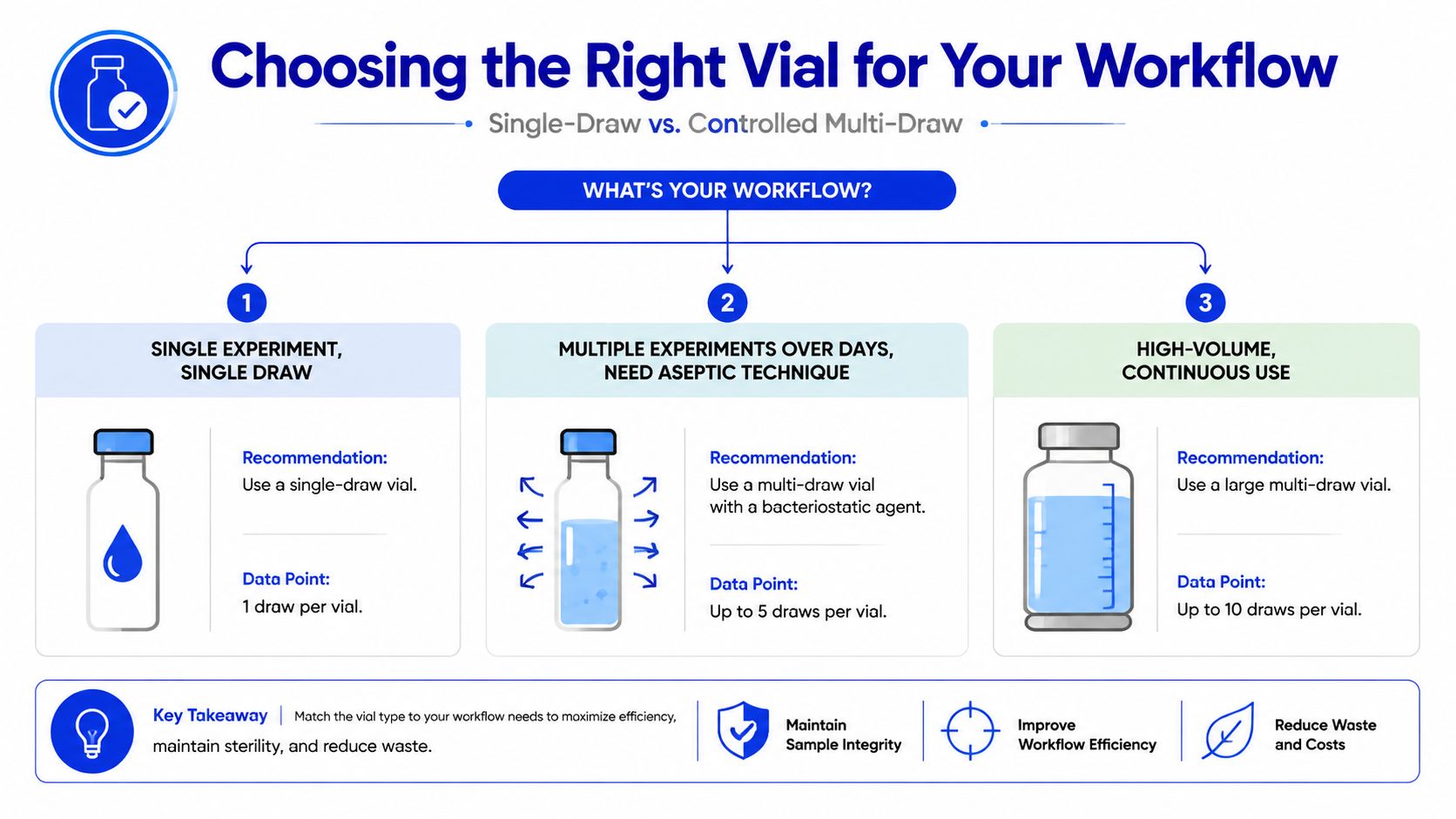
The practical rule is clear: container format drives workflow fit. Decide how often the vial will be entered first, then confirm what the downstream assay can tolerate, including whether a preservative is suitable.
A Practical Checklist Before You Order
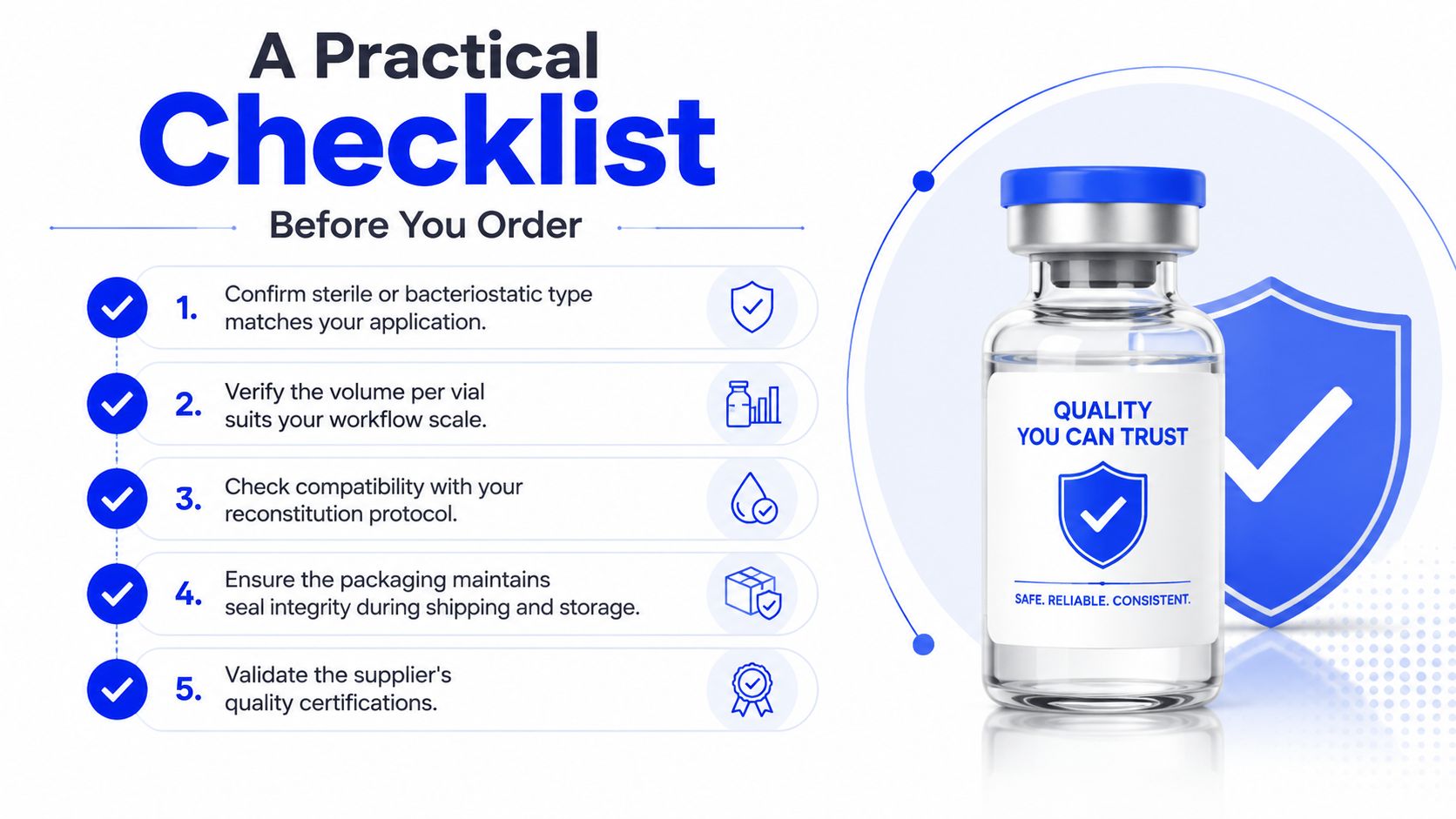
A vial should match the way your laboratory will handle it. Before ordering, check these points in sequence:
- Confirm the formulation: Identify whether it is sterile water without preservative or bacteriostatic water containing a preservative.
- Match the access pattern: Use a single-dose format for one-time withdrawal. Choose a labeled multi-dose format only when controlled repeated access is part of the workflow.
- Check fill volume: Select enough solution for the preparation while limiting leftovers and avoidable punctures.
- Review the quality file: Request the lot-specific COA and confirm that it reports relevant release attributes, including endotoxin where required.
- Inspect the container system: Review vial material, closure type, seal integrity, labeling, storage instructions, and shipping controls.
- Check assay compatibility: Confirm that benzyl alcohol, or its absence, suits the peptide, protein, cell, analytical, or media workflow.
- Set the in-use rule: Record the first puncture date and apply the labeled discard limit. Refrigeration does not automatically extend that window.
- Verify traceability: Keep supplier, lot, expiry, and storage records with the experiment or inventory file.
The main source of error is treating every vial as interchangeable. Plain sterile water may fit a single-use preparation but create unnecessary risk when repeatedly entered. Bacteriostatic water may support a controlled multi-dose workflow, yet its preservative may not suit every sensitive assay. Record each puncture in the bench or inventory record, because the first entry changes how the container must be managed.
For RUO peptide and protein reconstitution, the container is part of the procedure. A vial that reduces leftover volume can still be a poor choice if the workflow requires repeated needle entries. Conversely, a larger format may reduce source-vial handling only when aliquoting, aseptic controls, and discard rules are defined.
Herbilabs supplies RUO bacteriostatic reconstitution solutions in glass vial formats including 3 mL, 10 mL, 20 mL, and 30 mL, with lot-specific Certificates of Analysis and an in-use period of up to 28 days under proper aseptic technique, as described in its product information. Researchers and resellers evaluating bottled sterile water and related diluents can visit Herbilabs to review available formats, documentation, and research-use-only supply options.