Private Label, White Label, Wholesale partnerships available - EU, USA and UK - Free shipping from €75

Bacteriostatic Water UK Guide for Safe RUO Use
A UK research team has a lyophilised peptide ready for reconstitution, a clean bench prepared, and a schedule built around repeated withdrawals. The remaining decision seems simple: choose a sterile diluent, add it to the vial, and record the preparation. That decision becomes less simple when the diluent contains a preservative, the material is intended for research use only, and the vial may be accessed over several sessions.
For bacteriostatic water UK, the important question isn't only what the product is. It's whether the vial, supplier, handling method, documentation, and replacement routine fit a controlled RUO workflow. The guidance below approaches the choice as a senior lab manager would: understand the formulation, confirm the intended use, match the format to the workload, verify quality signals, and start the in-use record at the first puncture.
Table of Contents
- Introduction to Bacteriostatic Water in UK Research
- What Bacteriostatic Water Is and How It Works
- UK Regulatory Notes and Research Use Only Boundaries
- Choosing the Right Vial Format for Your Workflow
- Quality Signals You Should Verify Before Buying
- Storage Shipping and the 28 Day In Use Window
- How to Choose a Reliable Supplier in the UK
Introduction to Bacteriostatic Water in UK Research
A new researcher might place a peptide vial beside a syringe, a diluent vial, and a lab notebook, then discover that the supplier listing gives little detail beyond “sterile water.” That description leaves several practical questions unanswered. Is the water preserved? Is the product intended for repeated access? Does the label support research use only, and can the supplier provide lot-specific documentation?
Bacteriostatic water is used as a preserved diluent in workflows involving lyophilised peptides, proteins, antibodies, and other laboratory materials. The defining feature is benzyl alcohol, which helps inhibit microbial growth after repeated vial punctures. It doesn't make careless handling safe, and it doesn't turn a research product into a medicine.
UK researchers also need to separate RUO handling from clinical administration. A vial can have sterile and non-pyrogenic specifications while still being unsuitable for injection into humans or animals. The label, product information, reconstitution instructions, and local laboratory procedures must all point to the same intended use.
Practical rule: A diluent choice should be recorded as part of the experiment, not treated as an afterthought.
A useful purchasing record can include the product name, supplier, lot number, formulation, vial size, receipt condition, storage location, opening date, and the material reconstituted. That record gives the next researcher enough context to understand what happened if a result looks unusual.
This guide focuses on that decision process. It explains how the preservative works, why UK regulatory positioning matters, how vial volume affects exposure and waste, which quality signals deserve verification, and how the 28-day in-use discipline should be applied without becoming a blanket assumption. The discussion is for controlled laboratory and research workflows only, not clinical administration or personal use.
What Bacteriostatic Water Is and How It Works
The simplest way to understand the product is to separate the water from the preservation system. Plain sterile water provides a sterile diluent, while bacteriostatic water adds benzyl alcohol to help inhibit microbial growth during repeated withdrawals.
In the UK product information for bacteriostatic water, the formulation is listed as 9.45 mg/mL of benzyl alcohol in each 1 mL vial. A 10 mL container therefore contains about 94.5 mg of benzyl alcohol in total, as documented by the UK electronic Medicines Compendium product information. That exact label value is the useful reference for the UK product information rather than relying on a rounded description alone.
A practical analogy is a clean room with a controlled access system. The room starts sterile, and the access system makes repeated entry less hazardous, but every entry still creates an opportunity for contamination. Benzyl alcohol works in a similar supporting role. It helps suppress microbial growth, but it doesn't sterilise a vial that has been compromised or replace proper aseptic technique.
Why the preservative matters
Bacteriostatic water is defined as a sterile, nonpyrogenic water-for-injection preparation containing 0.9% benzyl alcohol, or 9 mg/mL, as described in DailyMed's product information. The UK label value is close to that commonly cited concentration, but the lot label and official product information should control the laboratory record.
The preservative is intended to support multi-dose access. That makes the product different from a plain sterile diluent selected for a single-use preparation. The unopened vial still requires appropriate storage, and the preserved formulation doesn't extend the stability of the peptide or other material being reconstituted.
The distinction matters because researchers sometimes treat “sterile” and “bacteriostatic” as interchangeable terms. They aren't. Sterility describes the condition of the product, while bacteriostatic function describes the role of the preservative in limiting microbial growth during in-use access.
What the product doesn't solve
A preserved diluent doesn't correct an unsuitable reconstitution volume, an incompatible formulation, an unstable peptide, or a contaminated needle. It also doesn't establish that a particular material can be used with that diluent. The sponsor's instructions, laboratory method, and compatibility information should guide the preparation.
For a plain-language overview of applications and handling considerations, researchers can consult this resource on bacteriostatic water uses and safety. It should be read alongside the relevant product label and the laboratory's own risk controls, rather than used as a substitute for them.

UK Regulatory Notes and Research Use Only Boundaries
The central UK distinction is between a research-use-only diluent and a product selected for clinical administration. A research workflow may require a sterile, preserved solution for preparing working samples, but that requirement doesn't make the resulting preparation suitable for injection or other human or veterinary use.
UK buyers should look for clear RUO language, complete product identification, and documentation that allows the vial to be traced back to a lot. The UK medicines system lists bacteriostatic water product information, including its benzyl alcohol formulation, so the category has a documented regulatory history rather than existing only as an informal laboratory product. That history still doesn't remove the need to check the actual product label and intended-use statement.
Why sterile water isn't automatically interchangeable
Plain sterile water and bacteriostatic water can look similar on a supplier page, but their use profiles differ. Bacteriostatic water contains a preservative intended to support repeated withdrawals, while plain sterile water doesn't offer that same preservation system.
UK clinical practice also places particular importance on Water for Injections BP expectations. A research buyer shouldn't assume that a bacteriostatic product is a substitute for a clinically specified diluent, or that a clinical diluent is automatically the right choice for every research material. The correct option depends on the protocol, compatibility requirements, and intended use.
The benzyl alcohol component also creates a real safety boundary. The provided UK-facing guidance identifies benzyl alcohol as contraindicated in neonates and requiring caution in sensitive groups, while UK guidance on bacteriostatic water and retatrutide highlights the need to avoid extending a general multi-dose rule to every product or setting.
RUO records should make the boundary visible
A well-managed laboratory record can state:
- Intended use: Research use only, with no clinical administration.
- Product identity: Name, formulation, supplier, lot, and vial size.
- Handling status: Date received, storage location, opening date, and assigned discard or review date.
- Material context: The peptide, protein, antibody, or reagent prepared, along with the approved method.
- Deviation control: Any temperature excursion, damaged seal, unclear label, or unexpected appearance.
The words “research use only” should change the handling system, not merely appear in small print on the label.
The product should remain within the laboratory's approved scope. If a protocol lacks a sponsor-approved reconstitution instruction, or if the preparation is intended for use in people or animals, the question has moved beyond a routine RUO diluent decision.
Choosing the Right Vial Format for Your Workflow
Vial size should follow the work pattern, not the supplier's default listing. A small laboratory preparing occasional samples may gain more from smaller containers because less material remains exposed after opening. A higher-throughput group may prefer a larger vial if repeated withdrawals are routine and the team can complete the work within its documented in-use period.
The trade-off has three parts: unused volume, handling exposure, and inventory control. A larger vial may reduce the number of containers on the bench, but a smaller vial can limit the amount tied to one opening event. Multi-pack kits can support planned rotation, provided each vial receives its own opening date and handling record.
A practical comparison
| Vial Format | Best Fit Workflow | Key Consideration |
|---|---|---|
| 3 mL glass vial | Low-volume or occasional preparation | Limits leftover volume when access is infrequent |
| 10 mL glass vial | Routine small-lab reconstitution | Useful where several withdrawals are expected |
| 20 mL glass vial | More regular preparation across a research schedule | Requires stronger rotation and opening-date control |
| 30 mL glass vial | Higher-throughput laboratory work | Greater opportunity for waste if demand slows |
| 10 × 3 mL kit | Multiple small projects or separated workstreams | Supports vial-by-vial rotation |
| 10 × 10 mL kit | Planned recurring use across a team | Simplifies stock planning but needs clear lot tracking |
The right choice also depends on the stability of the material being reconstituted. A vial may remain within its diluent handling window while the peptide or protein has a shorter approved working life. The shorter applicable limit should govern the workflow.
Matching volume to bench behaviour
A useful selection exercise starts with the number of planned preparation sessions, the expected withdrawal volume, and the time between sessions. The team can then ask whether a smaller vial would reduce the amount left unused, or whether a larger format would reduce procurement interruptions without creating unnecessary exposure.
Researchers comparing available options can compare bacteriostatic water formats before choosing a pack size. The important comparison isn't only the nominal volume. It includes glass quality, closure integrity, lot documentation, storage instructions, and whether the supplier clearly identifies the product as RUO.
A smaller format doesn't excuse poor technique, and a larger format isn't automatically inefficient. The best format is the one that fits the actual withdrawal pattern and makes the opening, rotation, and discard decisions easy to document.
Quality Signals You Should Verify Before Buying
A supplier listing can sound reassuring while leaving the most important questions unanswered. A QA reviewer reads past phrases such as “premium” or “laboratory grade” and asks whether the supplier can show evidence tied to the specific lot.
Start with the lot record
The first check is a lot-specific Certificate of Analysis. The document should identify the product, lot, test or release information, and the responsible quality process. A generic certificate that doesn't connect to the vial being purchased provides weaker traceability than a batch document linked to the actual product.
The formulation also deserves a direct check. The UK product information lists 9.45 mg/mL benzyl alcohol, while the broader bacteriostatic water definition uses 0.9%, or 9 mg/mL, as the technical differentiator. The product label and COA should make the concentration clear enough for the laboratory record, without forcing the buyer to infer it from promotional wording.
Review the manufacturing signals
The following points help separate a documented process from a vague claim:
- Sterile filtration: Ask whether the process uses 0.22 µm filtration and how the supplier controls aseptic filling.
- Container choice: Confirm that the product is supplied in suitable glass multi-dose vials with intact closures.
- pH information: Check whether the documentation identifies the stated pH range, such as 4.5 to 7.0 where that is the supplier's specification.
- Release review: Look for evidence that batches receive QA review before release.
- Traceability: Confirm that raw materials, filling records, lot identity, and distribution records can be connected.
- Quality systems: Treat ISO 13485, GMP-aligned procedures, and ISO 9001 procedures as system-level signals that still require supporting documentation.
These attributes don't prove compatibility with every peptide or protein. They show whether the supplier has built a process that can be reviewed and recorded.
Use a short pre-purchase routine
Before ordering, a buyer can save the product page, request the current COA, compare the label with the technical information, and record the supplier's storage and shipping instructions. Any mismatch should be resolved before the material reaches the bench.
A responsive supplier should answer specific questions about lot release, container closure, transport conditions, and replacement procedures. If the supplier avoids those questions or offers only a generic certificate, the buyer has a documentation problem before having a product problem.
Storage Shipping and the 28 Day In Use Window
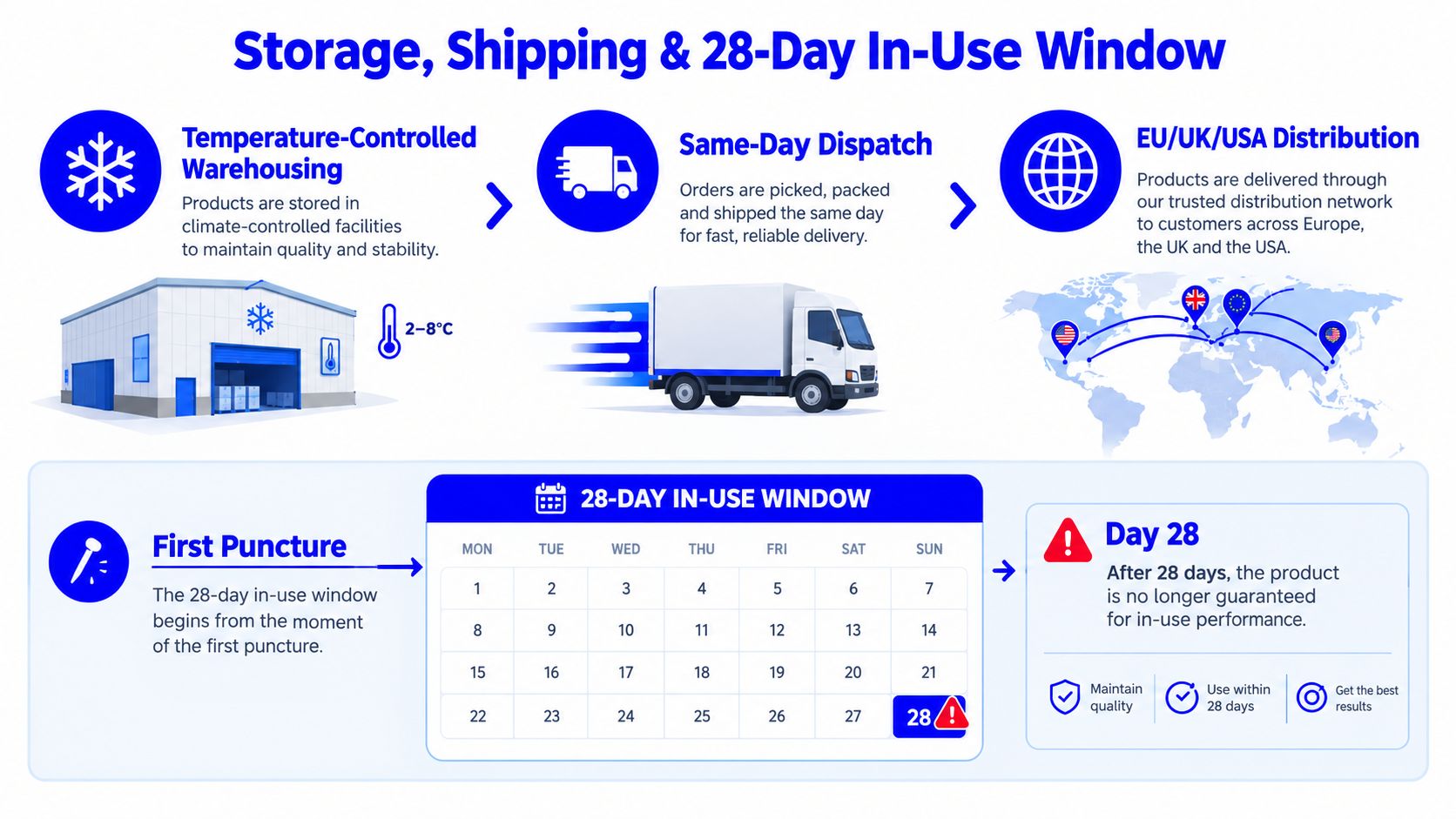
Product integrity depends on the whole chain, from warehousing to the final withdrawal. Temperature-controlled storage, suitable packing, dispatch timing, and arrival checks all matter because a sterile vial can still be affected by poor logistics or unnoticed damage.
At receipt, the laboratory should inspect the outer packaging, vial condition, label, seal, and any storage indicator supplied with the order. The team should record the arrival date and place the product into the specified storage environment without leaving it unattended on a receiving bench.
For teams reviewing transport planning, Novocargo cold chain insights offer useful background on why temperature-controlled logistics require coordination across storage, dispatch, and delivery. The relevant lesson for RUO buyers is straightforward: a supplier's shipping promise should be supported by a defined handling process.
The opening date starts the discipline
The widely cited multi-dose limit is 28 days after first puncture, not 28 days after manufacture or purchase. FDA correspondence on bacteriostatic water packaging states that multi-dose vials shouldn't be stored for more than 28 days after first use. That timing is why the opening date belongs on the vial and in the laboratory record.
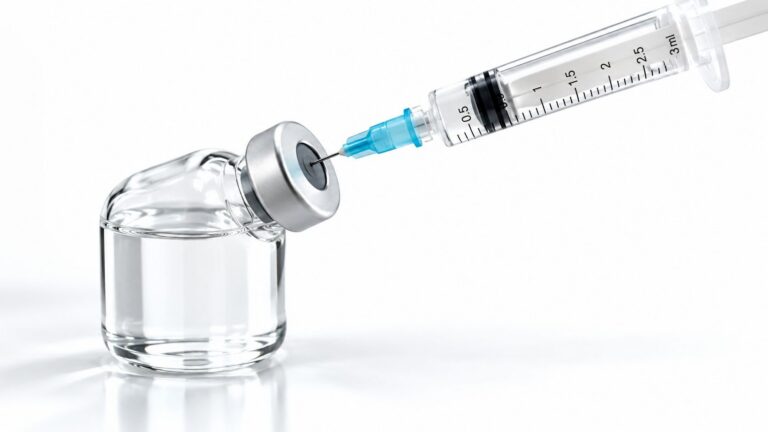
The preservative supports repeated withdrawals, but it doesn't provide unlimited usability. A new sterile needle and syringe should be used for each withdrawal, the stopper should be disinfected according to the laboratory procedure, and the vial should be protected from unnecessary handling. A damaged closure, unclear opening history, contamination event, or unexpected appearance should trigger quarantine and review rather than a debate about the calendar.
Bench discipline: The 28-day window is a maximum handling reference, not permission to ignore contamination controls or material stability.
The clock also doesn't override the stability of the reconstituted peptide, protein, antibody, or working solution. If the material's approved instruction gives a shorter period, that shorter period controls. The same caution applies to non-sterile home handling and products without a sponsor-approved reconstitution method.
Build the record around events
A simple vial log can include receipt, storage placement, first puncture, each preparation session, observed condition, responsible researcher, and final disposal. Guidance on how long bacteriostatic water lasts after opening can help with general planning, but the laboratory's approved procedure and product-specific instructions remain decisive.
The team should treat a replacement cadence as an operational control. A vial opened on a known date can be reviewed against the 28-day limit, while a vial with no reliable opening history shouldn't be treated as though its age is known.
How to Choose a Reliable Supplier in the UK
The strongest supplier decision isn't based on the lowest unit price. It's based on whether the supplier can provide a repeatable product, a traceable quality record, and delivery support that keeps the laboratory's workflow intact.
A UK buyer can score suppliers against a short set of practical questions:
- Can the supplier identify the lot? Product labels and COAs should connect the delivered vial to a defined batch.
- Does the supplier explain production? Information about aseptic filling, filtration, container closure, and release review is more useful than broad quality language.
- Can the supplier support recurring work? Multi-pack, wholesale, private-label, or white-label arrangements may matter to resellers and larger R&D groups.
- Does support answer technical questions? Clear responses about RUO status, storage, shipping, and documentation signal operational maturity.
- Can fulfilment be tracked? Dispatch arrangements, temperature-controlled storage, and distribution coverage should be explained before purchase.
Herbilabs offers RUO bacteriostatic water and reconstitution solutions in 3 mL, 10 mL, 20 mL, and 30 mL formats, with multi-pack options and lot-specific COA and QA information described as part of its supply model. That makes it one supplier option for laboratories comparing format, documentation, and fulfilment requirements.
Unverified marketplace listings create a different risk. The buyer may not know whether the formulation matches the description, whether the vial was stored correctly, or whether the certificate belongs to the delivered lot. A documented purchasing route helps laboratories avoid fake bacteriostatic water listings and maintain a clearer chain of custody.
The final choice should be recorded like any other research material decision. A supplier that communicates clearly, supports the required format, and provides usable documentation is usually more valuable than one that advertises a low price.
Herbilabs supplies RUO bacteriostatic water and reconstitution solutions in multiple vial formats, with documentation and fulfilment options suited to UK research workflows. Researchers, independent labs, and resellers can visit Herbilabs to review available formats and discuss sourcing requirements before placing an order.