Private Label, White Label, Wholesale partnerships available - EU, USA and UK - Free shipping from €75

Bacteriostatic Water Vials: Formats, Selection, and Handling
A lab manager can burn half a morning on what looks like a simple reorder. The worksheet says bacteriostatic water vials, but the actual decision is whether the workflow needs a small multi-pack that gets used quickly or a larger vial that stays in rotation long enough to make contamination control and recordkeeping matter. That choice sits upstream of convenience, waste, and reproducibility, and it affects resellers and white-label buyers just as much as it affects bench users.
Table of Contents
- Why the Vial Format Decision Matters More Than the Label
- What Bacteriostatic Water Is
- Vial Formats and Packaging Options Explained
- Multi-Dose Versus Single-Use Logic
- How Labs and Resellers Should Choose a Supplier
- Reading Labels and COAs the Right Way
- Understanding the 28-Day In-Use Window
- Putting It All Together Into a Selection Checklist
Why the Vial Format Decision Matters More Than the Label
A procurement lead can look at two listings, a 10 × 3 mL multi-pack and a single 30 mL vial, and think the choice is only about volume. In practice, the format changes how often the septum gets punctured, how long each container stays in circulation, and how much discipline the team needs when the vial is opened, stored, and documented. The chemistry is the same reference point, but the risk profile is not.
A small peptide lab often wants the smallest workable unit because it avoids leftovers that sit around after the session ends. A reseller, by contrast, may want fewer cartons to stock, simpler shelf management, and a format that maps cleanly into private label or white label fulfillment. Those are different purchasing problems, even if both buyers are ordering the same sterile diluent.
Practical rule: format selection should follow use pattern first, not price per milliliter.
The rest of the buying decision hangs off that first choice. If the vial is going to be punctured many times, the buyer needs a documented in-use window, clear storage rules, and a supplier that can prove lot traceability. If the workflow is intermittent, the priority shifts toward smaller containers or multi-packs that reduce the chance of opening product too early and holding it too long.
What Bacteriostatic Water Is
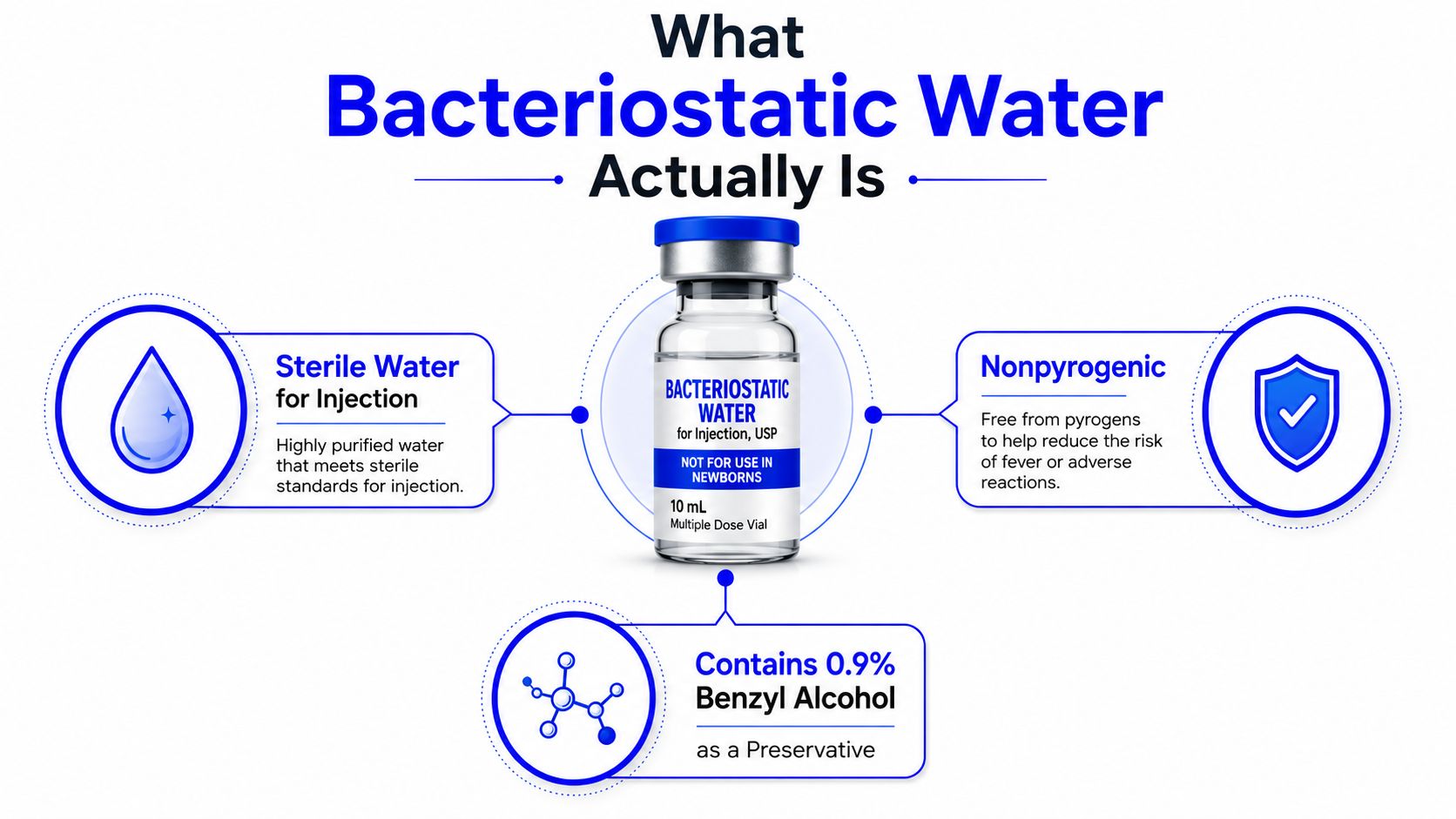
Bacteriostatic water for injection is sterile, nonpyrogenic water with 0.9% benzyl alcohol added as a preservative. That preservative does one job, it slows bacterial growth after the container has been entered. It does not make a contaminated vial safe again, and it does not replace aseptic technique. That distinction matters in procurement, because the product is chosen for repeated access, not for careless handling, as described in the current DailyMed monograph for bacteriostatic water for injection and its 0.9% benzyl alcohol formulation DailyMed.
What the formulation is built to do
A bacteriostatic water vial is designed for repeated withdrawals under controlled conditions. The preservative gives the vial a wider margin after puncture, but only inside the limits set by the label, storage rules, and the buyer's own handling process. That is the practical difference resellers and independent labs care about when they decide whether a vial belongs in a multi-dose workflow or should be treated as a short-use supply item.
The standard formulation has a clear history. The modern reference point traces back to the early 1950s, when the United States Pharmacopeia formalized bacteriostatic water as sterile water containing 0.9% benzyl alcohol Real Peptides history note. That standardization turned a basic diluent into a controlled repeat-use product, which is why documentation and access discipline matter as much as the liquid itself.
The handling limits are part of the product definition too. The monograph lists a pH of 5.7 within a 4.5 to 7.0 range, which can matter when the vial is used with sensitive proteins, peptides, or antibodies DailyMed. A procurement team does not need to turn that into chemistry theory, but it does need to know that the pH window can affect compatibility, and that compatibility issues become operational problems when a reconstitution target is narrow.
For a direct comparison of preservative logic, the internal primer on the difference between bacteriostatic and bactericidal is a useful companion, and the practical note on how to mix peptides safely helps tie the vial choice to real bench handling.
Vial Formats and Packaging Options Explained
The format decision is about how a container behaves in real handling, not just how much liquid it holds. A 3 mL vial suits low-volume use where the objective is to finish the container quickly and keep puncture count low. A 10 mL vial is the workhorse for many research settings because it balances practical volume with a manageable access pattern. Larger formats, such as 20 mL and 30 mL, reduce reorder frequency, but they ask more from storage discipline, access logging, and discard timing.
Matching format to workflow
The right format depends on how often the team opens the vial and how many sessions one container has to cover. A single bench session with a small number of reconstitutions usually favors a smaller vial or a multi-pack of small vials. A high-throughput workflow may justify a larger multi-dose container, but only if the team can keep the in-use window tight and the puncture record clean.
A standard 10 mL vial shows why the container matters as much as the fill. Industry specification data lists an approximate 13.5 to 14 mL brimful volume, about 45 mm height, and a 20 mm neck finish for that size vial specifications. That affects fill accuracy, closure fit, and automated handling, which is exactly why fill-finish operations and resellers care about container-closure details like Type I borosilicate glass, a rubber septum, and an aluminum crimp seal.
| Format | Typical Use Case | Puncture Frequency | Multi-Pack Option |
|---|---|---|---|
| 3 mL | Small-volume, short-window reconstitution | Low | Yes, often as 10 × 3 mL |
| 10 mL | General research and routine work | Moderate | Yes, often as 10 × 10 mL |
| 20 mL | Larger single-site workflows | Higher | Less common |
| 30 mL | Broad reuse across sessions | Highest | Usually single vial |
A practical buying note for peptide users is the guide on how to mix peptides safely. It's useful because format choice and mixing technique are tied together, and the wrong pairing leads to more waste than most buyers expect.
Multi-Dose Versus Single-Use Logic
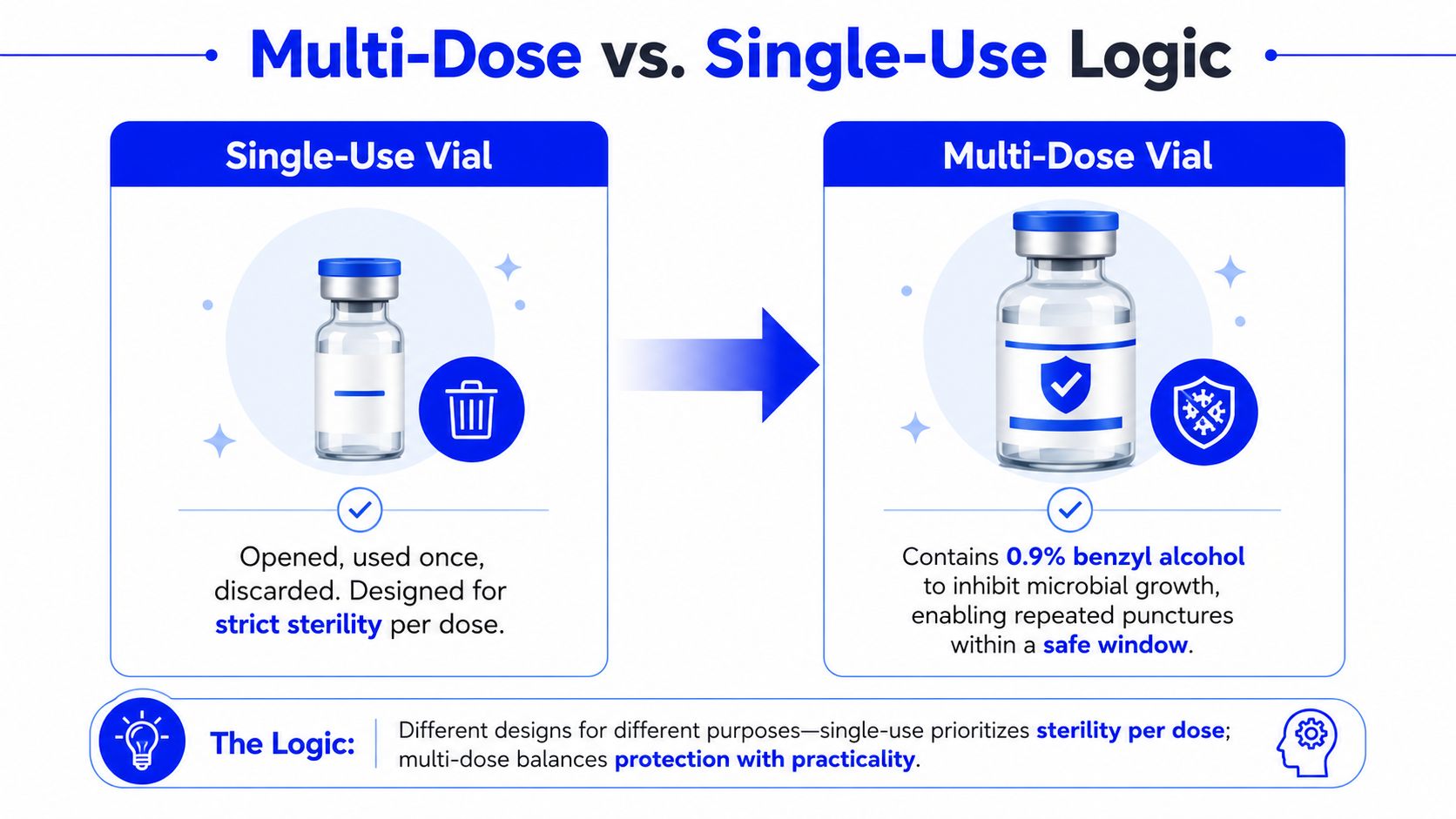
The multi-dose question is usually framed too vaguely. For bacteriostatic water, the answer starts with the formulation itself, because 0.9% benzyl alcohol exists to support repeated withdrawals under aseptic handling, which is why the product is normally sold in multi-dose presentations. That doesn't make every large vial a good choice, and it doesn't make every small vial safer by default. It just means the container is designed around reuse.
Where the 28-day window fits
Neutral medical guidance commonly treats opened multi-dose vials as discard candidates after about 28 days, and the bacteriostatic water reference material ties that window to controlled aseptic practice and preservative support history note. The point isn't that day 29 magically changes the chemistry. The point is that risk rises as punctures accumulate, handling gets messier, and storage conditions vary.
A single-use sterile water vial follows different logic. Without preservative support, it isn't built for repeated access, so the buyer should treat it as a one-and-done container. That's why “single-use versus multi-dose” is really a decision about access pattern, not a marketing label.
Opened multi-dose containers live or die by handling discipline, not by how clear they still look.
The choice is usually between a small multi-pack and a larger vial. A team that opens a vial only occasionally is often better served by a smaller pack, because the product gets used inside a predictable window. A team that draws often from the same container can justify a larger vial only if refrigeration, puncture logging, and discard timing are already part of routine behavior.
For a plain operational comparison of single-use and multi-use handling, the internal guide on single-use versus multi-use sterile water lab guidance gives a clean framing without turning the issue into theory.
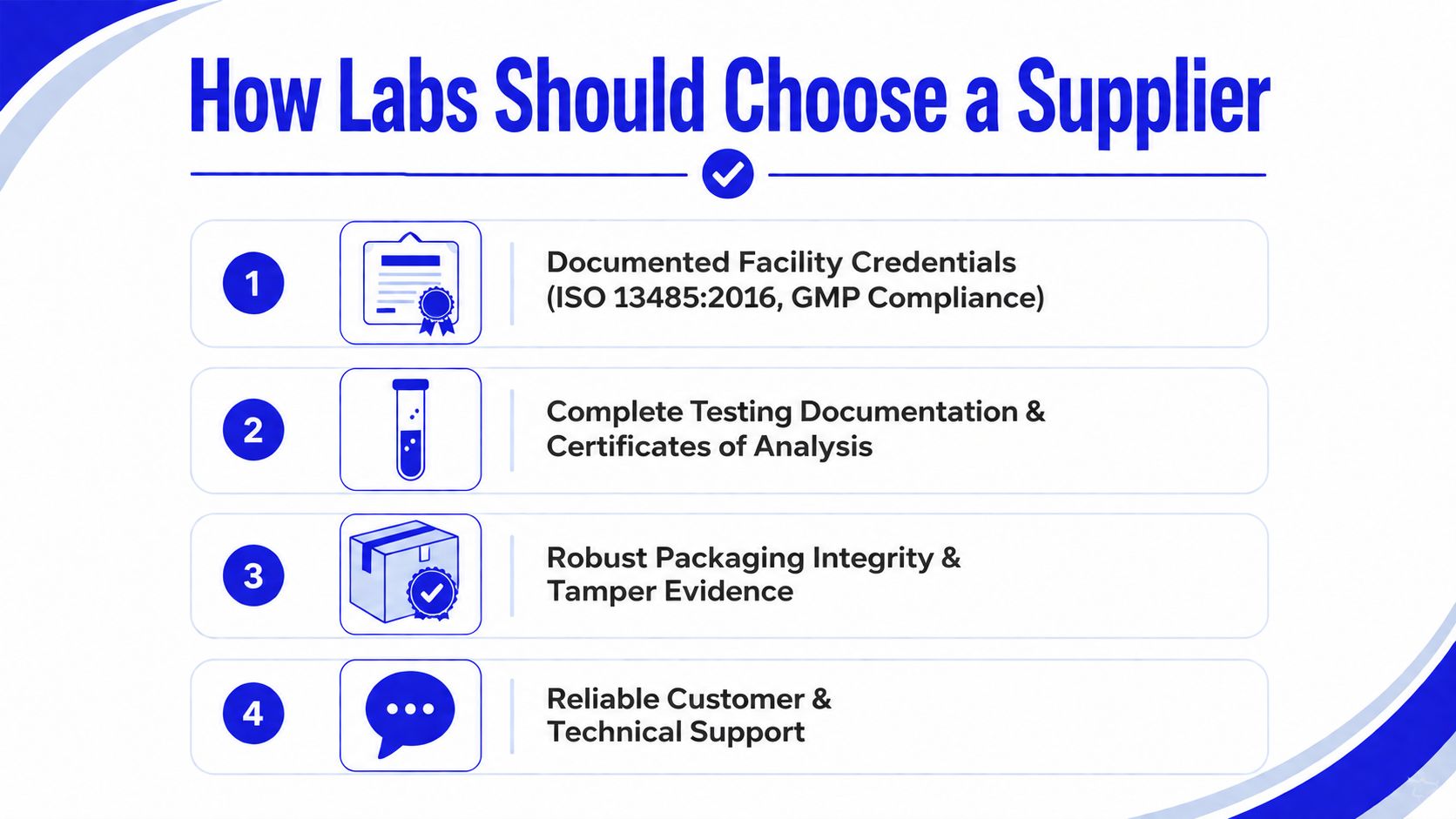
How Labs and Resellers Should Choose a Supplier
Supplier choice matters because a vial is only as useful as the paperwork and handling controls behind it. A buyer should start with documented facility credentials, then check whether the production process is run under defined procedures, and only then look at packaging, fulfillment, and commercial terms. That order keeps the review from getting distracted by unit price or glossy product photos.
A practical supplier screen
The first pass should ask whether the supplier can show ISO 13485:2016 and GMP credentials, plus processes run under ISO 9001:2016 procedures. Those credentials matter because they signal a controlled system rather than ad hoc blending and repackaging. A lab buyer doesn't need to assume perfection, but it does need a documented baseline.
Next, the buyer should ask about in-house production, standard operating procedures, and whether a lot-specific Certificate of Analysis is reviewed before release. Packaging integrity matters too, especially for multi-dose vials that will be accessed repeatedly. For resellers, the commercial fit also includes private label, white label, multi-pack availability, and distribution reach across the EU, UK, and USA.
- Documented credentials: Ask for facility certifications, not vague quality language.
- Testing documentation: Require lot-specific COAs with QA review before shipment.
- Packaging fit: Confirm tamper evidence, closure integrity, and storage controls.
- Commercial support: Check whether wholesale terms, same-day dispatch, and regional coverage match the buying model.
A useful operational side note for document handling is copy text from PDF guide, which is relevant when teams need to extract lot data into internal records without introducing transcription errors.
Herbilabs is one supplier that fits this model by offering bacteriostatic water and reconstitution solution formats with lot documentation, QA review, and distribution coverage across the EU, UK, and USA. Buyers comparing alternatives should still run the same checklist, because the process matters more than the logo.
Reading Labels and COAs the Right Way
A label tells a buyer what is in the vial, and the COA tells the buyer whether that batch was released under the stated controls. For RUO work, the label should clearly show volume, 0.9% benzyl alcohol, storage conditions, manufacturer or distributor identity, and the RUO designation when applicable. The COA should carry the lot number, manufacturing date, release date, and the relevant test parameters, including sterility, endotoxin, pH, and benzyl alcohol concentration.
What the paperwork should answer
If the label says a vial is 30 mL, the COA should let the buyer tie that unit to a specific lot. If the product is being moved through a reseller or white-label channel, the document trail should still make the source identifiable. That traceability matters because lot-to-lot consistency claims only hold when the paperwork can follow the vial.
The EU distribution side of the paperwork can also matter, because distributors may appear on the documentation for shipments into the EU, UK, and USA. In those cases, an entity such as Earthwise LTD may appear as part of the distribution chain, and that's normal when the buyer needs to know who handled the product after release. The point isn't to create extra bureaucracy, it's to make sure the vial can be traced if a question comes up later.
Buyers should read the COA like an audit trail, not like a brochure.
One small but expensive mistake is treating a label as sufficient proof. A clean vial with no corresponding release record still leaves the buyer blind on lot status, and that creates avoidable internal friction when teams compare shipments across time. The same is true in reverse, a COA without a matching label on the physical vial is incomplete for procurement records.
For anyone managing digital archiving or resale documentation, Creem's overview of VAT penalties is a useful reminder that recordkeeping gaps often become commercial problems long after the shipment is gone.
Understanding the 28-Day In-Use Window
The 28-day window gets treated like a casual suggestion, but that is the wrong way to read it. In practice, the risk comes from the interaction between benzyl alcohol concentration, septum integrity, and cumulative puncture count. Those variables shape the contamination curve, and a vial that still looks clear is not the same thing as a vial that has been handled safely.
What to do when the window is stretched
If a vial has stayed open longer than expected, the buyer should stop using visual clarity as a safety check. Clarity tells the user very little about what happened at the puncture site or how many times the container was accessed. If the opening date is unclear, or the access log is missing, the safer decision is to discard the vial.
Small-format vials and larger multi-dose containers fail in different ways. Smaller containers are often used up before the recordkeeping gets messy, while larger containers are the ones most likely to outlive the team's memory of when they were first punctured. In both cases, a simple puncture log with date, session, and remaining volume does more to reduce risk than guessing that the vial is still fine.
The hardest failure to catch is usually not bad technique. It is bad recordkeeping. A team can use alcohol swabs, sterile syringes, and careful handling, then still end up unsure whether an opened vial is inside or outside the intended window. The internal note on how long bac water lasts after opening is useful because it turns that ambiguity into a simple discard decision instead of a debate.
Putting It All Together Into a Selection Checklist
The fastest way to choose the right bacteriostatic water vial is to match workflow volume, puncture frequency, and in-use discipline before looking at unit price. Then verify that the supplier can show COA coverage, QA review, facility credentials, and distribution fit for the buyer's region. If the format and the documentation don't line up with the actual use pattern, the deal is wrong even if the listing looks neat.
For a quick five-minute screen, the buyer should ask four things. Does the format fit the number of withdrawals. Does the supplier support the needed paperwork. Is the container closure built for repeated access. Can the product move through the buyer's storage and fulfillment chain without gaps.
Herbilabs supplies bacteriostatic water and reconstitution solution in multiple vial formats for RUO workflows, along with lot-specific COAs and controlled fulfillment. Buyers comparing bacteriostatic water vials can review the available formats, documentation, and distribution coverage at Herbilabs and decide whether the supplier matches their actual access pattern, recordkeeping needs, and regional shipping requirements.