Private Label, White Label, Wholesale partnerships available - EU, USA and UK - Free shipping from €75
Bacteriostatic Saline for Injection Explained
Sterile does not mean compatible. The familiar advice to choose any sterile saline for reconstitution misses the deciding question: whether the material tolerates the salt, preservative, and final solution conditions. A sterile diluent can still produce the wrong working solution.
By Herbilabs
Table of Contents
- What Bacteriostatic Saline for Injection Actually Is
- How It Differs from Sterile Saline and Bacteriostatic Water
- When the Diluent Fits the Material
- Multidose Access and Dating Rules
- Labels COAs and What Labs Pay
- Match the Protocol Before You Reconstitute
What Bacteriostatic Saline for Injection Actually Is
Bacteriostatic saline for injection is salt water with an antimicrobial preservative, supplied as a diluent for compatible drugs. Its clinical name is bacteriostatic sodium chloride injection. It isn't a universal reconstitution fluid, and the word injection doesn't authorize administration of every material mixed into it.
Consider a laboratory receiving a lyophilized reagent while several similar-looking diluent vials sit in storage. One contains preserved saline, another contains preservative-free saline, and another contains research-grade bacteriostatic water. Their clear appearance tells the technician little about which belongs in the preparation.
Two ingredients with different jobs
Sodium chloride establishes the solution's osmotic backdrop, much as seasoning establishes the character of a broth. Benzyl alcohol acts as a brake on bacterial growth. It isn't a sterilizing wipe inside the bottle, and it doesn't excuse a contaminated puncture.
Preservative-free normal saline contains salt without that antimicrobial agent. Bacteriostatic water contains preservative without sodium chloride. Those differences matter before any withdrawal takes place.
A working solution can look clear and still be unsuitable because its tonicity, hemolysis risk, or preservative tolerance is wrong.
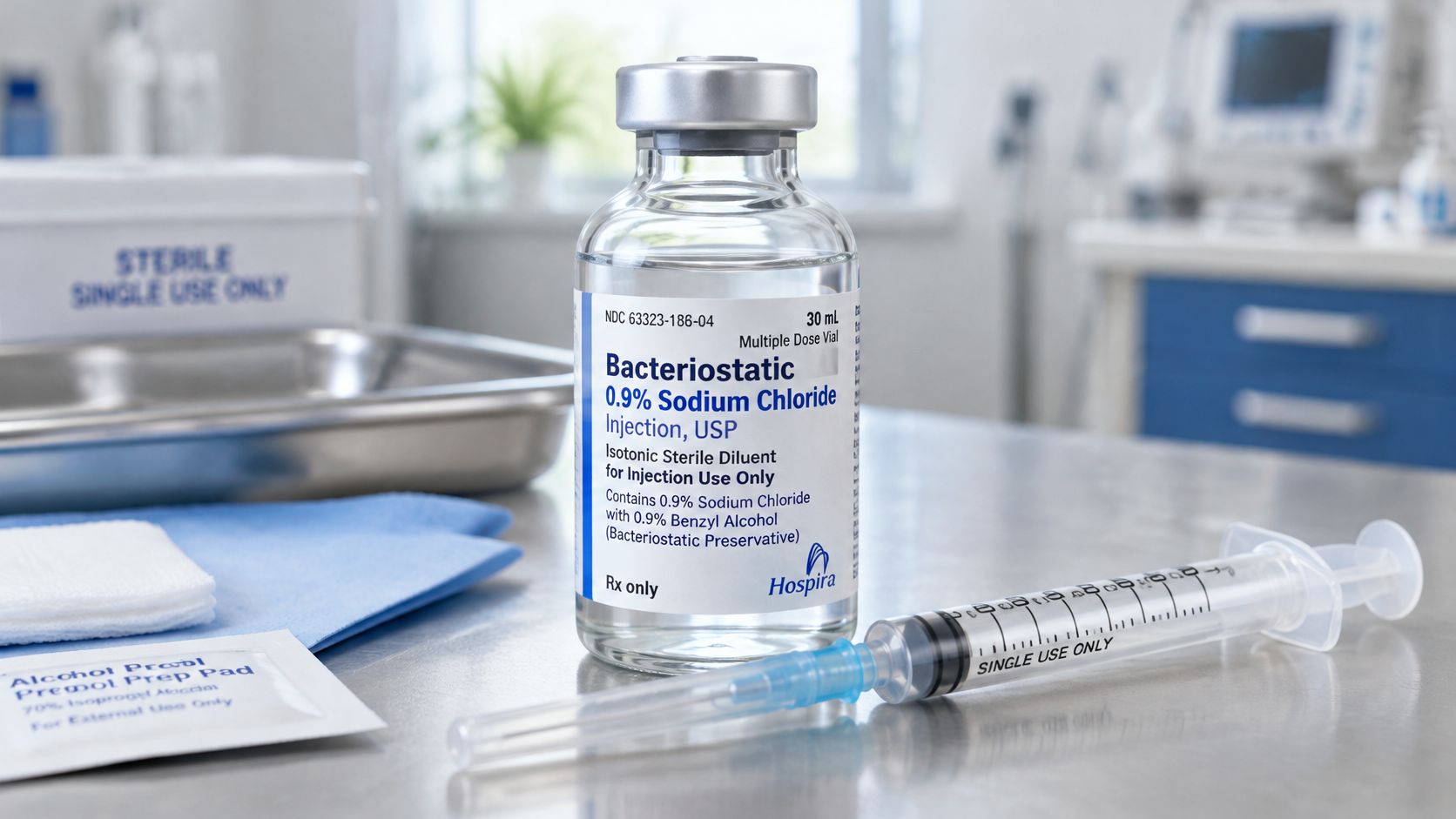
The container label identifies the formulation, not just the bottle's appearance.
Clinical labeling isn't research-use purchasing
A clinical injection product and a research-use-only diluent belong to different intended-use categories. A laboratory purchasing description doesn't establish suitability for human administration.
For a lab lead, the useful review starts with composition and compatibility, then continues through access records, discard dates, and batch documentation. Procurement follows those requirements rather than deciding them.
How It Differs from Sterile Saline and Bacteriostatic Water
| Diluent | Sodium chloride | Preservative | Role | Hard limit |
|---|---|---|---|---|
| Bacteriostatic 0.9% sodium chloride injection | 9 mg/mL | 0.9% benzyl alcohol (9 mg/mL) | Isotonic vehicle for a compatible drug | Not for neonates; route follows the drug label |
| Bacteriostatic water for injection | None | Usually 0.9% benzyl alcohol (9 mg/mL); some labels specify 1.1% (11 mg/mL) | Solvent; final mix should be about isotonic | Must not be injected alone; hemolysis risk; typical pH 5.7, accepted range 4.5–7.0 |
| Preservative-free 0.9% sodium chloride | 9 mg/mL | None | Isotonic vehicle when benzyl alcohol is unsuitable | No bacteriostatic protection after puncture |
| Sterile water for injection | None | None | Additive-free solvent | Not a multidose vehicle |
Diluent composition and hard limits. Pfizer's bacteriostatic sodium chloride labeling identifies the saline formulation as sterile, nonpyrogenic, and isotonic, containing 9 mg/mL sodium chloride plus 0.9% benzyl alcohol, or 9 mg/mL. The same labeling prohibits use in neonates and requires the administration route to follow the drug's instructions.
The water specifications come from FDA bacteriostatic water product information: benzyl alcohol is commonly 0.9%, some approved presentations contain 1.1%, and the typical pH is 5.7, with an accepted range of 4.5–7.0. That information also warns that intravenous administration without a dissolved solute may cause hemolysis.
Bacteriostatic water must not be injected by itself, and the final admixture should be approximately isotonic. Benzyl alcohol-containing preparations must not be used in neonates. These are safety boundaries, not optional handling preferences.
Reading the saline rows
The saline rows share sodium chloride, but they don't share preservative protection. A protocol naming preservative-free saline hasn't implicitly permitted substitution with preserved saline.
The opposite mistake is treating a preservative-free container as a multidose vial because its contents began sterile. Without a labeled multidose presentation, repeated access isn't justified by a clean-looking solution or an intact-looking stopper.
An isotonic starting diluent also doesn't establish every property of the finished preparation. The added material, concentration, and other formulation components still need evaluation.
Reading the water rows
Bacteriostatic water isn't saline with a different name. It lacks sodium chloride, and its preservative concentration must be confirmed from the actual product rather than assumed from the category.
The listed pH is another specification, not proof that the water will create the correct final pH for every reagent. The material itself can change the finished solution's conditions.
For peptide-focused terminology, PepFlow's peptide diluent comparison offers a supplementary comparison of water and saline. The discussion of peptide compatibility with water and saline can also support protocol review, but neither replaces product-specific directions.
A purchasing specification should therefore name salt content, preservative content, and required solution conditions. A request for sterile reconstitution liquid leaves too much unresolved.
When the Diluent Fits the Material
The correct choice starts with the source material's instructions, not the vial already open on the bench. For a lyophilized powder or concentrated reagent, a laboratory needs an explicit answer about the permitted vehicle before preparing a working solution.
The compatibility checks begin with the material and end with its validated protocol.
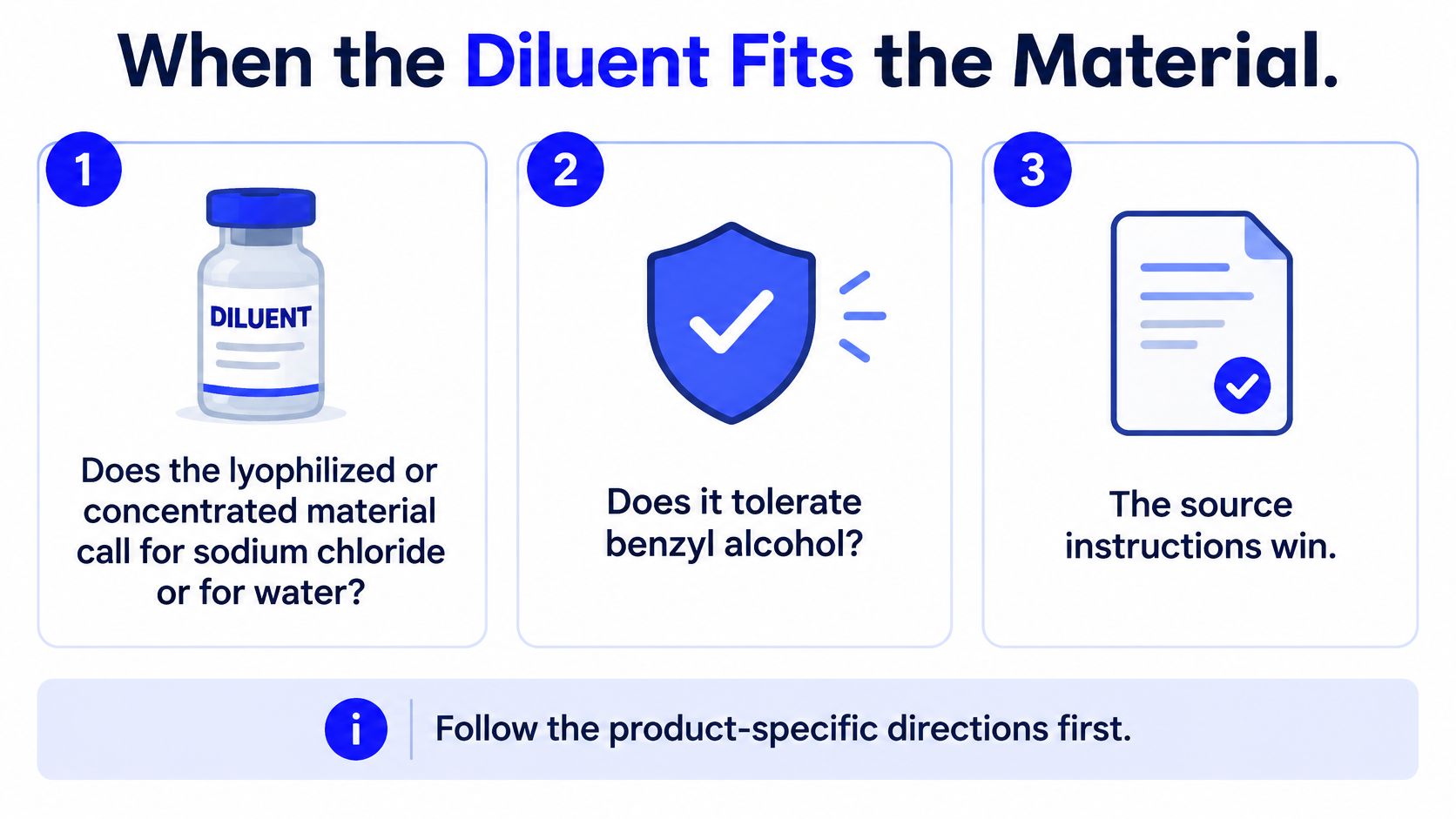
A pre-reconstitution compatibility review
- Vehicle requirement: Does the material call for sodium chloride solution or water? An unspecified aqueous vehicle warrants clarification rather than a convenient substitution.
- Preservative tolerance: Does the source product explicitly permit benzyl alcohol? Compatibility with another reagent doesn't establish compatibility with this one.
- Final solution conditions: What target pH and osmolality does the protocol require? The starting diluent alone doesn't answer that question.
- Working concentration: Does the planned preparation reach the validated concentration without introducing an unapproved formulation change?
- Container and exposure: Could the solute adsorb to glass or plastic, precipitate, or degrade under the planned light and temperature conditions?
These checks matter because dissolution and suitability aren't the same outcome. A peptide might dissolve visibly in preserved saline while the added salt changes its solubility under subsequent assay conditions. An antibody preparation might remain clear even though its protocol never validated benzyl alcohol exposure.
Those are hypothetical failure scenarios, not evidence that every peptide or antibody behaves that way. Their purpose is to show why appearance alone can't establish reproducibility.
Label restrictions establish boundaries
The DailyMed labeling for bacteriostatic water requires an appropriate solute and an approximately isotonic final admixture, and excludes use for fluid replacement and epidural or spinal anesthesia. These restrictions illustrate why a diluent's composition and intended use must be evaluated together.
A nonclinical laboratory isn't administering those preparations, but the formulation lesson still applies. Sterility is a microbiological attribute, not a compatibility certificate.
The accompanying video is supplementary material; product-specific directions remain the authority for preparation.
Decision rule: A prohibition on preserved diluent stops the substitution. A saline requirement doesn't permit water merely to obtain a multidose presentation, and a water requirement doesn't permit added salt for reassurance.
When directions are incomplete, the responsible scientist should obtain clarification or establish an approved validation plan. The source product's instructions and validated protocol take precedence over a general guide, including this one.
Multidose Access and Dating Rules
A multidose designation permits repeated withdrawals under appropriate conditions. It doesn't turn repeated entry into a low-consequence task. Every access should leave enough information for another trained person to determine whether the vial remains acceptable.
CDC safe-injection guidance calls for alcohol disinfection before every puncture and establishes a general 28-day in-use limit unless the manufacturer specifies a different interval. It also states that a multidose vial entering an immediate patient-care area should be dedicated to one patient and discarded after use.
A documented access routine
Confirm the identity. The operator checks that the label names bacteriostatic sodium chloride rather than preservative-free saline or bacteriostatic water. This prevents a lookalike-container substitution before it reaches the preparation record.
Inspect the vial and closure. Cracks, leaks, damaged septa, turbidity, or particles require rejection. A questionable container shouldn't remain in the usable stock while someone tries to explain away the defect.
Disinfect the septum. Alcohol disinfection takes place before every puncture, followed by drying according to the applicable procedure. Cleaning only at first opening leaves later entries uncontrolled.
Use a new sterile needle and syringe. Neither item is reused for another entry. A syringe doesn't become suitable for reuse merely because its needle has been changed.
Record first access. The vial receives its first-puncture date and calculated discard date, while the log retains lot, manufacturer expiry, operator identity, and storage location. This prevents an undocumented vial from circulating between benches.
Withdraw and return under the approved conditions. The operator removes only the amount required by the protocol and returns the vial to its assigned storage. Storage conditions come from the product instructions, not a general preference for refrigeration.
Benzyl alcohol slows bacterial growth; it doesn't sterilize a contaminated vial. A shared laboratory vial should have a controlled access log and a defined user group, with immediate disposal when its closure or handling history becomes uncertain.
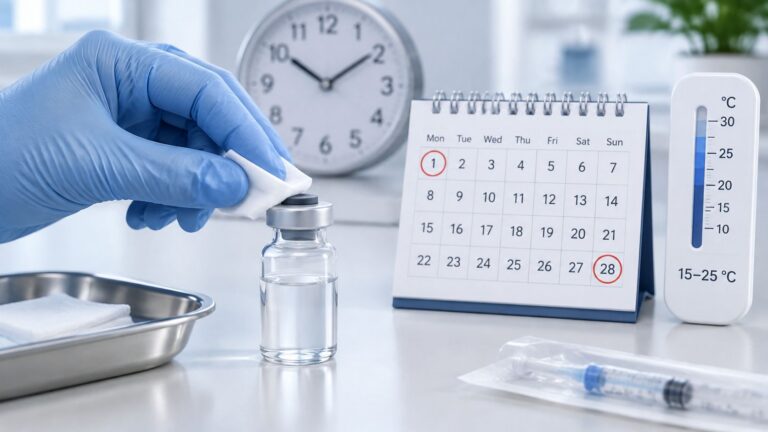
The visual summarizes identification and access controls. Its removable-cap timing statement must not be treated as a validated dating rule; the written manufacturer instructions and the dating rules below govern.
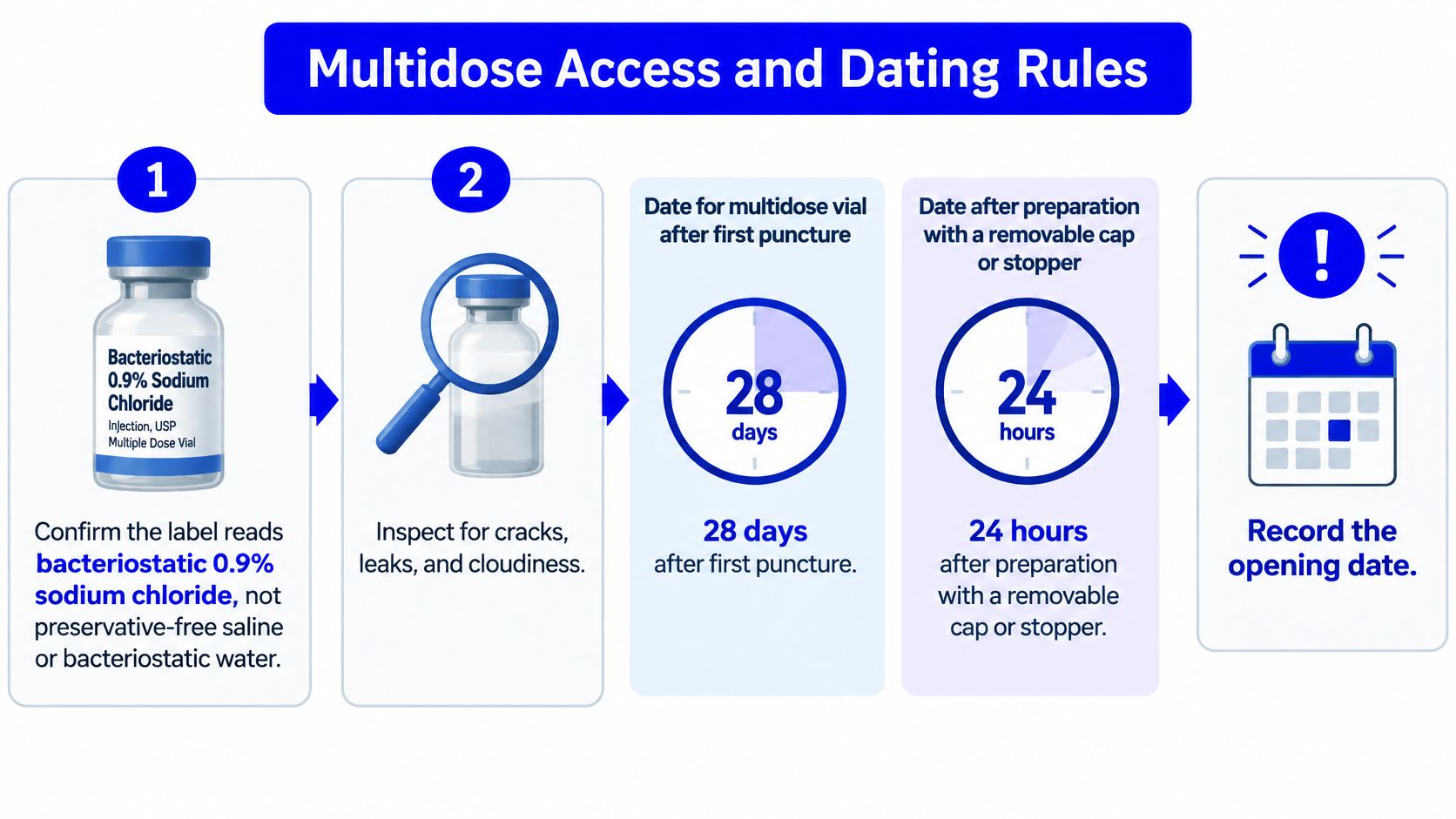
Two clocks and an immediate stop
The manufacturer expiration date governs unopened stock. Once the vial is accessed, an opened-vial beyond-use date applies as well, and the earlier applicable endpoint controls.
The CDC safe-injection checklist distinguishes manufacturer expiration from the generally applicable 28-day opened-vial period, unless another interval is specified, and requires disposal whenever sterility is compromised or questionable. An opened-vial date can never extend the original expiry.
Discard triggers for multidose saline vials
| Vial state | Discard rule | Example |
|---|---|---|
| Unopened multidose vial | Discard on manufacturer expiration date | An intact vial that reaches its labeled expiry leaves usable stock even if never punctured |
| Accessed vial | Discard within the standard opened-vial interval or manufacturer-specified interval, never past expiry | A vial punctured shortly before expiry is discarded on expiry, not after a fresh full in-use period |
| Any vial | Discard immediately if sterility is compromised or cannot be confirmed | Cracked septum, turbidity, or an undocumented handling history |
Refrigeration doesn't reset an overdue in-use window. Moving a vial to another room, changing its label, or opening a new access log doesn't reset it either.
Practical control: A missing first-access date is a handling failure, not evidence that the vial was opened recently.
The diluent clock doesn't date the mixture
An accessed diluent vial and a reconstituted material are separate preparations. The diluent's permitted access period doesn't automatically become the working solution's stability period.
The finished preparation needs its own product-specific storage and dating instructions. A certificate of analysis can support batch identity, but it doesn't replace either set of handling directions.
Laboratories using preserved water can apply the same recordkeeping discipline alongside their bacteriostatic water procedures. The formulation still needs to match the source protocol before those handling controls become relevant.
Labels COAs and What Labs Pay
Procurement teams need separate answers to separate questions: what the product is authorized for, what the named batch documentation supports, and whether the purchased format suits the laboratory's workload. A supplier listing or quality certificate can't answer all of them.
Three distinct paper trails
The clinical label identifies an injection product's formulation, intended diluent role, restrictions, and handling statements. Clinical use must remain consistent with the compatible drug's directions and applicable professional requirements.
The certificate of analysis, or COA, concerns a named lot. A reviewer should match the certificate's product identifier and lot to the received vials, then check the listed specifications, results, methods, and release status.
A COA may include appearance, pH, sterility, or endotoxin information where the manufacturer provides those tests. A broad quality statement shouldn't be mistaken for a reported result on the actual batch.
The RUO purchasing record establishes a nonclinical laboratory purchase. It should preserve the intended-use statement and must not describe a research diluent as a substitute for a prescribed injection product.
- Identity match: The label, order, and COA should describe the same formulation.
- Lot match: Batch documentation should correspond to the received inventory.
- Use match: The laboratory protocol should permit that vehicle and preservative.
- Handling match: Storage and opened-vial directions should be available before stock is released to the bench.
A water option isn't a saline substitute
For protocols requiring preserved water, Herbilabs offers an RUO sterile, nonpyrogenic reconstitution solution containing 0.9% benzyl alcohol, in 3 mL, 10 mL, 20 mL, and 30 mL glass vials, with 10×3 mL and 10×10 mL packs, lot-specific COAs, and private-label, white-label, and wholesale options; its bacteriostatic water vial handling guidance accompanies a product line with stated ISO 13485:2016, GMP, and ISO 9001:2016 process credentials.
That description concerns bacteriostatic water, not bacteriostatic saline. Process credentials and documentation support supplier assessment, but they don't establish compatibility with every peptide, protein, or antibody.
Comparing listed saline prices
The following listings concern sodium chloride products, even where the seller's name includes bacteriostatic water. Prices are listing snapshots rather than assurances about checkout totals or continuing availability.
2026 listed prices for bacteriostatic sodium chloride vials
| Seller | Pack | 2026 price | Previous price |
|---|---|---|---|
| Mountainside Medical | 25 × 10 mL bacteriostatic sodium chloride 0.9% | $185.00 | $269.00 |
| Bacteriostatic Water Australia | 10 × 10 mL bacteriostatic sodium chloride | A$192.00 | A$198.00 |
Pack size and currency belong at the start of the comparison. The dollar amounts aren't directly comparable across currencies, and a larger pack isn't automatically economical if the laboratory routinely discards partially used vials.
A useful quotation review also checks formulation, vial presentation, documentation availability, and intended use. A low per-millilitre slogan can't compensate for purchasing the wrong diluent.
Match the Protocol Before You Reconstitute
A laboratory can resolve most purchasing uncertainty by translating the source protocol into an explicit diluent specification. The decision should be made before an operator opens a vial, not during mixing.
The responsible scientist should approve the vehicle, preservative status, final concentration, and required storage conditions together. Purchasing can then obtain the named formulation without having to interpret experimental compatibility.
The permitted vehicle determines the action
When the protocol requires bacteriostatic saline, the laboratory purchases a labeled bacteriostatic sodium chloride product and verifies the received formulation against the order. The operator records lot and expiry, dates first access, and applies the earlier applicable discard endpoint.
When the protocol requires bacteriostatic water, the laboratory selects preserved water without adding sodium chloride. The access record and aseptic controls remain necessary, but a familiar vial format isn't a reason to alter the vehicle.
When benzyl alcohol or added salt is prohibited, the laboratory uses the preservative-free vehicle explicitly named in the protocol. A single-dose presentation is treated as single-access rather than retained as an improvised multidose supply.
A protocol that prohibits a formulation component needs a different vehicle, not a smaller amount of the forbidden ingredient. Where directions leave a genuine uncertainty, clarification belongs with the material supplier or the laboratory's authorized protocol owner.
Clarity after mixing is not proof of compatibility.
A bench record that supports the next operator
Quote comparison should finish before vial access begins. The buyer checks pack size and currency, while the receiving laboratory confirms that the actual label matches the approved protocol.
Before opening any vial, the operator prepares a bench record containing:
- Diluent name: The complete formulation, including preservative status.
- Lot: The identifier connecting the vial to its batch documentation.
- Expiry: The manufacturer's original expiration.
- First-puncture date: The date entered when access occurs.
- Discard date: The calculated endpoint, ready for confirmation at first access.
The same record should identify the protocol and storage location so another trained operator can reconstruct the decision. A vial with an uncertain history shouldn't remain available merely because useful volume remains.
Herbilabs offers research-use-only bacteriostatic water, lot-specific documentation, and wholesale and private-label supply options for laboratories whose protocols permit preserved water. Procurement teams can visit Herbilabs to review vial formats and request documentation before ordering, while keeping saline requirements separate from water purchases.