Private Label, White Label, Wholesale partnerships available - EU, USA and UK - Free shipping from €75
Bacteriostatic 0.9 Sodium Chloride Explained for Labs
A researcher has a lyophilized peptide on the bench, a protocol that calls for saline, and several planned withdrawals over the coming days. Opening a fresh single-use container for every preparation may create unnecessary handling and documentation work, but choosing a preserved diluent without checking compatibility can introduce a different problem. The practical question isn't just what's inside the vial. It's whether the formulation, the multi-dose workflow, and the laboratory's aseptic controls fit together.
Bacteriostatic 0.9 sodium chloride is designed for that decision point. It combines isotonic saline with benzyl alcohol, allowing a labeled multi-dose vial to support repeated access under controlled conditions. This guide helps research teams understand the chemistry, compare alternative diluents, plan peptide and protein workflows, protect vial integrity, manage the 28-day in-use framework, and evaluate procurement records before placing an order.
Table of Contents
- Introduction to Bacteriostatic 0.9 Sodium Chloride in the Lab
- What Bacteriostatic 0.9 Sodium Chloride Is and How It Works
- How Bacteriostatic Saline Compares to Other Diluents
- Common RUO Uses for Peptide and Protein Workflows
- Safe Handling and Aseptic Technique That Preserves Integrity
- Storage Shelf Life and In Use Stability You Can Trust
- Buying Guide for Labs and Resellers Seeking Reliable Supply
Introduction to Bacteriostatic 0.9 Sodium Chloride in the Lab
A small research laboratory may use the same diluent across several reconstitution sessions. One vial may be opened for a peptide preparation, accessed again for a protein working solution, and then returned to controlled storage while the team completes its testing schedule. That pattern creates two requirements at once: the liquid must suit the material being reconstituted, and the vial must tolerate repeated entry under disciplined aseptic conditions.
Bacteriostatic 0.9 sodium chloride addresses the first part with an isotonic saline base and the second with a preservative. The formulation contains 0.9% sodium chloride and 0.9% benzyl alcohol, with each milliliter containing 9 mg of sodium chloride and 9 mg of benzyl alcohol according to the FDA product information. Sodium chloride provides the saline environment, while benzyl alcohol suppresses bacterial growth after vial access.
That wording matters. Bacteriostatic doesn't mean permanently sterile after contamination. The preservative can slow microbial multiplication, but it can't turn poor handling into good handling. Every puncture, exposed stopper, reused needle, or uncontrolled storage condition adds risk to the workflow.
The product is also not a universal substitute for every sterile diluent. FDA labeling identifies bacteriostatic 0.9% sodium chloride as a sterile, nonpyrogenic, multi-dose diluent for injectable medications requiring 0.9% sodium chloride, while also warning against neonatal use because of the benzyl alcohol preservative. Research teams must therefore check the protocol, product label, age-related restrictions, and material compatibility before adopting it.
By the end of this guide, a lab manager should be able to answer four practical questions:
- Does the formulation match the protocol?
- Can the workflow justify a multi-dose vial?
- Can the team maintain aseptic access through the in-use period?
- Does the supplier provide enough documentation for traceability and release review?
What Bacteriostatic 0.9 Sodium Chloride Is and How It Works
A lab may need the same vial for several permitted withdrawals over an in-use period. That workflow depends on more than the liquid's name. It depends on the saline composition, the preservative, the vial label, and the way each puncture is controlled.
The saline base provides isotonicity
0.9% sodium chloride is an isotonic saline solution. Its salt concentration supplies a saline medium intended to support osmotic balance in the formulation context. The FDA labeling describes bacteriostatic 0.9% sodium chloride injection as a sterile, nonpyrogenic diluent for injectable medications that require 0.9% sodium chloride, containing 9 mg/mL sodium chloride. The same labeling identifies a multi-dose format.
For laboratory work, isotonicity is a functional requirement, not a decorative specification. A reconstitution protocol may depend on saline rather than plain water. Ionic strength can affect how a peptide, protein, antibody, or other lyophilized material dissolves and behaves. The protocol and product documentation should therefore determine whether this base is appropriate.
Benzyl alcohol supports repeated access
The second component is 0.9% benzyl alcohol, the bacteriostatic preservative. Each milliliter contains 9 mg/mL benzyl alcohol, according to the FDA reference document. The preservative suppresses microbial growth after the container is entered, supporting a multi-dose workflow when the label permits that use.
Benzyl alcohol works like refrigeration in one limited respect. It can make microbial growth less favorable, but it cannot sterilize liquid that has already been contaminated. A vial with a compromised stopper, questionable handling, or uncertain storage should not be treated as safe because it contains a preservative.
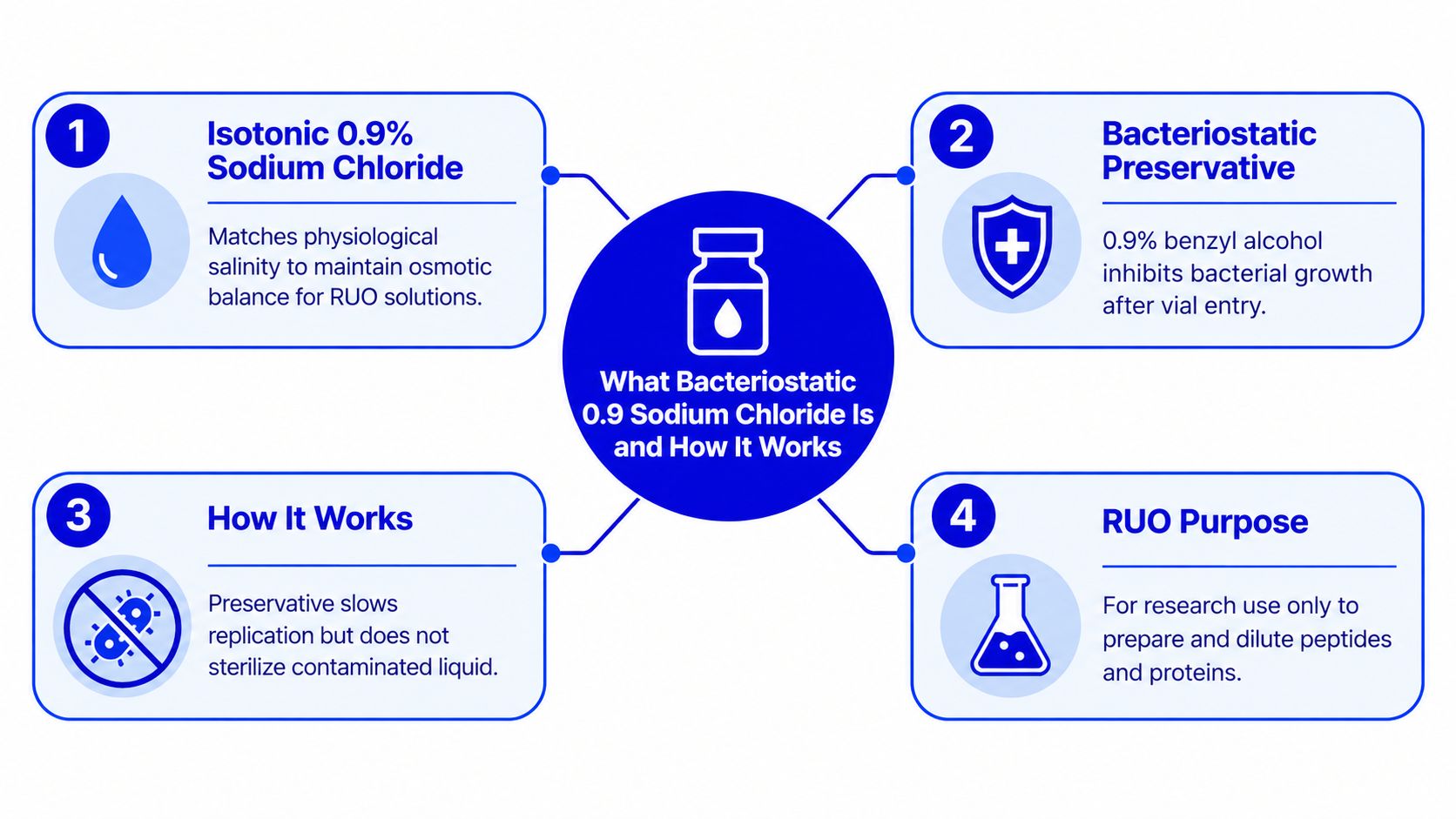
Specific products may document sterile, nonpyrogenic solution, aseptic filling controls such as 0.22 µm filtration, a defined pH range, and glass multi-dose vials. These details support initial quality and container integrity. They do not replace disinfecting the stopper, using a sterile needle and syringe, or controlling access after the first puncture.
The key operational reference is the 28-day beyond-use framework. Under common aseptic practice, a multi-dose bacteriostatic preparation is typically managed for up to 28 days after first puncture, unless the product-specific label states otherwise. This is an in-use handling period, not a guarantee against contamination, storage abuse, or careless entry.
Record the first puncture date, calculate the applicable discard date from product documentation, and discard sooner if vial integrity is uncertain. That record ties preservative chemistry to aseptic practice and gives procurement or release review a traceable decision point.
How Bacteriostatic Saline Compares to Other Diluents
A researcher opens a vial for a protocol that requires repeated access. The correct choice depends on two questions: does the material require saline or water, and does the workflow permit a preserved multi-dose format? A preservative does not make different diluents interchangeable.
Bacteriostatic saline combines sodium chloride with benzyl alcohol. Bacteriostatic water contains sterile water and benzyl alcohol, without the saline base. Preservative-free sterile saline provides sodium chloride in a sterile isotonic solution, without benzyl alcohol.
| Diluent | Composition | Preservative | Best For |
|---|---|---|---|
| Bacteriostatic 0.9% sodium chloride | 0.9% sodium chloride in sterile solution | 0.9% benzyl alcohol | Protocols requiring saline and permitted multi-dose access |
| Bacteriostatic water | Sterile water with benzyl alcohol | Benzyl alcohol | Materials or protocols requiring water rather than saline, when multi-dose use is permitted |
| Sterile saline without preservative | 0.9% sodium chloride in sterile solution | None | Single-use or protocol-defined applications where preservative-free saline is required |
When saline chemistry matters
Saline brings ions into the preparation; plain water does not. That difference can influence dissolution, stability, ionic strength, and compatibility for a specific peptide, protein, antibody, or injectable medication. A protocol calling for saline should therefore be matched with saline, rather than replaced with bacteriostatic water because both products contain a preservative.
The opposite substitution can also create problems. Adding sodium chloride to a water-based protocol changes the final system. Product labeling, institutional procedures, and compatibility data should identify the acceptable diluent. For background on sodium chloride water for labs, a supplier reference may help with procurement review, but it cannot replace the protocol or applicable product documentation.
When preservative-free saline makes more sense
Preservative-free sterile saline fits workflows that require a single-use container, exclude benzyl alcohol, or specify preservative-free material. It also suits procedures that do not need repeated entry. The vial format, intended use, storage instructions, and material compatibility should be checked before selection.
The 28-day multi-dose workflow does not decide the diluent by itself. It only becomes relevant after the protocol has confirmed that preserved saline is compatible and repeated access is allowed. Once opened, stopper disinfection, sterile entry, and a recorded first-puncture date determine whether that workflow remains controlled. Procurement records should retain the product description, lot information, and intended-use statement so the formulation choice can be traced.
Common RUO Uses for Peptide and Protein Workflows
A researcher opens a vial of lyophilized peptide, protein, antibody, or prepared reagent and needs a defined working solution. At that point, the diluent is no longer a generic liquid. It becomes part of the final formulation, much like an ingredient in a controlled recipe. The lab should therefore treat bacteriostatic 0.9% sodium chloride as a controlled input, not an automatic default.
Start with the protocol. Confirm whether the material calls for saline, water, a buffer, or another vehicle. Then check the required volume, container format, storage conditions, compatibility information, and permitted in-use period. These checks determine whether a multi-dose workflow is appropriate and whether the preservative can support the planned handling.
A repeatable reconstitution sequence
Confirm compatibility. The protocol or manufacturer documentation should identify the acceptable diluent. If it specifies 0.9% sodium chloride, bacteriostatic saline may be relevant. If it specifies water or a particular buffer, do not substitute saline based only on convenience.
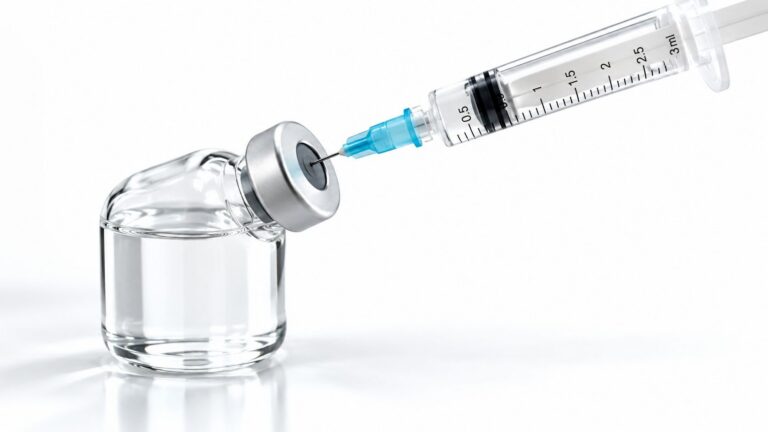
Match the vial format to demand. A 3 mL vial may fit a small preparation, while 10 mL, 20 mL, or 30 mL formats may suit larger or repeated workflows. Multi-pack options can standardize stock, but the selected size should reflect actual use. A larger vial does not improve a workflow if it remains open longer than the protocol allows.
Prepare the work area. Check the label, lot number, expiry information, and vial condition before entry. Place the diluent, sterile syringe, needle, receiving vial, and records within reach before puncturing the stopper.
Record the event. Document the first-entry date, lot number, material identity, and operator according to the laboratory recordkeeping system. For a 28-day multi-dose workflow, that date anchors the in-use review. The preservative supports the formulation only within the labeled conditions. Repeated punctures, poor technique, incompatibility, or storage outside instructions can still make the vial unsuitable.
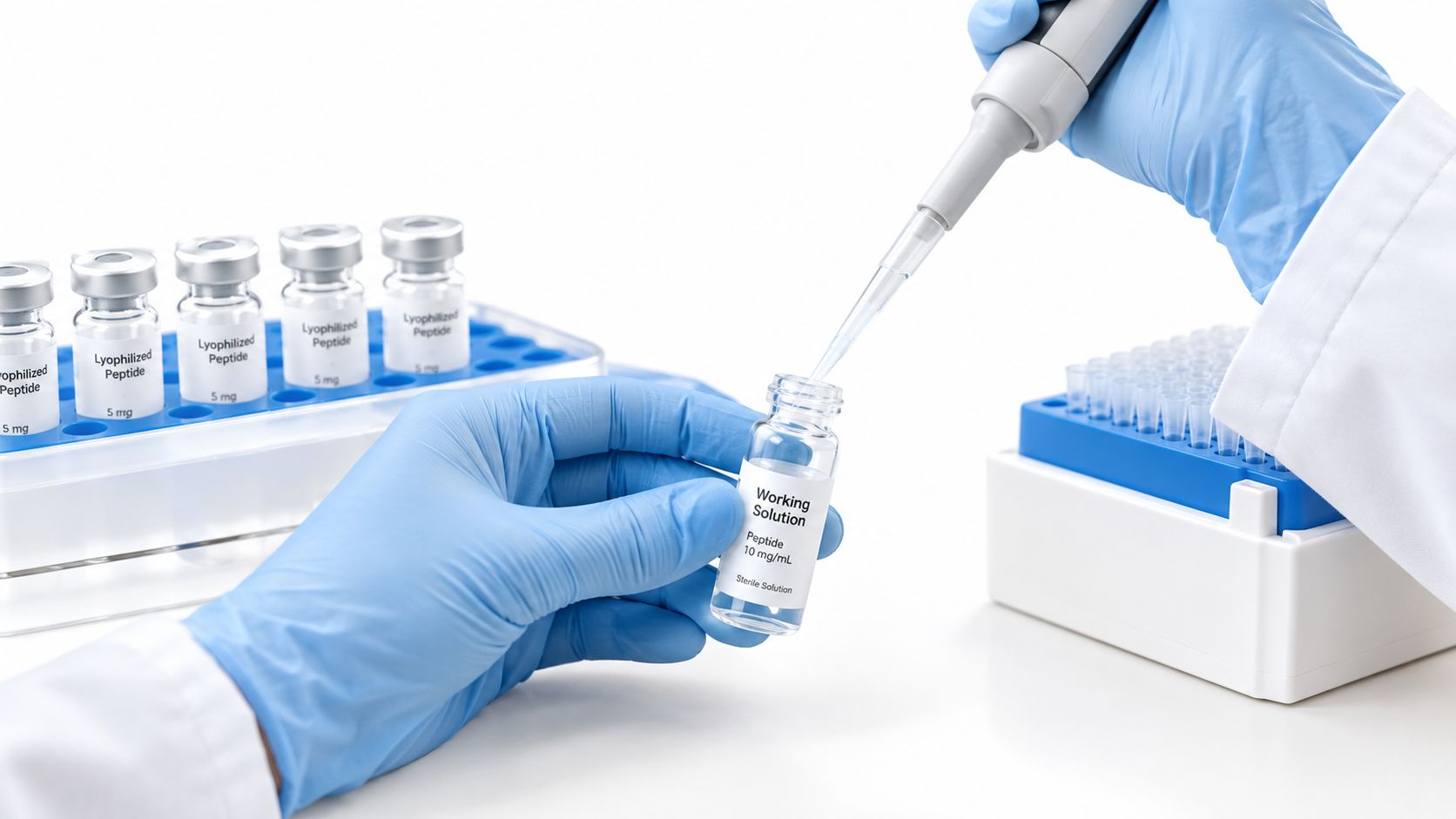
Repeated withdrawal can reduce container changes across planned experiments, provided the product label permits multi-dose use and the laboratory maintains aseptic handling throughout the applicable window.
Diluent choice remains product-specific. A biologic may be compatible with bacteriostatic saline while another requires a different vehicle. Ionic strength, pH, preservative exposure, and concentration can affect stability or recovery even between related materials. A third-party overview of bacteriostatic water choices may provide general background, but the protocol, manufacturer documentation, and procurement records should control the decision.
A proposed substitution requires review before the experiment starts. Record the original diluent, replacement, formulation differences, compatibility rationale, approval, and product documentation so the choice can be traced later.
Safe Handling and Aseptic Technique That Preserves Integrity
The preservative provides a margin against microbial growth. It doesn't provide permission to handle the vial casually.
Every entry is a contamination opportunity. The stopper may contact a glove, an unclean surface, or a used needle. A needle and syringe may carry contamination from another container. A vial may also sit in an environment where temperature, dust, or repeated handling undermines the original sterile condition.
What the contamination evidence means
A 2023 systematic study of parenteral vials found aerobic bacterial contamination in 5.5% of multiple-dose vials and 0% of single-dose vials. The figures are reported in the DailyMed reference. The finding doesn't mean every multi-dose vial becomes contaminated, nor does it show that a preservative is ineffective. It shows why repeated access demands stronger technique than a label alone can provide.
A sound withdrawal routine includes:
- Disinfect the stopper: Wipe the septum with the laboratory-approved alcohol preparation before every entry and allow the surface to dry.
- Use sterile consumables: Use a new sterile needle and syringe for every withdrawal. Never reuse a needle between containers.
- Reduce unnecessary punctures: Plan the work, consolidate compatible withdrawals where permitted, and avoid opening a vial to take an unplanned look.
- Protect sterile surfaces: Keep gloves clean, avoid touching the needle, syringe tip, and stopper contact points, and perform the work in a controlled clean area.
- Inspect before use: Reject the vial if the solution is cloudy, contains unexpected particles, shows container damage, or may have been contaminated.
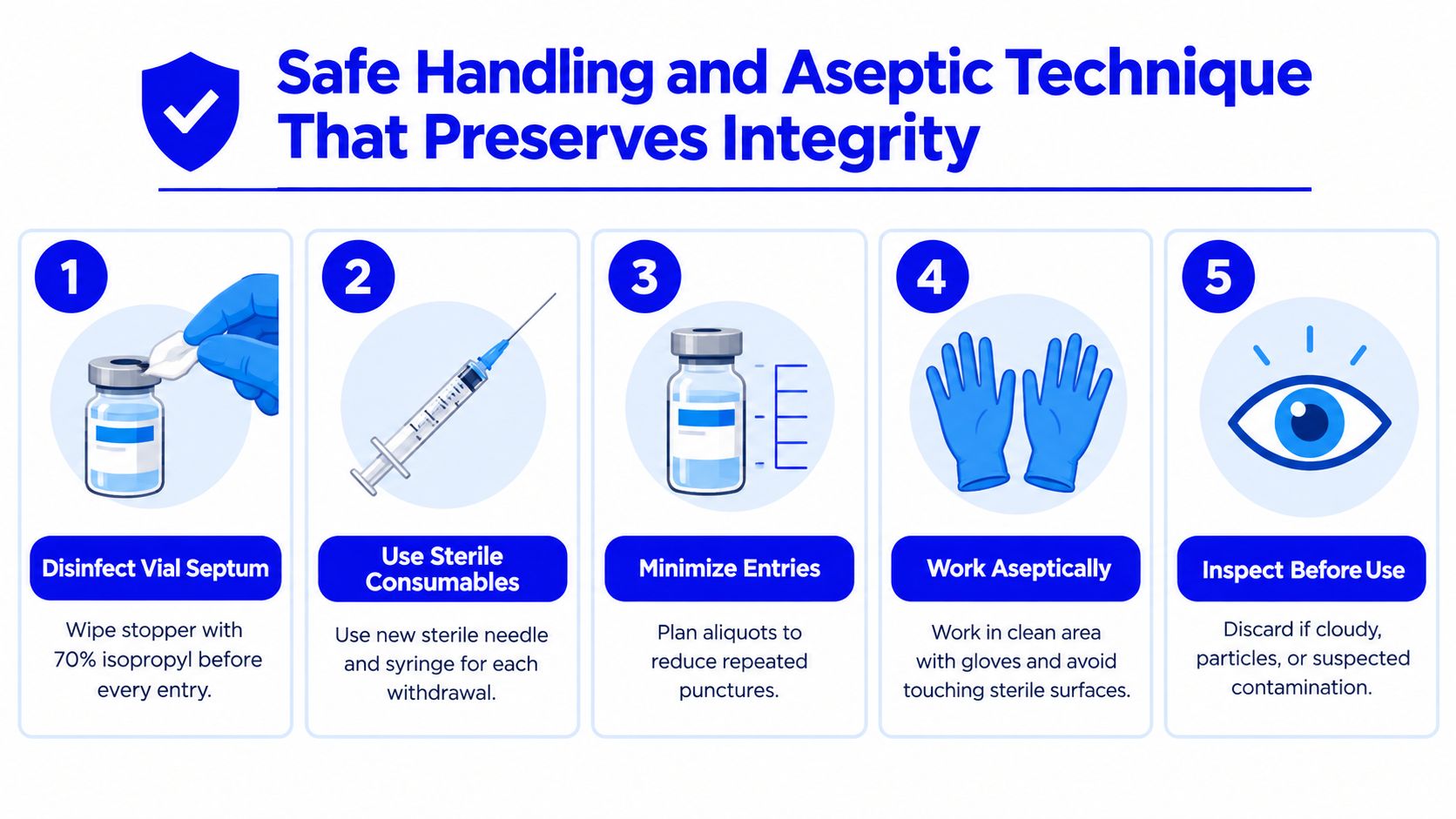
Core safety principle: A bacteriostatic preservative can slow microbial growth. It cannot sterilize a contaminated vial, correct a compromised stopper, or replace aseptic technique.
The age and intended population also matter. FDA labeling warns that benzyl alcohol has been associated with neonatal toxicity, so bacteriostatic sodium chloride shouldn't be used in neonates or young infants. The DailyMed product information documents that limitation.
Research-use-only status doesn't erase chemical or handling hazards. A laboratory should keep the product segregated from clinical materials, label it clearly, train operators on vial access, and escalate any uncertain exposure or compatibility question to the responsible scientific or safety professional. Teams comparing preserved diluents can also review practical handling guidance for bacteriostatic water, while keeping the specific product label in control.
Storage Shelf Life and In Use Stability You Can Trust
A sealed vial and an opened vial have different management questions. The manufacturer's expiry date governs the unopened product, while the 28-day in-use framework commonly governs a multi-dose vial after first puncture unless the product-specific label says otherwise.
The distinction prevents a common recordkeeping error. A vial can remain within its printed expiry period and still pass the permitted in-use window. Conversely, a newly opened vial can't be treated as acceptable if the stopper, container, solution, or storage history is compromised.
A simple storage record
The lab's receiving and usage records should capture:
- Unopened status: Store sealed vials according to the product label and keep them protected from conditions that could affect container or solution integrity.
- First-entry date: Mark the date of first puncture directly on the vial or in the approved electronic record.
- In-use deadline: Calculate the applicable discard date from the product documentation and laboratory policy.
- Condition checks: Inspect the solution and container before each planned use.
- Disposition: Discard the vial at expiry, at the end of the permitted in-use period, or immediately after suspected contamination.
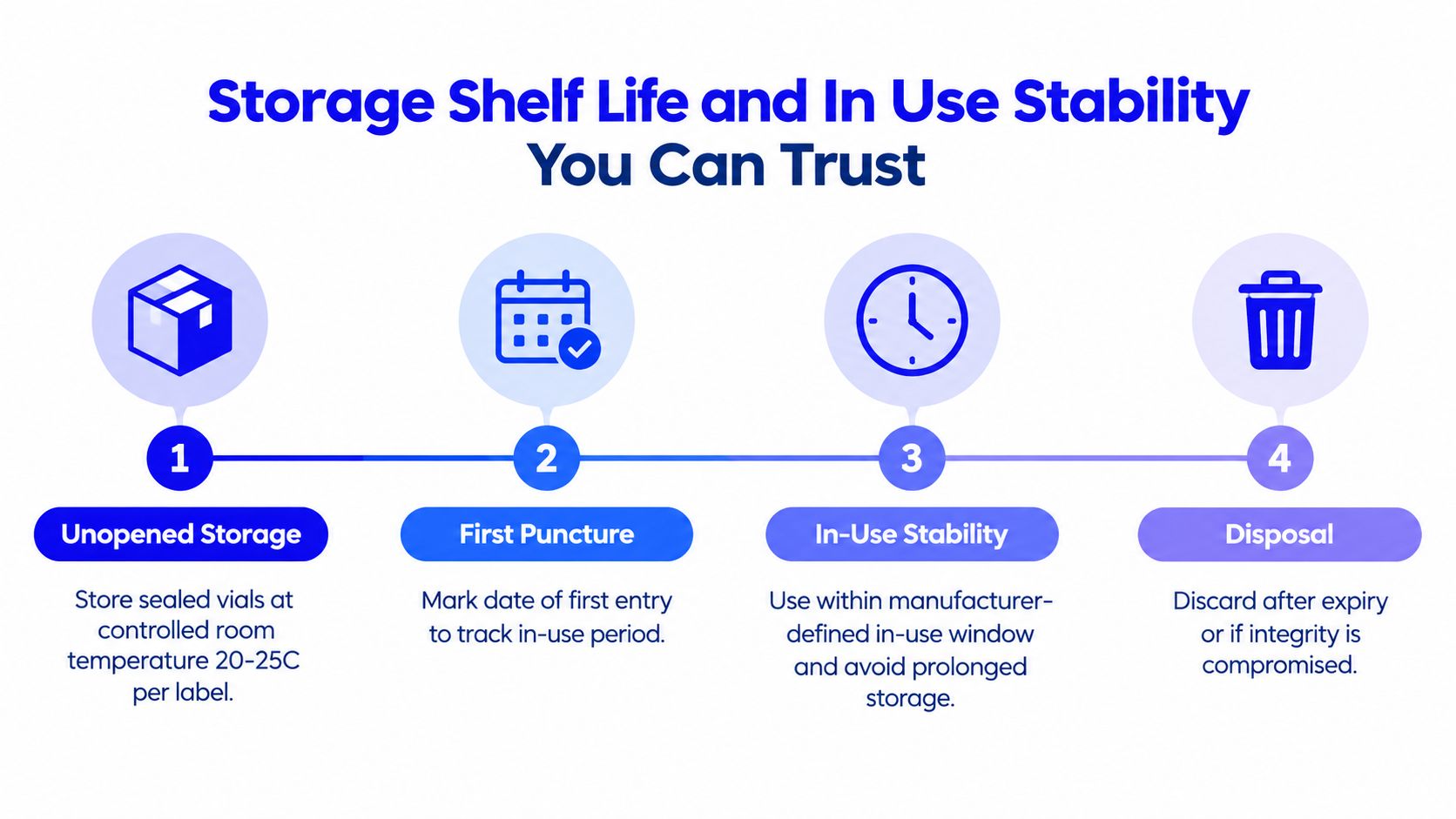
Temperature-controlled storage supports consistency, but the actual storage range must come from the label or supplier documentation. A laboratory shouldn't infer a storage instruction from another diluent, even if the containers look similar. Glass vial integrity, closure condition, filtration history, and pH information can support product evaluation, but none overrides the stated expiry or discard requirements.
The same logic applies to other preserved diluents. A team reviewing bacteriostatic water should apply the product-specific in-use instruction rather than transfer assumptions from bacteriostatic saline. The preservative system, container, labeling, and intended use all matter.
A visible change deserves a conservative response. Cloudiness, particles, leakage, a damaged stopper, or uncertainty about unauthorized access should trigger quarantine and review. The cost of discarding one questionable vial is easier to manage than losing confidence in a preparation used across several experiments.
Buying Guide for Labs and Resellers Seeking Reliable Supply
Procurement quality starts before the shipment arrives. A research organization, independent lab, or reseller should evaluate the formulation, documentation, manufacturing controls, and logistics as one system. A low-friction purchase that lacks lot traceability can create more work during release review and investigation.
Documentation should follow the lot
A supplier should provide or make available a lot-specific Certificate of Analysis and a clear quality review process. The document should identify the product, lot, relevant specifications, release status, and any applicable testing information. Generic marketing language can't replace a record tied to the actual vial batch.
Manufacturing credentials also deserve verification. For example, Herbilabs describes bacteriostatic and reconstitution solutions for RUO workflows, supplies 3 mL, 10 mL, 20 mL, and 30 mL vial formats, and states that its operations include ISO 13485:2016, GMP certification, and procedures operated under ISO 9001:2016. Those claims should be assessed alongside the supplier's current documentation, product label, and quality agreement.
A practical supplier checklist
- Formulation match: Confirm the sodium chloride concentration, benzyl alcohol presence, intended use, and preservative restrictions.
- Container format: Select a vial size and pack configuration that match the laboratory's withdrawal pattern.
- Traceability: Record supplier, lot, expiry, receipt condition, and storage location.
- Release evidence: Request the lot-specific COA and verify that QA review is completed before use.
- Fulfillment planning: Check dispatch timing, temperature-controlled handling where applicable, and distribution coverage for the laboratory's location.
- Commercial fit: Resellers should clarify private-label, white-label, wholesale, labeling, and recordkeeping requirements before committing to supply.
A procurement file should connect the purchased vial to the experimental record. That connection allows a lab to identify which lot entered a preparation, which operator accessed it, and whether storage or handling concerns affected the result.
Herbilabs offers sterile diluent and reconstitution solutions for RUO applications, with multi-dose vial formats, lot-specific COAs, QA review, and distribution serving the EU, UK, and USA. Labs and resellers can review the available documentation and formats by visiting Herbilabs, then compare those records with their protocol and internal procurement requirements.