Private Label, White Label, Wholesale partnerships available - EU, USA and UK - Free shipping from €75
Anti Bacterial Water: What Labs Actually Use
“Anti bacterial water” isn't a standard product name; in lab catalogues, it almost always means bacteriostatic water, sterile water containing 0.9% benzyl alcohol as a preservative. That preservative helps limit bacterial growth after repeated access, but it doesn't sterilize a vial or replace aseptic handling.
The costly mix-up is choosing a product because its name sounds right, then using it for a task it wasn't designed for. Bacteriostatic water, preservative-free sterile water, antiseptics, and consumer drinking-water filters aren't interchangeable. The label and the intended use matter more than the search phrase.
Table of Contents
- Four Waters Hiding Behind the Anti Bacterial Label
- Why Bacteriostatic Water Contains a Preservative
- Matching the Water to Your Lab Task
- How to Reconstitute Lyophilized Reagents Step by Step
- Storage, Dating and When to Discard Vials
- Buying Research Use Only Water Without Gaps
Four Waters Hiding Behind the Anti Bacterial Label
“Anti bacterial water” isn't a standard product name. In lab listings, the phrase most often points to bacteriostatic water, but search results can also lead to sterile water, antiseptic solutions, or consumer drinking-water products. Treating those as the same thing can lead to an unsuitable diluent, a damaged reagent, or a false sense of protection.
The quick check is to identify the product by its contents and intended use before adding it to an order or protocol.
Which water or antiseptic is which
| Type | Antimicrobial agent | Typical lab use | Multi-dose access |
|---|---|---|---|
| Bacteriostatic water | 0.9% benzyl alcohol (9 mg/mL) | Diluent for reconstituting lyophilized reagents | Yes, subject to product instructions and handling limits |
| Sterile water, preservative-free | None | Single-use diluent where no added agent is acceptable | No, use once and discard |
| Antiseptic solutions, such as 70% isopropyl alcohol or chlorhexidine | Antiseptic active ingredient | Skin or surface disinfection when approved by the relevant procedure | Not as a reconstitution diluent |
| Consumer “antibacterial” drinking water | Silver ions or antimicrobial filter media | Household filters and pitchers | Not applicable; not a laboratory reagent |
The table is the quick check to run before an order or protocol is written. A product's marketing phrase doesn't establish that it's suitable for a reagent, nor does it tell the lab how the product should be handled.
Practical rule: A diluent is for preparing a solution, an antiseptic is for skin or surfaces, and a filter additive isn't a lab reagent.
Why Bacteriostatic Water Contains a Preservative
Benzyl alcohol works like a doorway monitor who slows a crowd: it helps inhibit bacterial growth after the stopper has been punctured, while entry and technique still decide what reaches the vial. That is why the label “anti bacterial water” misleads people. The preservative is a brake on growth, and the costly errors start when a lab treats that brake as permission to skip aseptic handling.
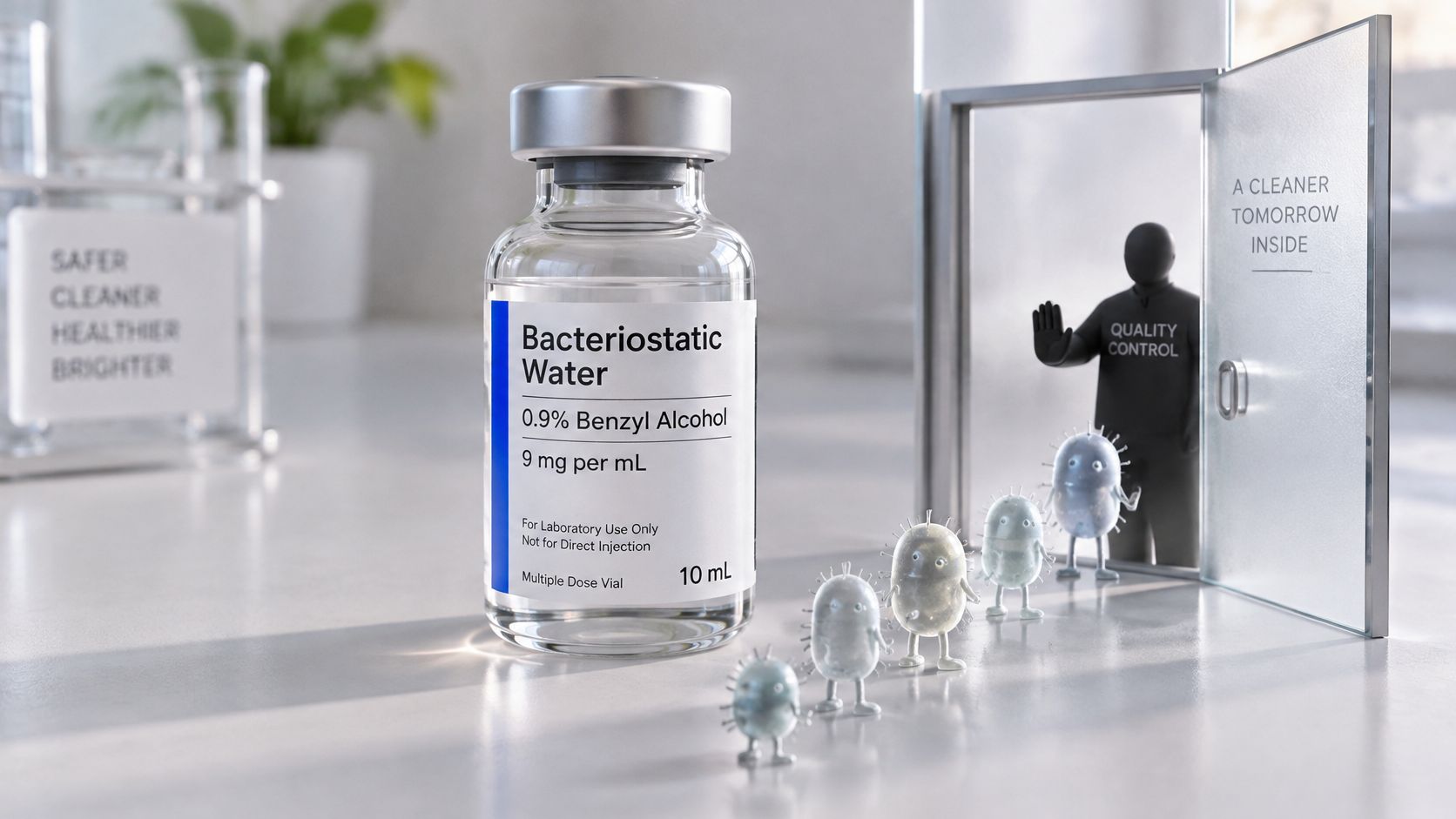
For a 0.9% formulation, each millilitre contains 9 mg of benzyl alcohol. As an example, a 10 mL vial contains approximately 90 mg, and a 30 mL vial contains approximately 270 mg. Check the specific vial and its documentation rather than assuming a concentration from the category name.
What the preservative does and doesn't do
“Bacteriostatic” means growth is inhibited under the labeled conditions. CDC injection-safety guidance describes the same boundary for multidose vials: preservatives help limit bacterial growth, they do not eliminate contamination risk, and they do not protect against viruses. Clean technique remains the control that keeps a reconstituted reagent usable.
The practical sequence stays fixed. Disinfect the septum, use a new sterile needle and syringe for each withdrawal, and discard any vial with suspected contamination or uncertain sterility. Benzyl alcohol cannot rescue a vial that already contains contaminants.
Product labeling for benzyl alcohol-preserved diluents also warns against use in neonates, so age and patient-population limits belong in the check alongside concentration.
The rule for the bench is narrow: bacteriostatic water slows bacterial growth after access. Preservative-free sterile water starts without an antimicrobial preservative to slow growth.
Matching the Water to Your Lab Task
The diluent should match the task, not the other way round. A researcher choosing a solution for repeated withdrawals has a different need from someone preparing a single-use dilution or doing cell-based work. Before ordering, the lab should confirm that the selected water fits both the reagent and the procedure.
| Lab task | Suitable choice | Why |
|---|---|---|
| Reconstituting a peptide or protein for repeated withdrawals within the product's permitted in-use period | Bacteriostatic water, 0.9% | The preservative slows bacterial growth between punctures |
| Single-use dilution where benzyl alcohol could interfere | Preservative-free sterile water | No added agent that could affect the result |
| Cell culture media or cell-based work | Preservative-free sterile water validated for cell culture | Benzyl alcohol can be toxic to cells |
| Bench or hand disinfection | 70% isopropyl alcohol or an SOP-approved disinfectant | Water products aren't biocides |
| Reagent with unknown benzyl alcohol compatibility | Preservative-free sterile water until checked | Compatibility must be confirmed from reagent data |
For a peptide or protein, the data sheet should identify a suitable diluent and any compatibility restrictions. If benzyl alcohol could interfere with the reagent or the assay, the preservative-free option is the more appropriate starting point, provided it also meets the protocol's requirements. Labs comparing diluents can compare sterile water and normal saline, but the reagent instructions and validated procedure should determine the final choice.
Three questions before preparation
- Could the reagent be sensitive to benzyl alcohol, or is the work cell-based? If yes, choose preservative-free sterile water that's appropriate for the application.
- Will the vial be accessed repeatedly within its permitted in-use period? If yes, bacteriostatic water may be appropriate if the reagent data confirms compatibility. Start a dated access log when the vial is first punctured.
- Are there a written SOP and documentation for the lot? If either is missing, pause before ordering or using the product. The lab needs a defined procedure and records that identify the material being used.
The protocol should state the water type, vial format, first-puncture rule, and discard date. The water type doesn't determine the volume to add or the target concentration. Those come from the reagent's stated preparation instructions, and the lab remains responsible for maintaining its protocol and audit trail.
How to Reconstitute Lyophilized Reagents Step by Step
Reconstitution means dissolving a freeze-dried reagent in a diluent to reach a working concentration. Many avoidable errors happen at the stopper and needle, where handling can introduce contamination or compromise the preparation.
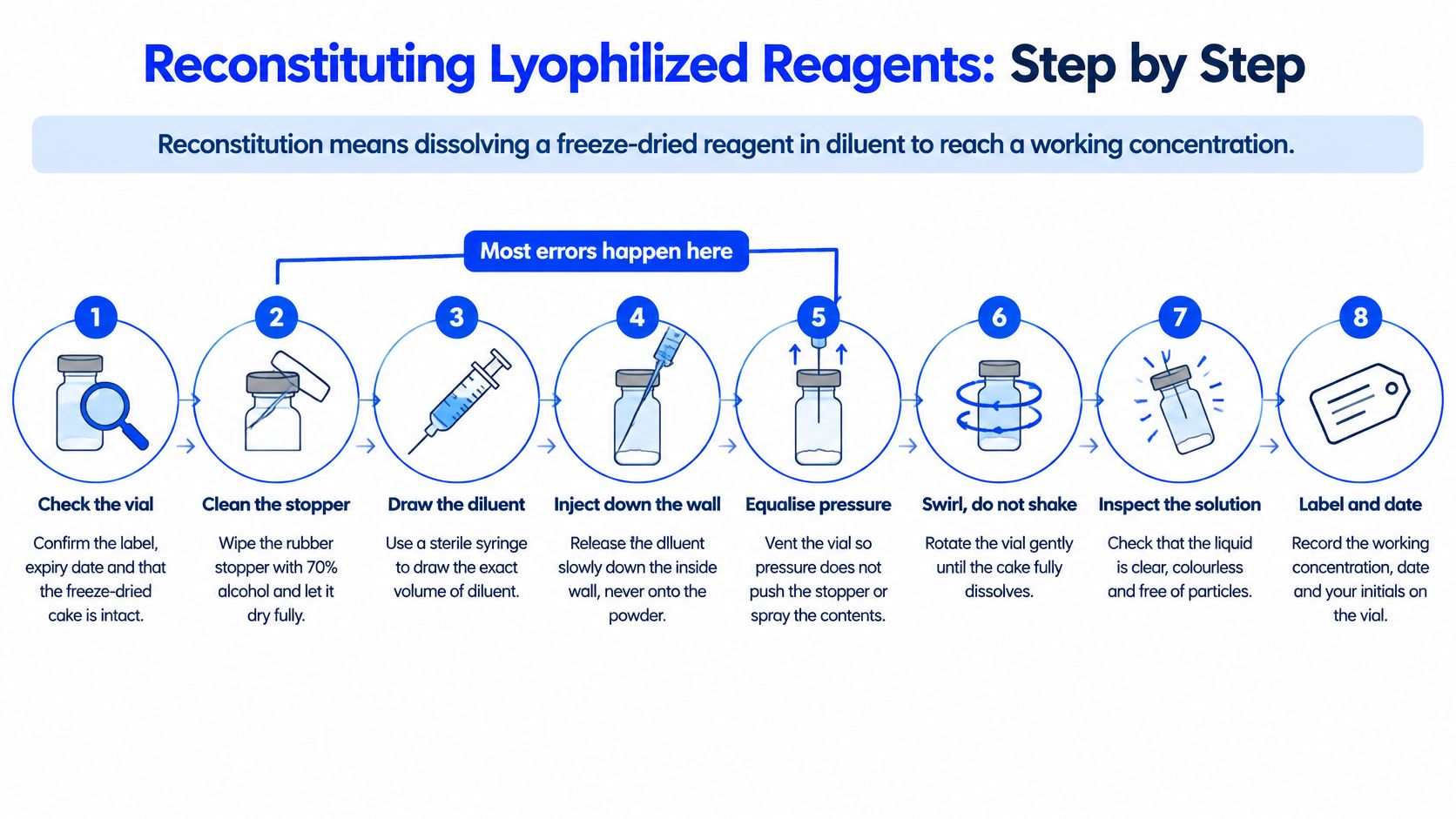
- Check the reagent data sheet. Confirm the recommended diluent and verify whether benzyl alcohol is compatible. Don't choose a water based only on the word “antibacterial” in a search result.
- Check the diluent vial and its documents. Confirm the label, lot number, certificate of analysis, and field for recording the first-puncture date. A mismatch between the vial and paperwork needs to be resolved before use.
- Bring the materials to the specified temperature. Follow the reagent sheet for both the vial and diluent. Avoid assuming that room temperature is suitable for every reagent.
- Disinfect the rubber stopper. Wipe it with 70% isopropyl alcohol and allow it to dry fully. Puncturing a wet or untouched stopper undermines the clean-access procedure.
- Draw the calculated volume. Use a new sterile needle and syringe. The volume should come from the reagent's preparation instructions, not from the vial size.
- Inject slowly down the inside wall of the vial. Avoid directing the stream onto the lyophilized powder, which can disturb the cake or create foam. Follow the product-specific instructions if they differ.
- Swirl or roll gently. Don't shake the vial. Gentle movement helps dissolve the material without the unnecessary agitation that can foam a solution or harm sensitive proteins.
- Inspect the solution. Check that it's clear and free of visible particles before use. If its appearance is unexpected, stop and follow the lab's procedure for investigating or discarding it.
- Label and store the vial. Record the reagent name, concentration, reconstitution date, and discard date, then follow the reagent sheet's storage instructions. An unlabelled vial can't be reliably tracked or audited.
For a visual reminder of these actions, use the reconstitution procedure infographic as a prompt, not a substitute for the reagent sheet or SOP.
The recurring slips are straightforward: shaking can cause foaming and may damage sensitive material, while an unlabelled vial is a serious traceability failure. The person preparing the reagent should check the solution and complete its label before it enters the workflow.
Storage, Dating and When to Discard Vials
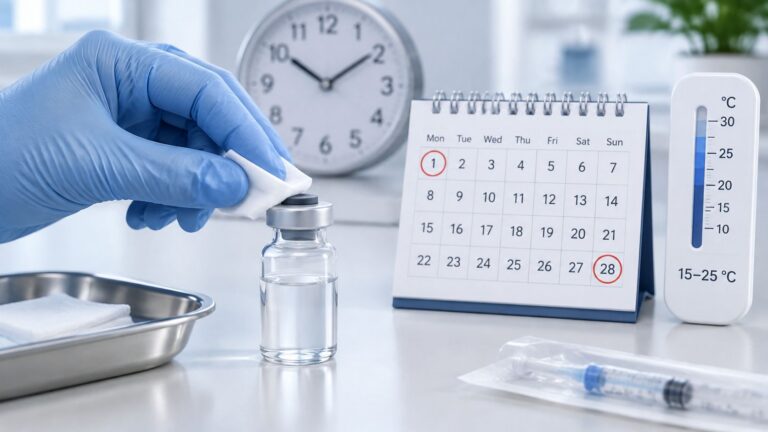
A date written on a vial is easy to misread. The commonly used 28-day period for an opened multidose vial is a handling limit: it caps how long repeated punctures are acceptable, assuming correct storage and a clean withdrawal every time. As noted earlier, CDC guidance recommends dating a multidose vial at first opening and discarding it within that period unless the manufacturer specifies a different period. Discard sooner whenever sterility is compromised or cannot be confirmed, and never let a beyond-use date run past the manufacturer's expiration date.
| Stage | Storage | Time limit |
|---|---|---|
| Unopened sealed vial | As the label states, with required temperature control | Manufacturer expiry date |
| Opened multidose vial after first puncture | Closed and stored as the label specifies | Discard within 28 days unless the manufacturer specifies otherwise |
| Vial where sterility is compromised or cannot be confirmed | Don't reuse | Discard immediately |
| Reconstituted reagent | As the reagent data sheet specifies | Follow validated reagent stability data, never beyond the vial's expiry |
Refrigeration doesn't reset the clock. Cooling a vial cannot extend its handling period, repair a compromised stopper, or override the manufacturer's instructions. The preservative works like a speed limit on bacterial growth: it slows what slips in, it cannot remove contamination that already entered. Aseptic technique still decides whether the contents stay usable.
Discard a vial if any of these apply:
- Cloudiness or particles: The solution looks cloudy or contains visible material.
- Unexpected colour change: Its appearance no longer matches the product or reagent instructions.
- Unknown access date: No reliable record shows when the vial was first punctured.
- Possible contamination: A needle touched a non-sterile surface before entering the vial.
- Damaged closure: The stopper appears damaged or container integrity is uncertain.
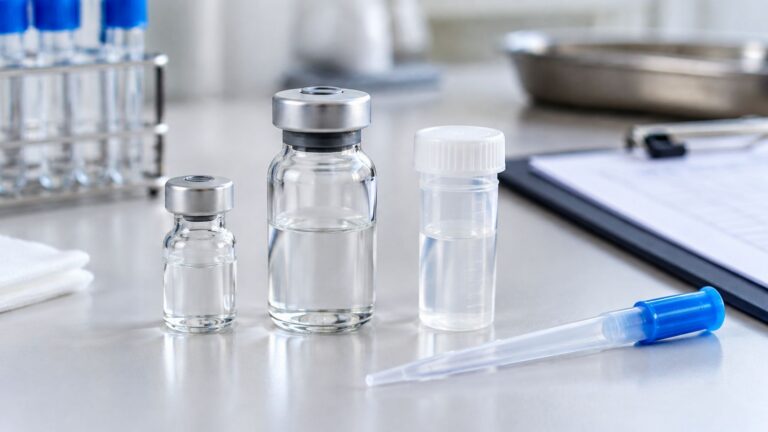
Put a dated label on each vial, keep an access log, and use a new sterile syringe and needle for every withdrawal. Larger 10 mL or 30 mL formats reduce repeat procurement, though that benefit holds only when access dates are documented. Labs reviewing opened stock can check guidance on how long bacteriostatic water remains usable, while still following the specific product label.
Buying Research Use Only Water Without Gaps
A purchasing check should establish what the product is, whether its documentation matches the vial, and whether the supply route fits the lab's procedures. Buyers in research organisations, independent labs, and reseller businesses can verify these items before accepting a supplier's product description.
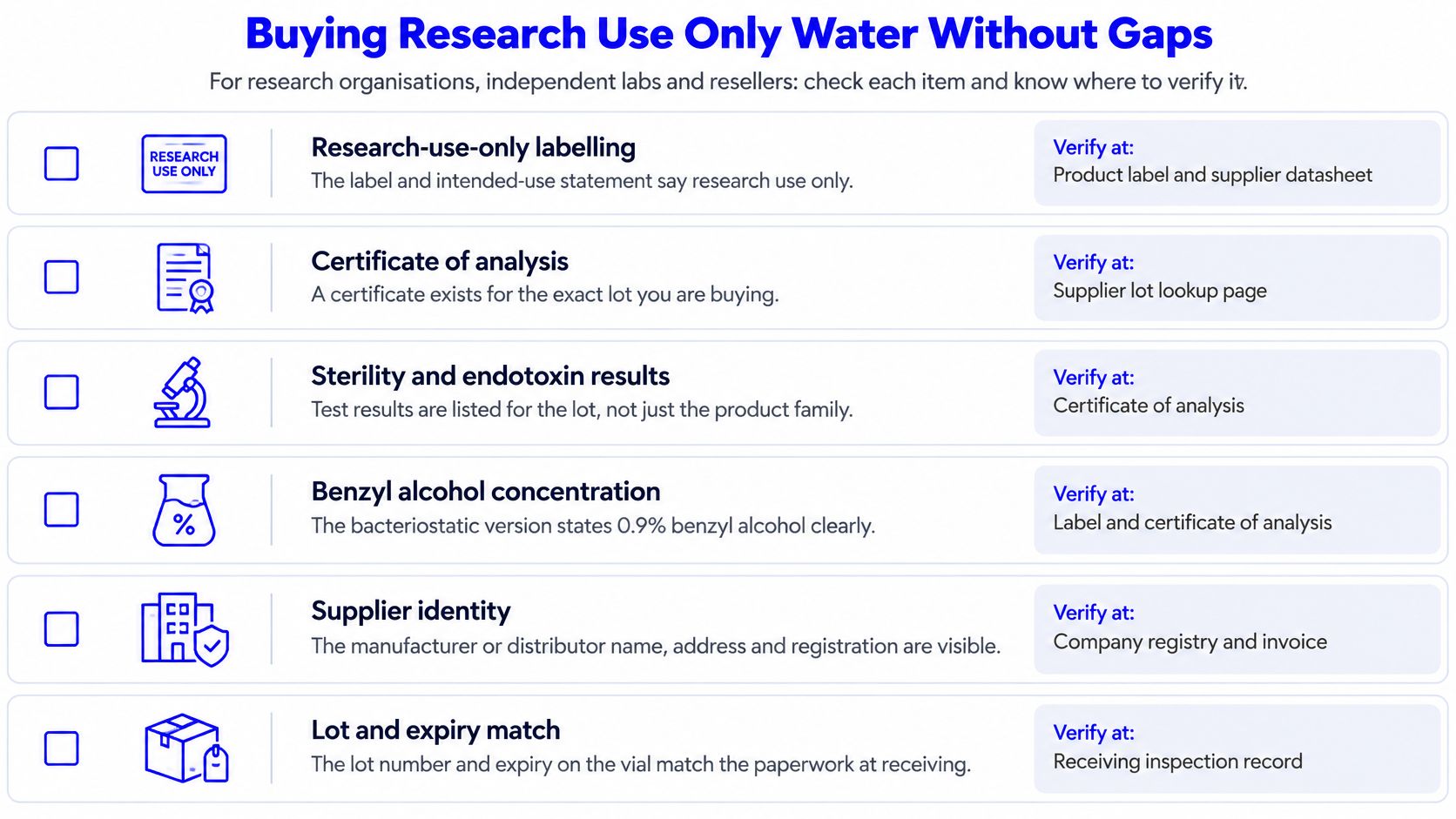
- Research-use-only status: Confirm the label and intended-use statement identify research use and don't present the product for human injection.
- Preservative concentration: Check that the benzyl alcohol concentration is stated on the vial label and certificate of analysis. Don't infer it from the product category.
- Lot-specific certificate: Match the certificate's lot number to the vial and confirm that quality assurance released that specific lot.
- Sterility and non-pyrogenic claims: Review the lot documentation for the claims and any stated filtration method, such as 0.22 µm.
- Format and cost per millilitre: Compare the vial sizes and multipacks to the lab's workflow. Herbilabs offers research-use-only bacteriostatic water in multiple vial formats and provides lot-specific certificates of analysis; buyers should request the certificate for the exact lot before ordering because it's the traceable record, not dispatch speed.
- Storage and shipping: Check the supplier's stated storage conditions and temperature controls for shipping and fulfillment.
- Quality-system credentials: Verify claims such as ISO 13485:2016, GMP, or ISO 9001:2016 against a certificate or registry record rather than relying on a homepage statement.
- Distribution and customs: For shipments across the EU, UK, and USA, confirm who handles distribution and any customs responsibilities.
For procurement, it can also help to review sterile water vial formats and storage alongside the lab's handling and documentation requirements.
The global bacteriostatic water-for-injection market was estimated at USD 1,207.42 million in 2024, according to Market Research Future's market coverage. That market estimate doesn't establish whether a particular product or lot suits a laboratory task; the label, compatibility information, and lot documentation remain the practical checks.
Herbilabs offers research-use-only bacteriostatic water and reconstitution solutions in several vial formats, with lot-specific certificates of analysis for documentation. Review the product details and request the certificate for the intended lot when you visit Herbilabs.