Private Label, White Label, Wholesale partnerships available - EU, USA and UK - Free shipping from €75

5 mL Sterile Vials: Formats, Compatibility, and Handling
A researcher has a lyophilized peptide on the bench, a sterile diluent ready, and one practical decision left: should the material go into a 3 mL or 5 mL sterile vial? The answer isn't determined by capacity alone. The vial must match the reconstitution volume, withdrawal pattern, closure system, storage plan, and product labeling.
A 5 mL sterile vial is a compact pharmaceutical container designed around that complete workflow. Its glass body, elastomeric stopper, aluminum seal, headspace, and container-closure integrity all contribute to safe handling. The most important distinction is simple: a vial's physical size doesn't tell a researcher whether it can be accessed repeatedly. Labeling, preservative content, and validated use instructions do.
Table of Contents
- Why 5 mL Sterile Vials Matter in the Lab
- How the 5 mL Format Became a Standard
- Anatomy of a 5 mL Sterile Vial
- Single-Dose vs Multi-Dose 5 mL Vials
- Using 5 mL Vials for Peptide and Small-Volume Reconstitution
- Aseptic Handling and Storage Best Practices
- Common Misconceptions When Buying 5 mL Sterile Vials
- Choosing the Right 5 mL Vial for Your Workflow
Why 5 mL Sterile Vials Matter in the Lab
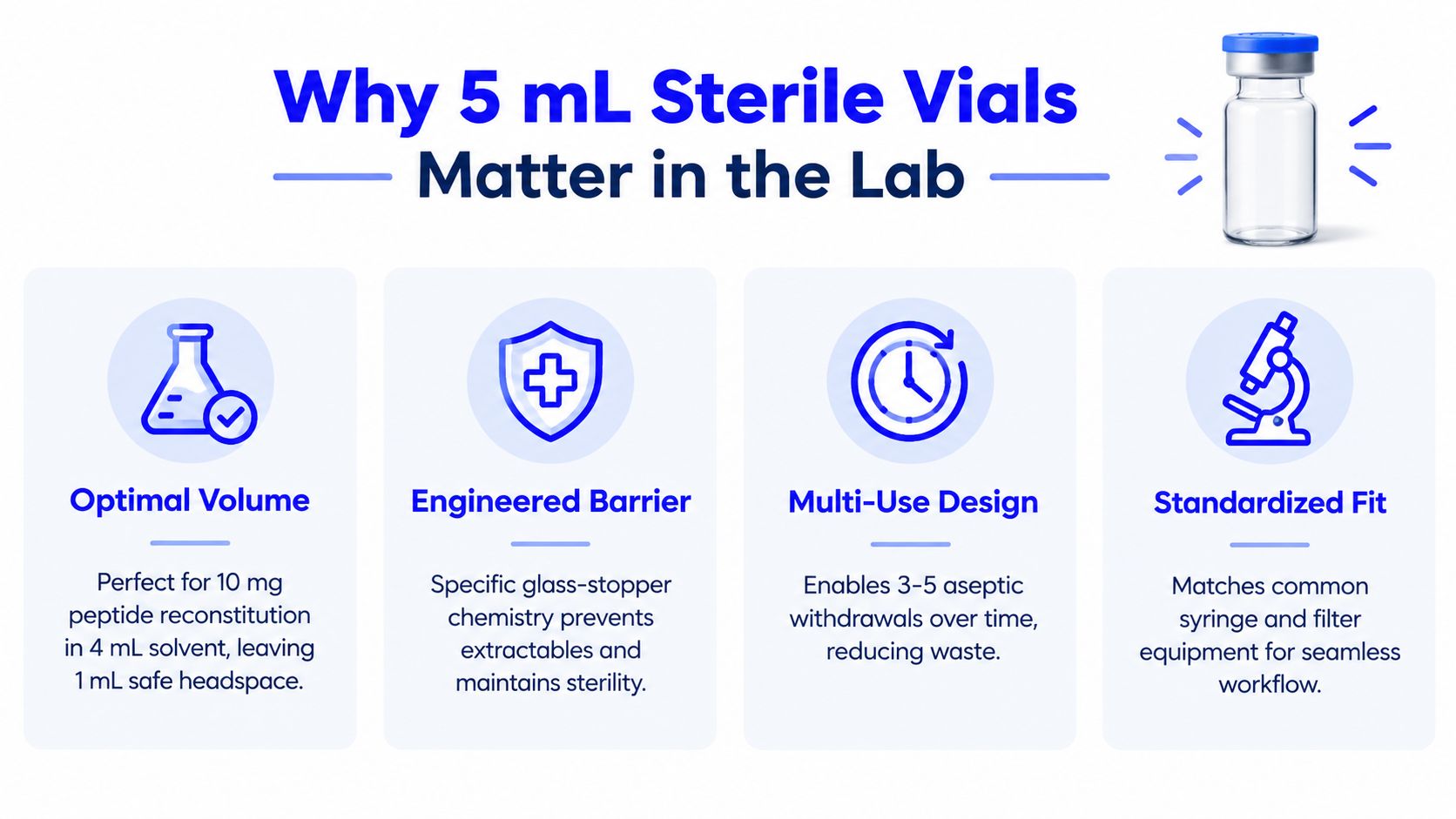
Consider a bench scientist preparing a 10 mg lyophilized peptide. A smaller vial might hold the reconstituted material, but a 5 mL format can provide practical room for diluent, mixing, needle access, and controlled handling without turning the container into an unnecessarily large reservoir. The format is therefore an engineering choice, not a small bottle selected from a catalogue.
The nominal volume helps organize the workflow, but the actual internal geometry matters just as much. A vial needs enough room for the liquid and an air gap above it. That headspace supports pressure equilibration and gives the needle a workable entry path, while the compact body helps limit unnecessary residual volume and material exposure.
The format reflects a complete system
The FDA DailyMed record for a marketed sterile water product identifies a 5 mL single-dose vial, packaged 25 per tray, with a marketing start date of 09/30/1990. The label describes the product as sterile and nonpyrogenic, with no antimicrobial added, and intended for use as a drug diluent. That long-established listing shows how the format became embedded in parenteral preparation and distribution workflows. FDA DailyMed records provide the product and packaging context.
A researcher choosing among 5 mL sterile vials should therefore ask four questions:
- What is the labeled dose format? A single-dose vial isn't automatically suitable for repeated access.
- What stopper material is specified? Butyl, bromobutyl, and chlorobutyl formulations have different qualification requirements.
- What is the intended storage and in-use period? The formulation and label control this, not the vial volume.
- Has the complete closure system been tested? Glass alone can't guarantee sterility after filling and sealing.
Practical rule: Treat the vial, stopper, and crimp seal as one controlled package. The 5 mL label describes capacity, not permission for repeated withdrawals.
How the 5 mL Format Became a Standard
The 5 mL format endured because pharmaceutical packaging works as an ecosystem. Glass manufacturers, stopper suppliers, crimping equipment makers, filling lines, sterilization processes, and laboratory users all benefit when container dimensions and closure components remain compatible. A format that fits established equipment is easier to source, inspect, fill, seal, transport, and replace.
FDA DailyMed documentation provides a historical example. The sterile water listing identifies a 5 mL single-dose vial and a 25-vial tray configuration, demonstrating that the format has supported commercial sterile supply chains for decades. Current supplier descriptions connect the same nominal volume with Type I borosilicate glass, sterile packaging, endotoxin controls, and cleanroom assembly. One listing describes a 5 mL vial with a 7 mL brimful capacity and a 10 g weight, while another describes sterile tray packaging and ISO-classified cleanroom assembly. Those specifications show the distinction between nominal fill volume and the container's total physical capacity. Current sterile vial product descriptions illustrate how the category is specified today.
A buyer researching practical container choices can also consult the Peptide Warehouse USA vial guide, particularly when comparing glass vial formats for research workflows. The useful lesson is that nominal size should be evaluated alongside closure dimensions, material compatibility, and intended access pattern.
Standards governing the 5 mL sterile vial format
| Standard or reference | Scope | Why it matters for 5 mL vials |
|---|---|---|
| FDA DailyMed labeling | Product identity, dose presentation, packaging, and intended use | Confirms whether a vial is single-dose, a diluent, sterile, or nonpyrogenic |
| USP <71> | Sterility testing | Supports release testing for sterile products |
| USP <85> | Bacterial endotoxins | Addresses endotoxin control for products used in parenteral workflows |
| USP <788> | Particulate matter | Helps control visible and subvisible particulate risk |
| Type I borosilicate specifications | Glass chemistry and container suitability | Supports low hydrolytic interaction for injectable and reconstitution products |
| Container-closure qualification | Seal performance over the labeled shelf life | Connects the vial body, stopper, and crimp seal into one barrier system |
The standardization is practical rather than accidental. A 5 mL vial can move through familiar procurement and fill-finish channels because the surrounding industry already recognizes its dimensions, closure options, and quality expectations.
Anatomy of a 5 mL Sterile Vial
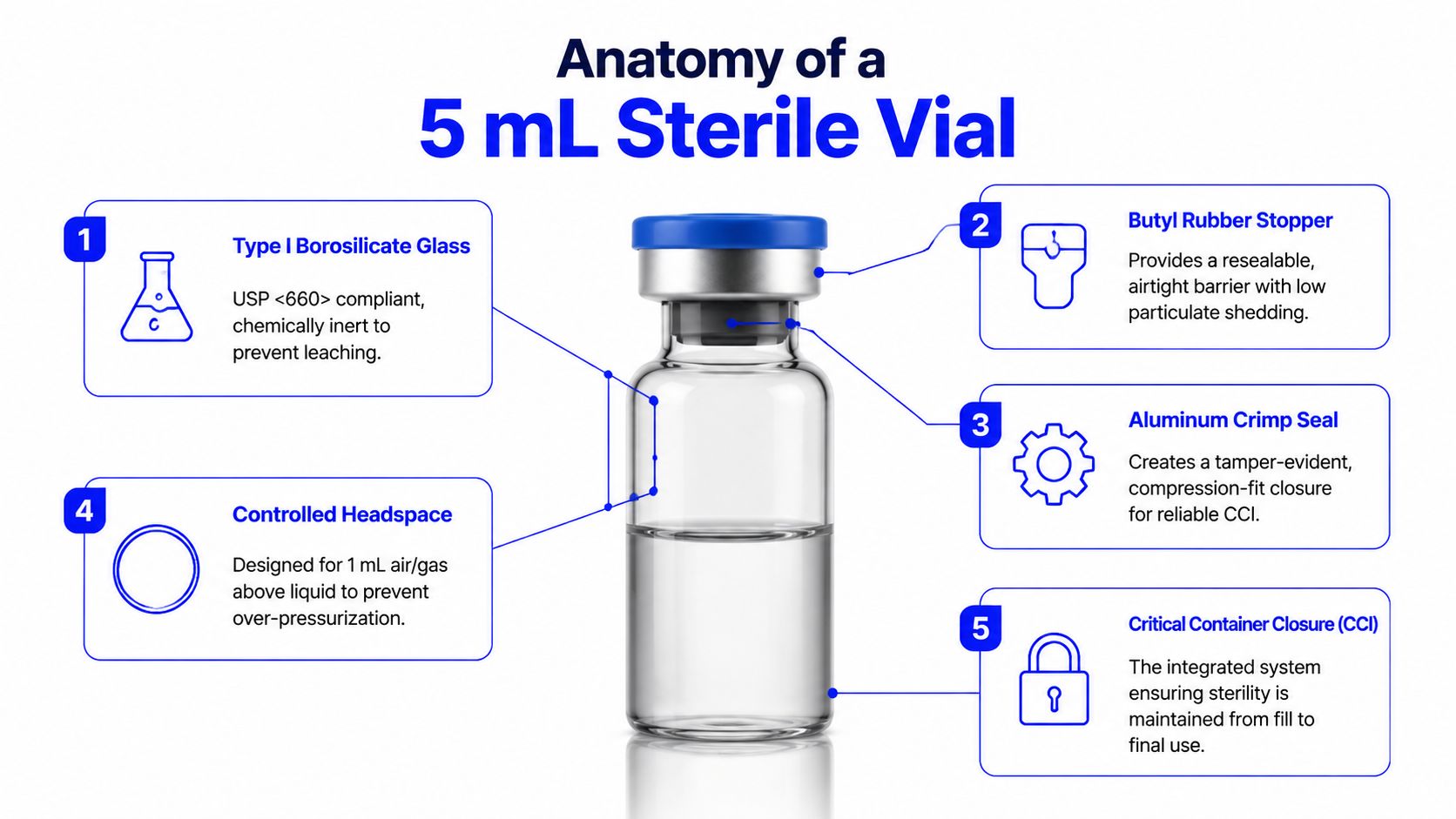
A sterile vial looks simple from the outside, but five connected features determine whether it protects its contents. The glass body provides the primary container. The stopper and crimp seal create the closure. The headspace gives the fill room to behave correctly. Container-closure integrity, or CCI, evaluates the finished system rather than one component in isolation.
Five parts that control performance
Type I borosilicate glass body. Type I glass is selected for its chemical durability and suitability for injectable or reconstitution products. It helps reduce concerns about hydrolytic interaction and extractables compared with less suitable container materials. Commercial descriptions of sterile 5 mL vials commonly identify Type I borosilicate glass and reference USP sterility, endotoxin, and particulate expectations. A sterile 5 mL glass vial specification provides an example of this category.
Neck and crimp finish. The neck accepts the stopper and seal. Common pharmaceutical finishes use standardized tooling, allowing the filling line and crimping equipment to apply consistent compression.
Butyl or bromobutyl stopper. The elastomer closes the vial after needle access and helps limit gas exchange and particulate shedding. The exact formulation must be qualified for the drug, diluent, sterilization process, and puncture pattern.
Aluminum crimp seal. The crimp holds the stopper under compression. A flip-off cap protects the access surface and provides a visible indication that the seal has been opened.
Headspace and CCI. Headspace is the air or gas above the liquid. CCI is the leak-tight performance of the complete vial system, protecting against microbial, gas, and liquid ingress throughout the labeled shelf life. Validated methods can include vacuum decay, helium-based testing, headspace analysis, or high-voltage leak detection, depending on the closure design. Container-closure integrity testing guidance explains why visual inspection alone isn't enough.
The Herbilabs glass injection vial guide can help buyers compare vial construction details before selecting a container for a defined research process. The central point remains constant: a glass body isn't sterile assurance unless the entire closure system has been manufactured and tested appropriately.
Single-Dose vs Multi-Dose 5 mL Vials
A single-dose and multi-dose 5 mL vial can look nearly identical on a laboratory shelf. Their intended use is different, however, and the difference appears in the product label, formulation, stopper qualification, and handling instructions.
A single-dose vial is intended for one preparation or one working session. It may contain no antimicrobial preservative, so the product isn't designed to tolerate repeated entries over an extended period. Once the vial is entered, the contents should be handled according to the label and applicable sterile-use procedures, not saved merely because liquid remains.
A multi-dose vial is specifically labeled for repeated withdrawals. It may contain an antimicrobial preservative, such as benzyl alcohol or metacresol, and its closure system must support the stated access pattern. Preservative presence doesn't eliminate contamination risk. It only forms part of a validated product and handling strategy.
Public injection-safety guidance states that single-dose vials shouldn't be saved for later use. It also requires sterile needle-and-syringe access for each entry into a multi-dose vial and calls for disposal when sterility is questionable. CDC injection safety guidance should take precedence over assumptions based on vial size.
| Feature | Single-Dose 5 mL Vial | Multi-Dose 5 mL Vial |
|---|---|---|
| Intended access | One preparation or working session | Repeated withdrawals under labeled conditions |
| Preservative | Often preservative-free, depending on product | May contain an antimicrobial preservative |
| Labeling | Marked or described as single-dose | Explicit multi-dose and in-use instructions |
| Stopper expectation | Qualified for the labeled access pattern | Qualified for repeated puncture and resealing |
| Research implication | Suitable when the full preparation is used promptly | Suitable only when the formulation and label support repeated use |
For a peptide planned for withdrawals across several days, the researcher shouldn't choose a single-dose container because it costs less or looks convenient. The schedule must match the label. Five milliliters describes volume. It doesn't define multi-dose status.
Using 5 mL Vials for Peptide and Small-Volume Reconstitution
Peptide reconstitution begins with a calculation, not a vial purchase. The researcher needs to know the mass of lyophilized material, the chosen diluent, the target concentration, the planned draw volume, and whether the product is intended for one-time or repeated access.
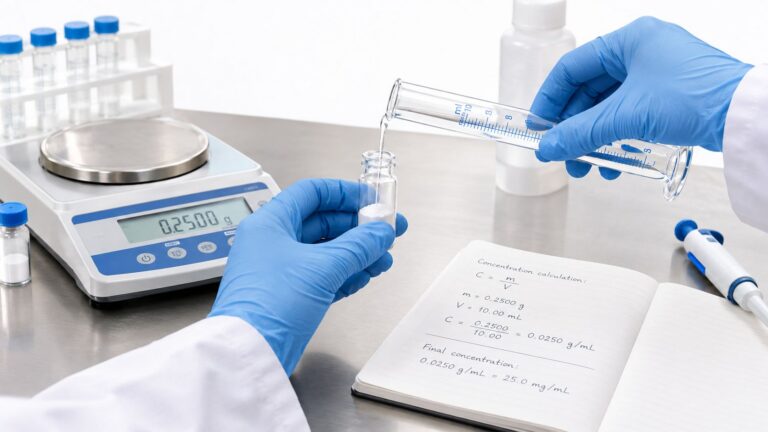
For example, a 5 mg peptide in 3 mL produces approximately 1.67 mg per mL. A planned draw of 0.3 mL would contain approximately 0.5 mg, while a 0.6 mL draw would contain approximately 1 mg. Those figures come directly from the concentration calculation, not from a general property of 5 mL vials. The selected vial still needs enough internal space for the powder, liquid, headspace, and safe needle handling.
Diluent selection changes the workflow
A preservative-free sterile diluent may fit a single-use preparation when the product instructions support that approach. A bacteriostatic diluent containing 0.9% benzyl alcohol may fit a labeled multi-dose workflow, but researchers must confirm compatibility with the peptide or other material. Preservatives can affect sensitive proteins, assays, cell systems, and downstream analytical results.
The DoseRoutine reconstitution help can assist with concentration and draw-volume planning, but the product label and study protocol remain the controlling documents. The bac water guide is also relevant when a research workflow uses a benzyl-alcohol-containing bacteriostatic diluent.
Where the format fits
The same reasoning applies to small-volume biologics, growth-media supplements, analytical standards, and other lyophilized materials. Type I borosilicate glass can support compatibility, while the stopper coating and elastomer formulation influence adsorption, extractables, and puncture performance. No vial material can guarantee that every peptide or protein will remain stable, so the formulation, storage study, and certificate of analysis must guide the final decision.
A useful bench record should include:
- Material identity: Record the peptide, protein, reagent, or standard.
- Reconstitution volume: Document the diluent and calculated concentration.
- Access plan: State whether the preparation is single-use or repeatedly withdrawn.
- Storage condition: Follow the validated product instruction, rather than assuming refrigeration alone establishes stability.
- Discard rule: Apply the labeled in-use period and dispose of the vial if contamination or closure damage is suspected.
Aseptic Handling and Storage Best Practices
Repeated access only works when each withdrawal follows the same controlled sequence. A sterile vial can lose its protective status through a contaminated septum, a reused needle, poor storage, or an unrecorded opening date. The container remains visually unchanged while the microbiological risk changes.
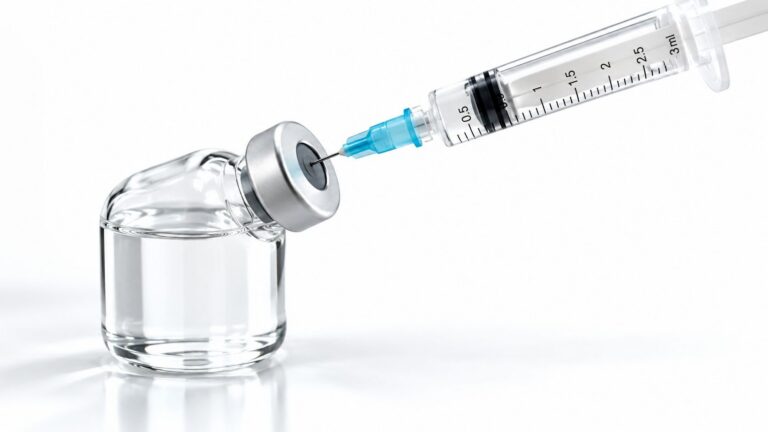
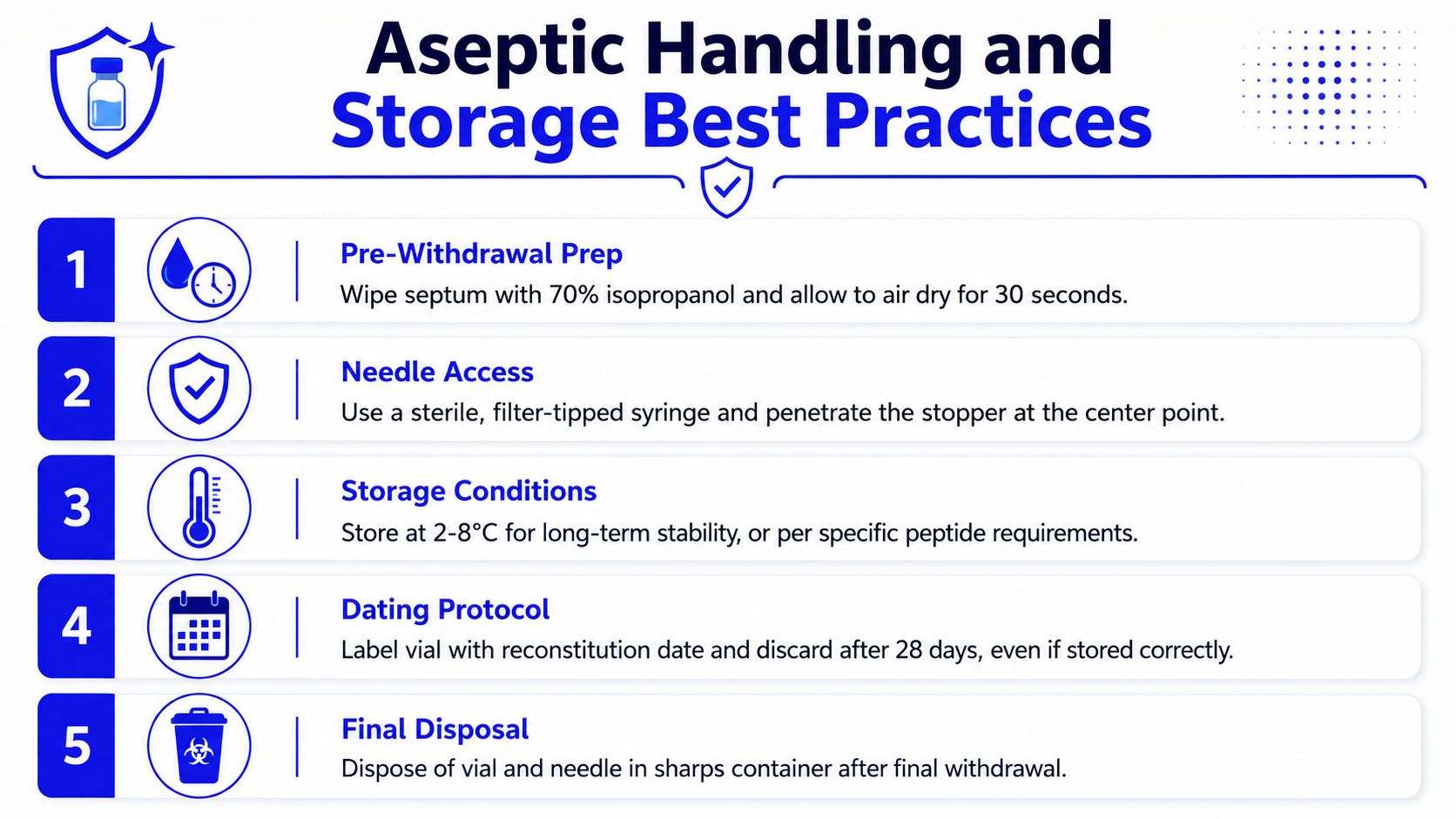
Before every withdrawal, the researcher should inspect the vial and confirm the label, storage condition, and preparation date. The septum should be wiped with 70% isopropyl alcohol and allowed to air-dry before needle entry. A new sterile needle and syringe should be used for every withdrawal, and the needle should enter the stopper without touching surrounding surfaces. The five-step sequence shown below is a useful visual reminder.
A practical handling checklist
- Prepare the access point: Clean the septum and let it dry. Wet alcohol can carry contaminants or interfere with the puncture surface.
- Use fresh sterile equipment: Match syringe capacity and needle selection to the draw, and never return a used needle to the vial.
- Control the environment: Perform access in the validated clean area for the workflow, with the vial and supplies protected from unnecessary movement.
- Record the opening: Mark the reconstitution date, diluent, storage condition, and calculated discard date on the vial or secondary record.
- Inspect before use: Cloudiness, unexpected particles, leakage, a loose crimp, or a damaged stopper warrants disposal and investigation.
Handling principle: A preservative supports a multi-dose design, but it doesn't replace aseptic technique.
After access, the vial should be placed in a labeled secondary container and stored under the conditions specified for the product. Refrigeration may be appropriate for some preparations, but a researcher shouldn't infer stability from temperature alone. Light-sensitive materials may require light protection, and the storage record should distinguish the original product expiry from the shorter in-use period.
Further background on what is sterile technique can help new researchers understand why clean gloves, controlled surfaces, air-drying time, and fresh sterile equipment all matter. For workflows using bacteriostatic water, the diluent's own opening and storage instructions must also be followed.
Common Misconceptions When Buying 5 mL Sterile Vials
Once capacity is separated from use classification, the purchasing questions become clearer. A 5 mL vial may be labeled for single-dose or multi-dose use. The label, formulation, stopper qualification, container-closure integrity (CCI), and validated instructions establish that category.
Careful needle insertion does not convert a preservative-free vial into a multi-dose container. Repeated withdrawals require a product designed and labeled for that access pattern. A preservative also does not make a vial indefinitely reusable. The label still sets handling conditions and the permitted in-use period.
Sterility addresses viable microorganisms, while depyrogenation addresses pyrogenic contamination, including endotoxin risk. Both descriptions may apply to one vial, yet each represents a different control. A buyer should verify the specific documentation rather than infer one property from the other.
Questions buyers should challenge
- Does larger mean safer? No. More internal volume does not extend stability or create a longer in-use period. Formulation data and validated storage conditions control those decisions.
- Is every clear glass vial equivalent? No. Type I borosilicate glass, tubing or molded construction, surface treatment, and closure materials can influence extractables and seal performance.
- Can any stopper support repeated punctures? No. Elastomer composition, coating, hardness, and resealing performance need qualification for the intended access pattern. A peptide vial withdrawn repeatedly has different closure demands from a one-time reconstitution vial.
- Does a crimp seal prove CCI? No. A proper appearance supports visual inspection, but validated leak testing and process controls offer stronger evidence of container integrity.
Autoclave tolerance, gamma compatibility, and sterile presentation also describe different capabilities. The supplier's technical file should identify the sterilization method, packaging configuration, materials, and intended use. The correct SKU is the one whose documented controls match the workflow, not the one with the most familiar volume.
Choosing the Right 5 mL Vial for Your Workflow
A practical selection starts with the access pattern. A one-time peptide dilution needs a sterile container labeled for single-dose use, while a preparation withdrawn repeatedly requires a multi-dose product with appropriate preservative information and closure qualification. The vial should then be screened for glass, stopper, seal, sterilization, and storage compatibility.
A useful purchasing sequence looks like this:
- Define the application. Separate peptide reconstitution, sample storage, analytical standards, and media preparation. Each may impose different extractables, particulate, and stability requirements.
- Set the access frequency. Decide whether the vial will be entered once or repeatedly. Never infer this from 5 mL capacity.
- Confirm the materials. Type I borosilicate glass is a common choice for sterile injectable and reconstitution workflows. Ask whether the elastomer is butyl, bromobutyl, or chlorobutyl and whether it has been qualified with the intended formulation.
- Check the closure. Review the crimp finish, stopper dimensions, flip-off or tear-off presentation, and CCI documentation.
- Match storage and sterilization. Confirm the storage instruction, light protection, and whether the empty vial or finished product is compatible with the lab's sterilization and handling process.
- Request documentation. A lot-specific certificate of analysis, sterility information, endotoxin data, particulate controls, and packaging details can support internal qualification.
| Workflow | Vial type | Stopper | Storage |
|---|---|---|---|
| One-time small-volume reconstitution | Labeled single-dose sterile vial | Qualified butyl or bromobutyl elastomer | Follow the product instruction and use promptly |
| Repeated peptide withdrawals | Labeled multi-dose sterile vial | Resealable elastomer qualified for repeated puncture | Follow validated temperature, light, and in-use instructions |
| Sensitive analytical standard | Sterile vial compatible with the solvent and assay | Low-extractables closure selected for the formulation | Use the stability protocol for the standard |
| Sample or reagent preparation | Sterile format matched to the sample and access method | Closure selected for leak resistance and sampling needs | Store according to the sample or reagent specification |
Herbilabs offers sterile, nonpyrogenic reconstitution solutions in glass multi-dose vial formats for research-use workflows, with lot-specific quality documentation described by the company. That type of product can be evaluated alongside the 5 mL vial itself when the complete reconstitution system, rather than the container alone, is being qualified.
For sterile diluents, glass vial formats, and research-use reconstitution workflows, visit Herbilabs to review available products and documentation. Researchers can compare the diluent format, handling requirements, and quality records against the selected 5 mL sterile vial before placing an order.