Private Label, White Label, Wholesale partnerships available - EU, USA and UK - Free shipping from €75

2ml of Water Explained Weight Drops and Lab Measuring
A small vial sits beside a syringe, and the label calls for 2 mL of water. The volume looks too small to deserve much attention, yet a slightly inaccurate draw can change a working solution, especially when the next step depends on a precise concentration. The same question also appears in kitchens, classrooms, and home laboratories: how much does 2 mL weigh, how many drops is it, and what tool can measure it reliably?
The answer starts under standard conditions, 2 mL of pure water has a mass of about 2 grams, or 2,000 milligrams. That estimate works because water provides a useful metric reference. Applying it in practice requires more care, because household spoons, droppers, and poorly matched syringes don't provide the same level of control. Small-volume work is less about difficult arithmetic and more about choosing a suitable device, reading it correctly, and matching the volume to the intended research use.
Table of Contents
- Understanding 2ml of Water as Volume Weight and Density
- How Many Drops and Teaspoons Are in 2ml of Water
- How to Measure 2ml of Water Accurately in the Lab
- Using 2ml of Water for Reconstitution and Concentration Planning
- Key Takeaways for Handling 2ml of Water in RUO Workflows
Understanding 2ml of Water as Volume Weight and Density
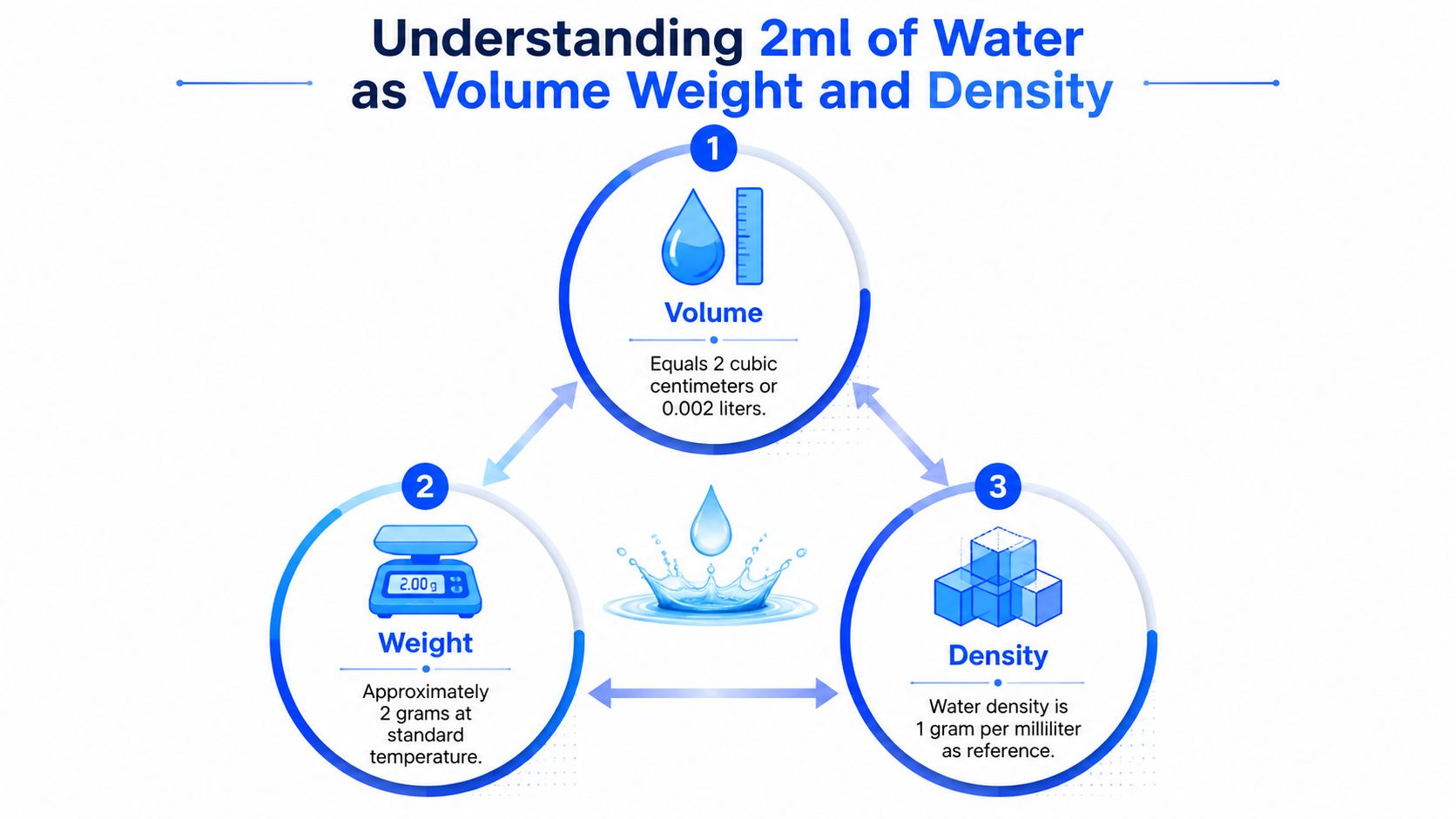
The clearest way to understand 2ml of water is to separate three ideas: volume, density, and mass. Milliliters measure space, grams measure mass, and density connects the two. Water is especially convenient because its density is close to 1 gram per milliliter, with modest temperature-related variation. The University of Illinois chemistry reference describes the familiar laboratory convention and explains why water became such a useful reference liquid.
Two milliliters therefore occupy:
- 2 mL of volume
- 2 cubic centimeters, or 2 cm³
- 0.002 liters
- About 2 grams
- About 2,000 milligrams
The volume relationship is exact in the metric system because 1 mL equals 1 cm³. A small graduated cylinder containing 2 mL of water holds the same volume as a cube measuring 2 cubic centimeters in total. The water doesn't form a literal cube in the container, but the comparison helps translate an abstract liquid measurement into three-dimensional space.
Why water makes the conversion easy
The metric system was historically designed around water's approximate density of 1 g/cm³, equivalent to 1,000 kg/m³, making water a natural anchor for scientific and engineering conversions. OpenStax and LibreTexts' density explanation/03:_Unit_2-Mechanics_II-_Energy_and_Momentum_Oscillations_and_Waves_Rotation_and_Fluids/7.03:_Density) describes how this relationship supports straightforward volume-to-mass calculations.
A useful mental picture is a very small amount of liquid spread across the surface of a teaspoon. Two milliliters is less than a full teaspoon, but the mass is still easy to estimate because water's density sits near the one-to-one relationship. A different liquid, such as oil, glycerol, or a concentrated reagent, may occupy the same 2 mL while weighing more or less.
Practical rule: The conversion from milliliters to grams works directly for water as an estimate. It shouldn't automatically be applied to every liquid.
Temperature explains the remaining qualification. Water reaches a density of about 1.000 g/mL at 4°C, while practical laboratory references commonly use roughly 1 g/mL for ordinary calculations. At everyday working temperatures, the difference is usually small for an approximate 2 mL conversion, but highly controlled experiments may account for temperature, purity, and the calibration of the measuring device.
How Many Drops and Teaspoons Are in 2ml of Water
People often search for 2 mL because a syringe or pipette isn't available. A dropper seems convenient, and a kitchen teaspoon seems familiar, but both comparisons are estimates rather than dependable laboratory measurements.
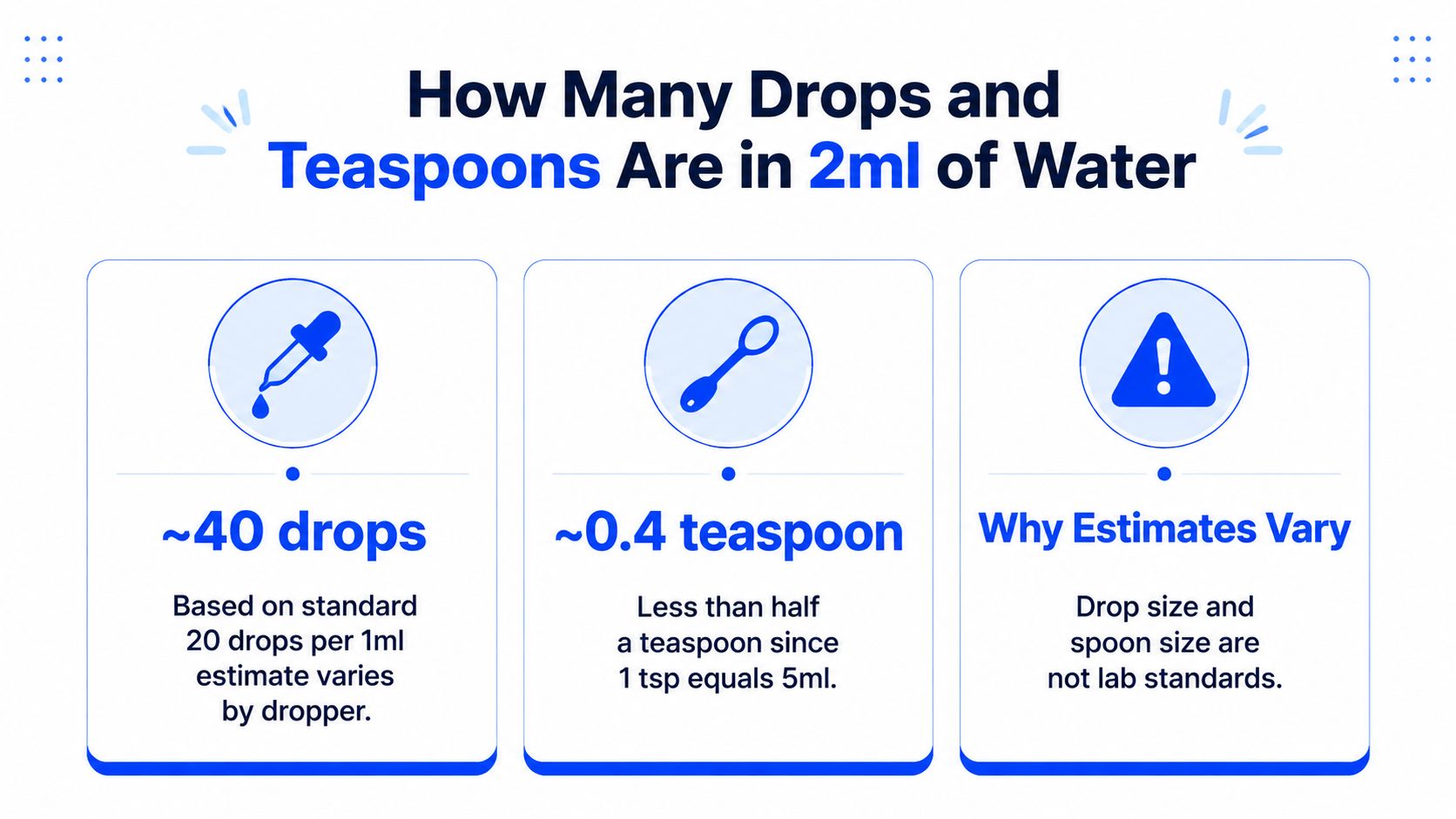
A common approximation treats 1 mL as about 20 drops, which puts 2 mL at approximately 40 drops. A teaspoon is commonly treated as 5 mL, so 2 mL is approximately 0.4 teaspoon. The 2 mL conversion infographic presents those everyday estimates while also highlighting why they can vary.
Why a drop isn't a fixed unit
A drop's size depends on the opening and shape of the dropper, the angle of the device, the speed of dispensing, and the liquid itself. Water's surface tension affects how a drop forms, while a thicker liquid may produce a different-sized drop from the same opening. Even two droppers that look similar can deliver different volumes.
That makes drop counting reasonable only for rough, noncritical tasks. It can help someone visualize a tiny volume or approximate water for a casual demonstration, but it shouldn't replace a graduated syringe or pipette when concentration, reproducibility, or contamination control matters.
Why spoons create a similar problem
A household teaspoon isn't necessarily calibrated to hold exactly the volume expected from a laboratory conversion. The way liquid sits in the spoon also matters. A level spoon, a rounded spoon, and a spoon filled close to the edge can represent different amounts, and a 0.4-teaspoon fraction is difficult to reproduce by eye.
For a simple kitchen activity, that approximation may be adequate. For RUO preparation, a marked device is the better choice because its scale gives the operator a defined reference rather than a visual guess.
A conversion estimate can describe 2 mL, but it can't turn an uncalibrated dropper or spoon into a precision instrument.
How to Measure 2ml of Water Accurately in the Lab
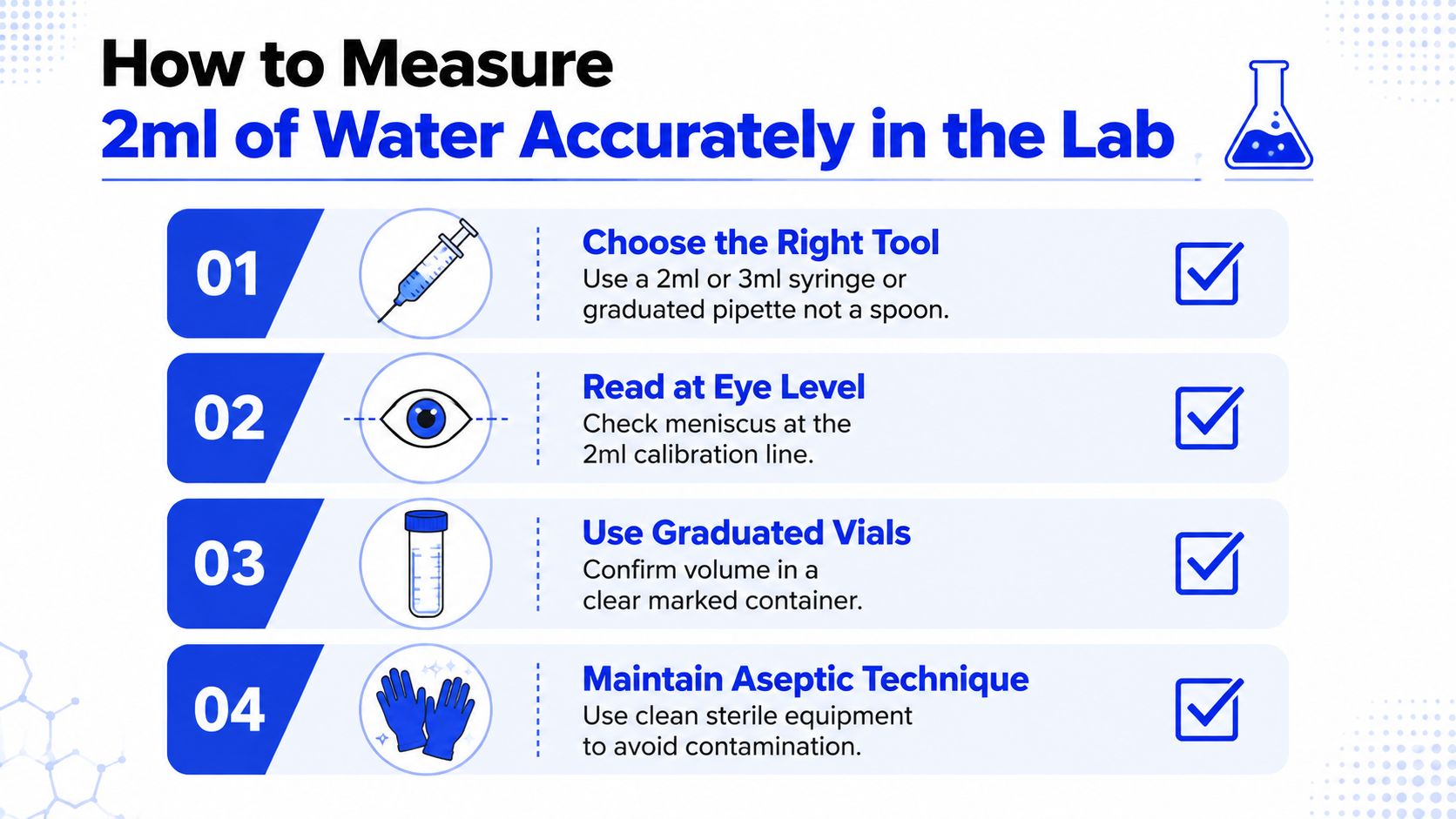
Accurate 2 mL measurement starts with the right device. A 2 mL or 3 mL syringe, a graduated pipette, or a clearly marked laboratory vessel gives the operator a more useful reference than a spoon or an improvised dropper. The device should also match the size of the draw. A large syringe may make a 2 mL mark harder to read, while a very small syringe can become unsuitable when the workflow includes larger transfers.
A peer-reviewed study of small-volume measurement found that, with a 1 mL syringe, accuracy below 0.2 mL was only 0.07 mL. That finding matters when a nominal 2 mL workflow includes repeated sub-0.2 mL adjustments or draws. The peer-reviewed syringe measurement study shows why device selection and error tolerance belong in the planning stage, not after an inconsistent result appears.
A controlled measuring sequence
Choose a suitable tool. Use a graduated syringe or pipette with a scale that makes the 2 mL target easy to identify. Herbilabs syringe recommendations can help researchers compare syringe formats for small-volume handling.
Inspect the device. Check that the barrel, plunger, tip, and graduations are clean, intact, and appropriate for the intended RUO procedure. A damaged scale or sticky plunger can make a correct draw difficult.
Remove visible air. Draw the water slowly, hold the syringe upright, and gently move trapped air toward the tip before adjusting the plunger. An air bubble takes up space that should contain liquid, so the indicated volume may not represent the intended liquid volume.
Read at eye level. Hold the device vertically and align the eye with the liquid surface. For a clear aqueous liquid, read the bottom of the meniscus at the 2 mL calibration mark.
Transfer consistently. Keep the tip from touching nonsterile surfaces, dispense at a controlled pace, and record the actual device and volume used. Consistent handling supports better comparison between preparations.
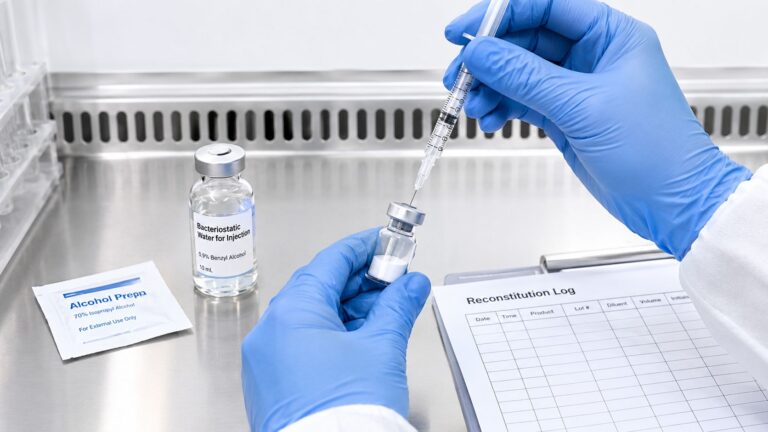
For a vial workflow, clean equipment and aseptic handling remain essential. The operator should follow the relevant laboratory protocol, avoid unnecessary vial access, and keep a record of the diluent lot, reagent lot, target volume, and preparation date.
The following video provides a visual demonstration of small-volume syringe handling:
Using 2ml of Water for Reconstitution and Concentration Planning
In reconstitution planning, 2 mL is a volume choice, not a universal default. The final concentration depends on how much material is present in the vial. The calculation is direct:
Concentration in mg/mL = vial amount in mg ÷ liquid volume in mL
The same 2 mL produces three distinct outcomes:
- 5 mg in 2 mL equals 2.5 mg/mL
- 10 mg in 2 mL equals 5 mg/mL
- 20 mg in 2 mL equals 10 mg/mL
Those examples come from the peptide concentration calculator reference, which also illustrates why a fixed volume can create very different working strengths. The arithmetic is simple, but usability depends on the desired dose increments, syringe markings, and number of withdrawals.
Comparing volume choices
| Vial Amount | Concentration with 2 mL | Concentration with 1 mL | Best Use Case |
|---|---|---|---|
| 5 mg | 2.5 mg/mL | 5 mg/mL | 2 mL offers a more diluted working solution, while 1 mL creates a stronger solution |
| 10 mg | 5 mg/mL | 10 mg/mL | 2 mL provides a middle-ground concentration for routine planning |
| 20 mg | 10 mg/mL | 20 mg/mL | 1 mL produces a concentrated solution, while 2 mL may support larger working-volume increments |
A smaller volume can be useful when the workflow favors concentration and fewer liquid additions. It can also make small target quantities harder to measure because the required draw may fall into a less readable part of the syringe scale. A larger volume may improve dose granularity, but it requires more liquid capacity and may not suit the vial, reagent stability, or protocol.
When 2 mL fits and when it doesn't
Two milliliters often functions as a practical middle option. It provides more working volume than 1 mL without requiring the larger transfer associated with 3 mL, and it can make a solution easier to manipulate when the target concentration is appropriate.
It isn't automatically the right choice. A researcher should consider:
- Dose granularity: A diluted solution may make small volume increments easier to distinguish.
- Syringe readability: The planned draw should sit comfortably within the device's marked range.
- Vial capacity: The container and stopper must accommodate the selected liquid volume.
- Workflow frequency: Repeated withdrawals increase the importance of aseptic handling and clear documentation.
- Material instructions: The source protocol or lot-specific documentation should take priority over a generic calculator.
For RUO preparation, a suitable bac water handling guide can support planning around sterile diluent handling, vial access, and documentation. The guide doesn't replace the material manufacturer's instructions or a validated laboratory procedure.
Key Takeaways for Handling 2ml of Water in RUO Workflows
The central conversion is straightforward: 2 mL of water occupies 2 cm³ and weighs about 2 grams, or 2,000 milligrams, because water is commonly estimated at roughly 1 g/mL. That relationship provides a useful starting point, not permission to treat every liquid or every measuring device as interchangeable.
For practical RUO work, the decision process is more useful than memorizing a single conversion:
- Define the target concentration. Calculate the final amount per milliliter before selecting the reconstitution volume.
- Choose a readable device. A graduated syringe or pipette should make the intended draw easy to see and repeat.
- Treat drops and spoons as approximations. They can provide visual context, but they aren't substitutes for calibrated equipment.
- Control the draw. Remove air, read the meniscus at eye level, and keep the device and vial handling consistent.
- Document the preparation. Record material identity, diluent lot, volume, date, and relevant handling details.
Sterile diluent selection, aseptic vial access, and storage conditions also affect reproducibility. For multi-dose RUO workflows, researchers should consult the product documentation and the guidance on bacteriostatic water before establishing an in-use process. Lot-specific Certificates of Analysis and internal laboratory records can help connect a prepared solution to its source materials.
Decision point: Choose 2 mL when its resulting concentration and syringe readability fit the workflow. Choose another volume when 2 mL creates awkward draws, poor dose granularity, or a mismatch with the documented procedure.
Herbilabs offers sterile bacteriostatic water and reconstitution solutions for RUO preparation, along with syringe-compatible labware and lot-specific documentation. Visit Herbilabs to review available diluent formats and measurement supplies for a more controlled 2 mL workflow.