Private Label, White Label, Wholesale partnerships available - EU, USA and UK - Free shipping from €75
0.9 Sodium Chloride Inhalation Solution USP Explained
A lab technician reaches for a saline vial during nebulizer preparation, then stops. Beside it sit a multi-dose vial of bacteriostatic saline and a larger container of injectable normal saline. All three appear to contain 0.9% sodium chloride, but the labels point to different routes, handling requirements, and workflows.
That hesitation is appropriate. 0.9% sodium chloride inhalation solution USP is not interchangeable with every product carrying the words “normal saline.” The concentration matters, but so do the intended route, preservative status, container format, sterility claims, and exact label language.
Table of Contents
- When Three Saline Vials Sit on the Bench
- Inside the 0.9 Percent Formulation
- What USP Actually Certifies
- Inhalation Saline Versus Injection and Bacteriostatic Saline
- How Inhalation Saline Is Used in Practice
- Common Misconceptions About USP and Interchangeability
- A Procurement Decision Framework for Research Users
- Frequent Questions From Buyers and Lab Teams
When Three Saline Vials Sit on the Bench
The technician reads the first vial. It says Sodium Chloride Inhalation Solution USP, sterile, preservative-free, and for respiratory therapy. Its small, single-use format fits the nebulizer protocol written on the bench sheet.
The second container is bacteriostatic saline. It may also display a 0.9% sodium chloride concentration, but its preservative system and multi-dose design make it a different product category. The third is injectable normal saline, packaged for parenteral use and labeled according to an entirely different route.
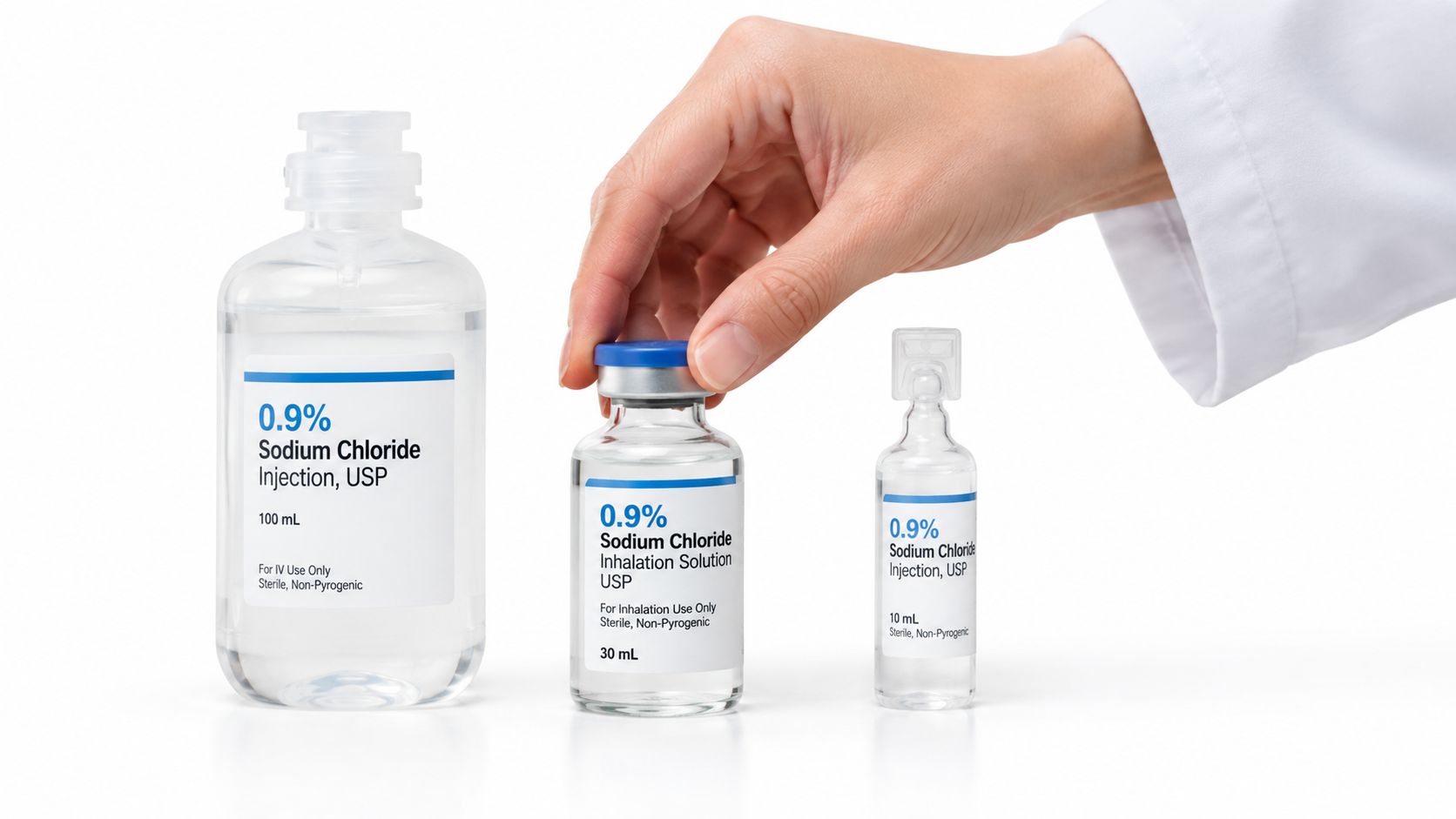
A product search can make the decision harder because “0.9% sodium chloride,” “normal saline,” and “saline USP” appear across several formats. The decisive information usually appears elsewhere on the label:
- Route: Does the container say inhalation, respiratory therapy, injection, or reconstitution?
- Preservatives: Is the solution preservative-free, or does it contain an antimicrobial preservative?
- Container: Is it a single-use respiratory vial or a multi-dose container?
- Intended use: Does the labeling explicitly prohibit injection, inhalation, or preparation of injectable products?
FDA device documentation describes 3 mL and 5 mL sterile, preservative-free inhalation presentations in low-density polyethylene vials for respiratory therapy, including dilution of solutions used in nebulizers. The same documentation identifies tracheal irrigation or lavage as an application and states that the product contains no additives. These details appear in the FDA-cleared device documentation for sodium chloride inhalation solution.
Bench rule: The shared concentration is only one matching criterion. The route statement is the first practical filter.
For a research facility, the decision should be recorded rather than left to visual recognition. A technician who confirms the route, preservative status, and single-use format has already avoided the most common saline substitution error.
Inside the 0.9 Percent Formulation
The formulation starts with a simple calculation. 0.9% w/v sodium chloride means 9 mg of sodium chloride per milliliter, equivalent to 900 mg per 100 mL or 9 g per liter. The solution uses Sodium Chloride, USP, in Water for Injection, USP, without an added active drug.
The same concentration provides approximately 154 mEq/L of sodium and 154 mEq/L of chloride, with a calculated osmolarity of about 308 mOsmol/L. Those specifications are included in the FDA labeling for comparable 0.9% sodium chloride USP formulations, which also identifies a nominal pH of approximately 5.5, with an acceptable range of 4.5 to 7.0 when pH adjustment is required. The full reference is the FDA labeling for 0.9% sodium chloride USP.
What the numbers mean
The sodium and chloride ions are present in matching amounts because sodium chloride separates into those two electrically charged components in solution. Their balanced ionic contribution helps explain why the preparation is commonly described as isotonic relative to body fluids.
Tonicity matters in respiratory workflows because a near-physiologic solution can humidify airway surfaces and dilute nebulized medicines without intentionally producing the osmotic water shifts associated with hypertonic saline. That doesn't mean the solution is suitable for every patient, device, or protocol. It means the formulation has a physiological concentration commonly selected for gentle respiratory dilution and hydration.
| Component | Amount per mL | Amount per L | Function |
|---|---|---|---|
| Sodium chloride | 9 mg | 9 g | Supplies sodium and chloride ions |
| Sodium | Approximately 0.154 mEq | Approximately 154 mEq | Contributes to ionic balance |
| Chloride | Approximately 0.154 mEq | Approximately 154 mEq | Balances the sodium contribution |
| Calculated osmolarity | Approximately 0.308 mOsmol | Approximately 308 mOsmol | Supports the isotonic description |
| Water for Injection | Remainder | Remainder | Aqueous vehicle |
The solution's quality profile matters as much as its salt content. Inhalation products described in FDA and DailyMed records are sterile, non-pyrogenic, and preservative-free, with no bacteriostatic antimicrobial agent or other additive. The absence of preservatives is particularly important when a liquid is converted into an aerosol and delivered through respiratory equipment.
The product shouldn't be judged solely by whether the liquid looks clear. The expected USP product has defined concentration, ionic content, sterility-related controls, and purity characteristics. A clear container with a familiar label isn't enough to establish that the contents match an inhalation protocol.
What USP Actually Certifies
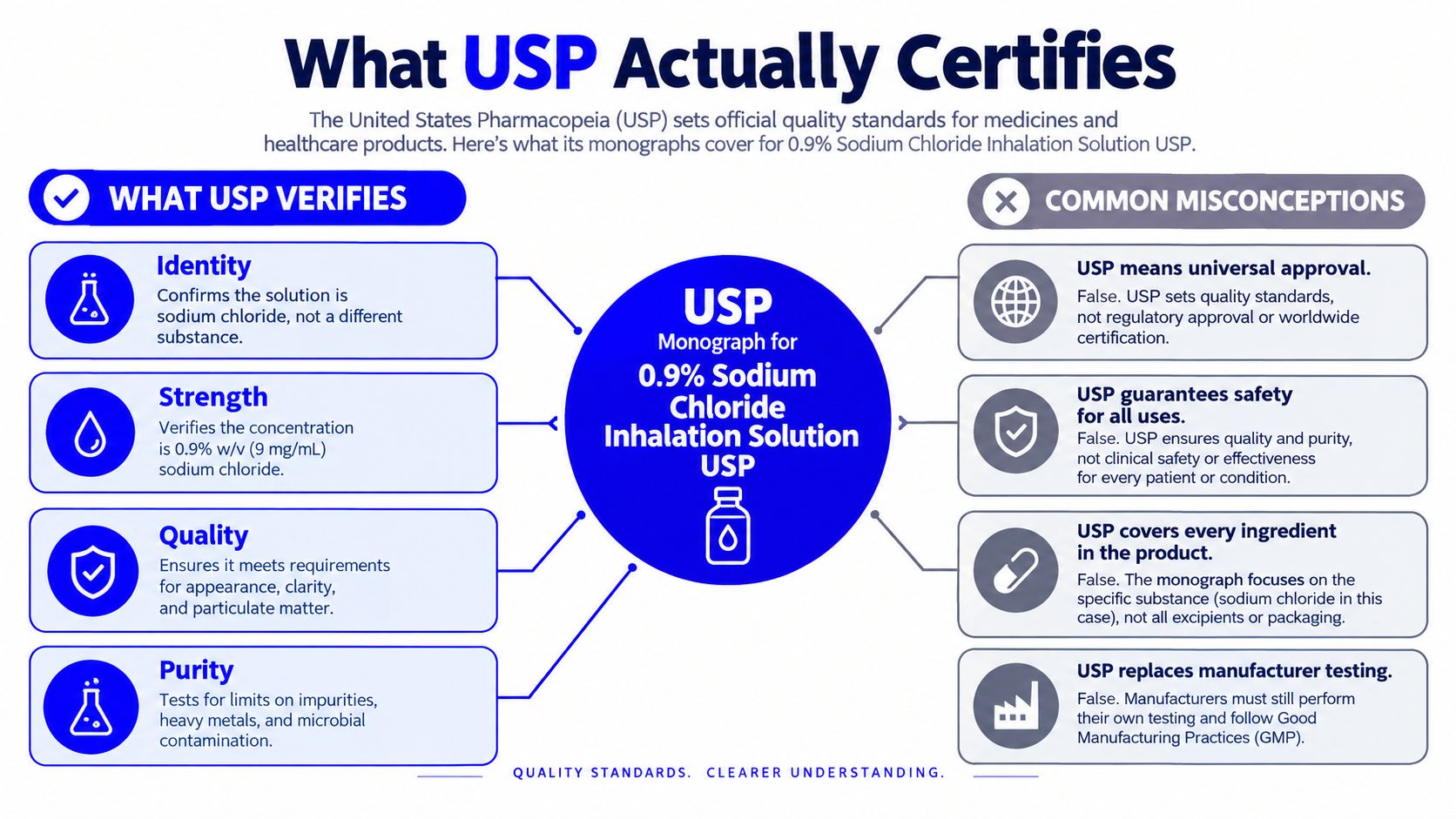
The USP mark is a quality benchmark, not a universal interchangeability passport. It points to compliance with relevant compendial expectations for the named product, including identity, strength, and quality attributes. It doesn't erase the manufacturer's route statement or turn an inhalation product into an injectable preparation.
For procurement purposes, the most useful interpretation is narrow and practical. A 0.9% sodium chloride inhalation solution USP should correspond to the expected sodium chloride identity and concentration, and the finished product should meet the applicable quality requirements described by its labeling and release documentation.
The scope of the designation
The USP reference helps a laboratory ask better questions:
- Is the material actually sodium chloride in the stated aqueous vehicle?
- Does the stated strength match the required 0.9% w/v formulation?
- Does the product have the claimed sterile and preservative-free characteristics?
- Does the supplier provide lot-specific documentation supporting release?
- Does the packaging and label identify respiratory use rather than another route?
The designation doesn't independently approve a product for every possible administration method. Route suitability depends on the manufacturer's product filing, the container system, the manufacturing controls, and the intended-use statement on the label.
The distinction matters because “USP” can appear alongside a broad chemical name while the actual product category remains route-specific. A laboratory should therefore preserve the complete product label and not record only “NaCl USP” in its inventory system.
A Certificate of Analysis should be reviewed as a lot-release document, not treated as a substitute for the label. Useful records include the product identity, stated strength, sterility-related release information, relevant purity testing, lot number, and container-closure or packaging details where supplied.
The ruo lab quality guide from Herbilabs can provide additional context for teams building a documented quality process around research materials.
A useful internal record separates three statements: what the product is, which quality standard it claims, and how the manufacturer says it should be used. Those statements may support one another, but they aren't interchangeable.
Inhalation Saline Versus Injection and Bacteriostatic Saline
Three saline formats can share the same sodium chloride concentration while serving different technical purposes. A respiratory vial is designed around aerosol or airway use. An injectable product is labeled for parenteral administration. Bacteriostatic saline is designed for repeated access under its own labeled conditions and contains a preservative.
The route statement should decide the first comparison. A product labeled for respiratory therapy shouldn't be selected for injection, and a product labeled for injection shouldn't automatically be placed in a nebulizer. The official DailyMed record for 0.9% sodium chloride inhalation solution identifies inhalation presentations as sterile, preservative-free, single-use respiratory-therapy vials and distinguishes them from injectable use.
| Attribute | Inhalation Saline USP | Injection Saline USP | Bacteriostatic Saline |
|---|---|---|---|
| Intended route | Respiratory therapy and nebulizer workflows | Parenteral administration | Reconstitution or other labeled multi-dose workflows |
| Preservative status | Preservative-free | Depends on the specific product and label | Contains an antimicrobial preservative |
| Container format | Commonly a small, single-use vial | Commonly a larger flexible container or other injectable package | Commonly a multi-dose vial |
| Additives | Labeled inhalation products contain no additives | Must be assessed from the exact label | Includes the stated preservative system |
| Substitution decision | Use only where respiratory labeling matches the protocol | Use only where injectable labeling matches the protocol | Use only where the protocol permits the preservative and repeated access |
Bacteriostatic saline should not be confused with preservative-free inhalation saline. The preservative is part of the product's identity and affects where the solution can be used. A separate explanation of preservative-based multi-dose diluents appears in this guide to bacteriostatic water and its uses.
The same caution applies to injectable normal saline. The word “normal” describes the familiar concentration, not a universal route. Inhalation labeling may explicitly state that the product is not for injection, while an injectable or bacteriostatic product may carry its own route restrictions.
Substitution check: A procurement team should match concentration, route, preservative status, container format, and intended use before approving an alternative.
The phrase bacteriostatic water vs saline 0.9% can help teams distinguish a preservative-containing reconstitution solution from saline products intended for respiratory or injectable workflows. The comparison should support a documented decision, not a casual swap based on similar wording.
How Inhalation Saline Is Used in Practice
Inhalation saline appears most often where a respiratory device needs a sterile aqueous solution with a compatible salt concentration. A clinician or researcher may use it as a diluent for a nebulized medication when the product instructions and approved workflow call for saline. The exact medication, device, volume, and treatment procedure still come from the relevant protocol or product labeling.
The solution can also appear in respiratory humidification setups, tracheostomy-related care, or tracheal irrigation and lavage workflows where the labeling supports that use. Its role is supportive. It isn't a bronchodilator, an antibiotic, or a replacement for a prescribed respiratory medicine.
The single-use handling point
A unit-dose vial changes the bench routine. The operator checks the label, inspects the container for damage or loss of integrity, opens it using clean technique, transfers the required contents, and treats the opened vial as used.
Unused contents shouldn't be saved for a later session or poured into another container. The product is preservative-free and supplied for single use, so the lack of an antimicrobial system means the open container isn't a multi-dose reservoir.
- Before opening: Confirm product name, route, concentration, expiry information, and container integrity.
- During preparation: Keep the vial and transfer surfaces away from avoidable contamination.
- After transfer: Discard remaining solution according to the facility's waste procedure.
- Before the next run: Use a new unit-dose container rather than a previously opened vial.
Research teams working with airway models or aerosolization studies should define whether the solution is being used as a diluent, rinse, humidification component, or experimental control. Those purposes can require different device settings and documentation even when the same saline product is selected.
The phrase bacteriostatic water belongs to a different handling conversation. A bacteriostatic reconstitution solution is formulated for its own labeled use and preservative system, while preservative-free inhalation saline is selected when respiratory delivery and single-use handling are required.
Storage should follow the manufacturer's label. Before use, the operator should reject a container that is cracked, leaking, visibly contaminated, or otherwise inconsistent with the product specification. A strong laboratory record links the opened unit to the session, protocol, operator, and lot when traceability is required.
Common Misconceptions About USP and Interchangeability
The most persistent error is treating 0.9% sodium chloride USP as a complete product description. It isn't. The concentration identifies the salt strength, while the route and label identify the intended application.
A USP designation supports confidence that the product is associated with a recognized compendial quality benchmark. It doesn't mean that every 0.9% sodium chloride product has been evaluated for every route, device, container, or workflow.
Misconception one
“If both products say USP, they can be swapped.”
The safer conclusion is narrower. Two products may share a compendial reference and concentration but differ in route labeling, preservatives, packaging, or use restrictions. An inhalation product can be explicitly labeled for respiratory therapy and not for injection, while an injectable product can be unsuitable for aerosol delivery without a documented use-case match.
Misconception two
“Preservative-free means suitable for every use.”
Preservative-free status removes one concern, but it doesn't establish universal suitability. The solution still needs to match the labeled route, sterility expectations, container system, and protocol. A single-use respiratory vial is not automatically a reconstitution diluent merely because it contains sterile water and sodium chloride.
Misconception three
“A clear liquid is a validated substitute.”
Appearance is an initial inspection, not a full release decision. The purchasing record should retain the exact label, lot information, Certificate of Analysis, and supplier documentation needed by the facility's quality system.
A laboratory can turn the misconception into a simple review sequence:
- Read the stated route.
- Check whether preservatives or other additives are present.
- Confirm whether the container is single-use or intended for repeated access.
- Review the available lot documentation.
- Compare the product against the written protocol rather than against another bottle on the shelf.
Quality mark, not route passport: USP helps define what a product should meet. The label and validated workflow determine where it belongs.
That distinction protects both patient-facing and research environments. It also gives procurement staff a defensible reason to reject a cheaper or more familiar saline format when the documented use doesn't match.
A Procurement Decision Framework for Research Users
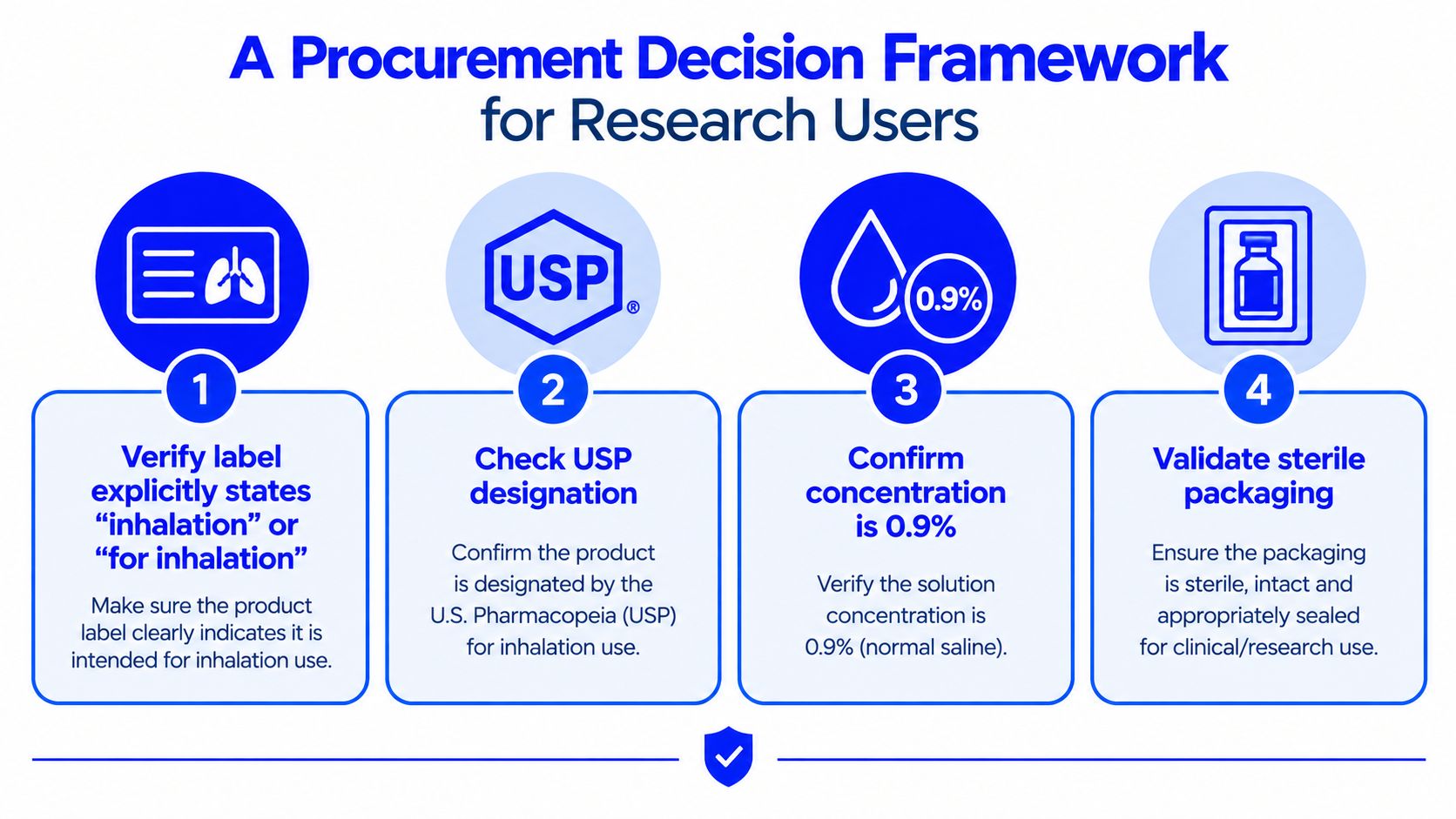
A research buyer can reduce saline errors by turning the shelf decision into four documented gates. Each gate answers a different question, so a product shouldn't move forward because it passed only the concentration check.
Gate one confirms the route
The label should explicitly identify inhalation, respiratory therapy, or another route that matches the protocol. “Sodium chloride 0.9%” by itself is incomplete. If the supplier's page and the container label use different route language, the label and official documentation should control the review.
Gate two confirms quality documentation
The buyer should request the product specification and lot-specific Certificate of Analysis. The review can include identity, strength, sterility-related information, purity testing, particulate data where applicable, endotoxin information where applicable, and container-closure information supplied for the product.
The exact acceptance criteria depend on the intended route and the supplier's documentation. A research team shouldn't assume that a missing test result means the product failed, but it should treat missing documentation as an unresolved procurement question.
Gate three matches the container to the workflow
A single-use vial fits a single preparation session because it limits repeated access. A multi-dose container belongs only in a workflow with a documented aseptic procedure and a product label that permits that handling.
The container also affects training. A technician can identify a unit-dose vial as a discard-after-opening item, while a multi-dose vial requires clear access controls, dating, storage, and in-use procedures.
Gate four preserves traceability
The order file should connect the quote, supplier identity, product name, route, lot, expiry information, delivery record, and receiving inspection. If the material is intended for research use only, the record should preserve that designation without confusing it with authorization for human administration.
Common warning signs include a vendor listing that uses “injection,” “inhalation,” and “reconstitution” as if they were interchangeable terms, or a product page that omits the preservative status. A buyer should pause when the supplier cannot provide the exact label or lot documentation for the item being shipped.
The final approval should name the use case. “For nebulizer dilution in the respiratory model” is more useful than “saline,” because the wording preserves the route decision for the next person who handles the stock.
Frequent Questions From Buyers and Lab Teams
Can inhalation saline replace a reconstitution diluent?
Not automatically. A reconstitution protocol should specify the required diluent, preservative status, container format, and compatibility. A respiratory product labeled for inhalation shouldn't be substituted merely because it contains sodium chloride in water.
Does a research-use-only statement mean the product is approved for patients?
No. RUO describes the declared research context. It doesn't convert a laboratory material into a product authorized for human administration, and the receiving team should preserve that distinction in its records.
What should a buyer request from a supplier?
The exact product label, current specification, lot-specific Certificate of Analysis, sterility-related release information, concentration, preservative statement, storage requirements, and route designation are sensible starting points. A structured product data sheet guide can help teams organize those fields consistently.
How does inhalation saline differ from bacteriostatic water for injection?
Bacteriostatic water is a preservative-containing reconstitution product with a different intended use. Inhalation saline is selected for the respiratory route when its labeling identifies it as sterile, preservative-free, and suitable for respiratory therapy.
Can leftover contents be transferred to another protocol?
No routine transfer should occur. Once a single-use inhalation vial has been opened, unused contents should be discarded rather than saved for another session or moved into a different container.
Herbilabs supplies sterile diluents and related labware for research-use workflows, with lot-specific documentation and multiple vial formats for teams that need controlled reconstitution materials. Research organizations can visit Herbilabs to compare the appropriate product category with the protocol before ordering.