Private Label, White Label, Wholesale partnerships available - EU, USA and UK - Free shipping from €75
Where Can I Buy Sterile Vials: A Lab Sourcing Guide
A sterile glass vial can contain a diluent rather than be an empty container, so the first sourcing question isn't always which vial to buy. Herbilabs sells sterile reconstitution solution in premium glass vials labeled for research use only, a distinction that changes what the product is suitable for and what documentation a buyer should request.
For anyone asking where can I buy sterile vials, the practical answer is to settle the intended use and the paperwork first. Then compare suppliers, formats, and prices against a specification the lab can verify.
Table of Contents
- Where Research Labs Buy Sterile Vials
- Confirm the Intended Use Before You Order
- Vial Size, Material and Dose Format to Specify
- Documents That Prove Sterility and Traceability
- How to Vet a Supplier Before Your First Order
- Storage, Shipping and the 28-Day Clock
Where Research Labs Buy Sterile Vials
Sterile vials for research use come from five main channels, each with a different documentation load. Specialist RUO suppliers are generally the most practical starting point for labs that reorder a consistent format. Packaging manufacturers, vial distributors, direct manufacturers, general lab catalogs, and marketplaces can each fit a particular purchasing need, but the amount of quality information available usually changes with the channel.
| Channel | Best for | Documentation to expect | Main risk |
|---|---|---|---|
| Specialist RUO lab suppliers | Labs reordering the same format in small to mid-size lots | Lot-specific certificate of analysis and QA release | Minimum order sizes vary by product |
| Packaging manufacturers and vial distributors | Labs formulating their own products that need material and closure data | Material specifications and closure data on request | Often bulk-only; needs in-house technical review |
| Direct manufacturers, private label or white label | Brands and resellers who want their own label | Full QA package and batch records under contract | Longer lead times and higher minimum quantities |
| General lab supply catalogs | Occasional single purchases | Basic certificate, not always lot-specific | Labels may omit the in-use period or intended-use limits |
| Online marketplaces and resellers | Price comparison only | Often generic or unavailable | Lot history cannot be verified; highest risk |
For routine research purchasing, a specialist RUO supplier can make repeat orders simpler by tying release records to a specific batch. Packaging manufacturers and vial distributors are a better fit when the lab needs empty containers and can evaluate component specifications in-house. A direct manufacturer may suit a reseller or brand that needs private-label production, but contract terms, minimum quantities, and lead times need to be settled before a launch schedule is set.
General catalogs can fill an occasional need, but a listing may not state the product's in-use period or intended-use limits. Marketplace prices can look attractive, yet a low price doesn't resolve the central quality question: whether the shipped lot can be traced to reliable records.
Herbilabs supplies sterile diluent for laboratory use in premium glass vials labeled RUO, with single-unit, bulk, wholesale, and private-label options. That product is a diluent, not an empty container, so buyers should confirm which category their application requires before comparing offers.
Practical rule: Choose the channel that can provide the lot paperwork before the order is placed, not after a problem appears.
Confirm the Intended Use Before You Order
The intended use determines which product category and supplier documentation are relevant. Research-use-only products are not for administration to humans or animals. Herbilabs' 30 mL Reconstitution Solution is intended for research use only and isn't for administration to humans or animals; its 20 mL Reconstitution Solution is also RUO and not for clinical use.
A sterile empty vial, a sterile diluent in a vial, and a medicinal product aren't interchangeable categories. Before comparing vendors, a buyer should establish:
- What is being purchased? An empty container, a diluent, or a medicinal product.
- Who will use it? A research lab, a clinic, or a reseller.
- Which records are required? Institutional procurement may require product-specific authorization, lot records, or other quality documents.
A facility's GMP or ISO claim describes a quality framework, but it doesn't automatically authorize every product for clinical or human use. Product labeling and intended-use status still matter. The same physical vial format may be sold as a laboratory consumable, a packaging component, or part of a regulated medicine, with different obligations in each case.
Jurisdiction matters too. In the EU, revised GMP Annex 1 for sterile medicinal products became operational on 25 August 2023, with one provision delayed until 25 August 2024. Its contamination-control approach emphasizes documented, risk-based manufacturing rather than reliance on a single end-product sterility result. FDA materials likewise state that sterile containers and closures must be suitable for their intended use, and that parenteral products require sterile, non-pyrogenic components. The European Medicines Agency's GMP guidance helps frame why jurisdiction and product category belong in the buying decision.
Once the use is defined, the procurement team can shortlist two suitable channels, request the relevant records, and evaluate a test lot before committing to a larger order.
Vial Size, Material and Dose Format to Specify
A useful quote starts with a format that matches the lab's workload. The sizes below show how a supplier can describe capacity and typical use; the chosen nominal fill volume should also be checked against the amount the workflow can use.
| Format | Fill volume | Best for |
|---|---|---|
| 3 mL single vial | 3 mL | One small lyophilized vial per reconstitution |
| 10 mL multi-dose vial | 10 mL | Several reconstitutions |
| 20 mL multi-dose vial | 20 mL | More than 10 mL but under 30 mL of use |
| 30 mL multi-dose vial | 30 mL | Largest single vial; lowest cost per mL |
| 10 × 3 mL pack | 3 mL each | Labs opening a fresh vial for each reconstitution |
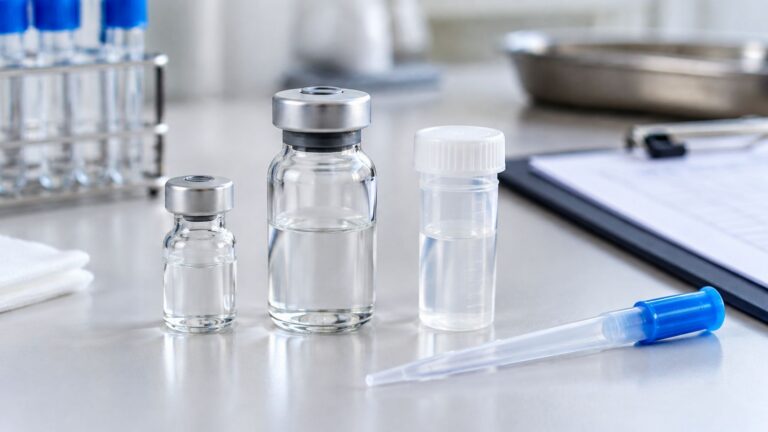
The 3 mL vial is Herbilabs' smallest size and suits a single reconstitution of one small lyophilized vial. Its 10 mL vial is the most popular size and holds enough for several reconstitutions within the applicable in-use period. The 20 mL format sits between 10 mL and 30 mL, while the 30 mL vial is the largest single vial and has the lowest cost per mL among single-vial sizes.
Before requesting quotes, put the following details on the specification sheet:
- Material and glass type. Record the required material and any compatibility requirements for the formulation.
- Nominal fill and usable volume. Confirm how much liquid the vial holds and how much can be withdrawn in the intended process. The supplier's guidance on vial capacity and headspace considerations can help frame that check.
- Closure system. Specify the elastomer stopper and aluminum crimp cap, including compatibility with the vial and handling equipment.
- Dose format. State whether the vial is single-dose or multi-dose. Single-dose formats avoid repeated access to the same vial; multi-dose formats can reduce packaging consumption but require controlled access.
- Preservative and concentration. For example, Herbilabs' bacteriostatic solution contains 0.9% benzyl alcohol, a detail that should be confirmed against the specific product label.
- Sterilization or filtration route. Specify the process being offered, such as 0.22 µm filtration with aseptic filling, and request its supporting record.
- Labeled storage temperature. Use the manufacturer's stated condition in the purchasing and storage plan.
The 10 × 3 mL pack suits labs that open a fresh vial for each reconstitution. For multi-dose formats, count expected reconstitutions and select a size the lab can use within the labeled in-use period. That decision should be made alongside vial capacity and withdrawal needs, not by unit price alone.
Documents That Prove Sterility and Traceability
The first document to request is a lot-specific certificate of analysis (CoA). It should identify the batch being purchased and show the release tests associated with that batch. A generic certificate with no matching lot number doesn't establish what was tested in the shipment.
| Document | What it proves | Red flag |
|---|---|---|
| Lot-specific certificate of analysis | Release tests were run on the batch being purchased | Certificate has no lot number or matches another lot |
| Container-closure integrity validation protocol | The microbial barrier holds through shelf life | Only a sterility test is offered, with no integrity data |
| Sterilization or filtration record | Method used, such as 0.22 µm filtration with aseptic filling | Only the word sterile appears on the product page |
| Material and dimensional specifications | Glass type, stopper, and crimp fit the formulation and equipment | No specifications available on request |
| QA release and traceability record | Who released the lot, when, and under which storage conditions | No batch traceability or expiry information |
The World Health Organization's good manufacturing practice guidance for sterile pharmaceutical products describes separated clean-area operations for container and closure preparation, filling, and sterilization. For aseptically filled vials, it treats the closure as integral only after the stopper is secured and the aluminum cap is crimped, with crimping performed as soon as possible after stopper insertion. The buyer should therefore request evidence about the closure process, not rely on the word “sterile” on a product page.
A sterility result and container-closure integrity (CCI) answer different questions. CCI testing assesses whether the package maintains its microbial barrier through shelf life; it doesn't replace a required pre-release sterility test. The FDA's container-closure integrity guidance identifies methods such as pressure or vacuum decay, tracer-gas testing, dye penetration, seal-force testing, and microbial challenge. The supplier should identify the method and validation for the exact vial, stopper, and closure configuration.
Procurement records should capture vial material, closure system, lot number, sterilization or filtration method, expiry or retest date, and the available CoA. Buyers reviewing the difference between vial packaging and a finished product may also find this Vials + Vitals Zepbound comparison useful for keeping the product categories distinct. For facility terms, see GMP and ISO explained by Herbilabs, then verify what applies to the specific product and lot.
How to Vet a Supplier Before Your First Order
A supplier qualification check should test whether the quoted product matches the lab's requirements and whether the supporting records identify the lot being sold. FDA inspection guidance emphasizes component specifications, defect controls, and closure integrity under stresses from sterilization, handling, storage, and shipment. The FDA guidance on inspection of container-closure systems supports a practical review built around those points.
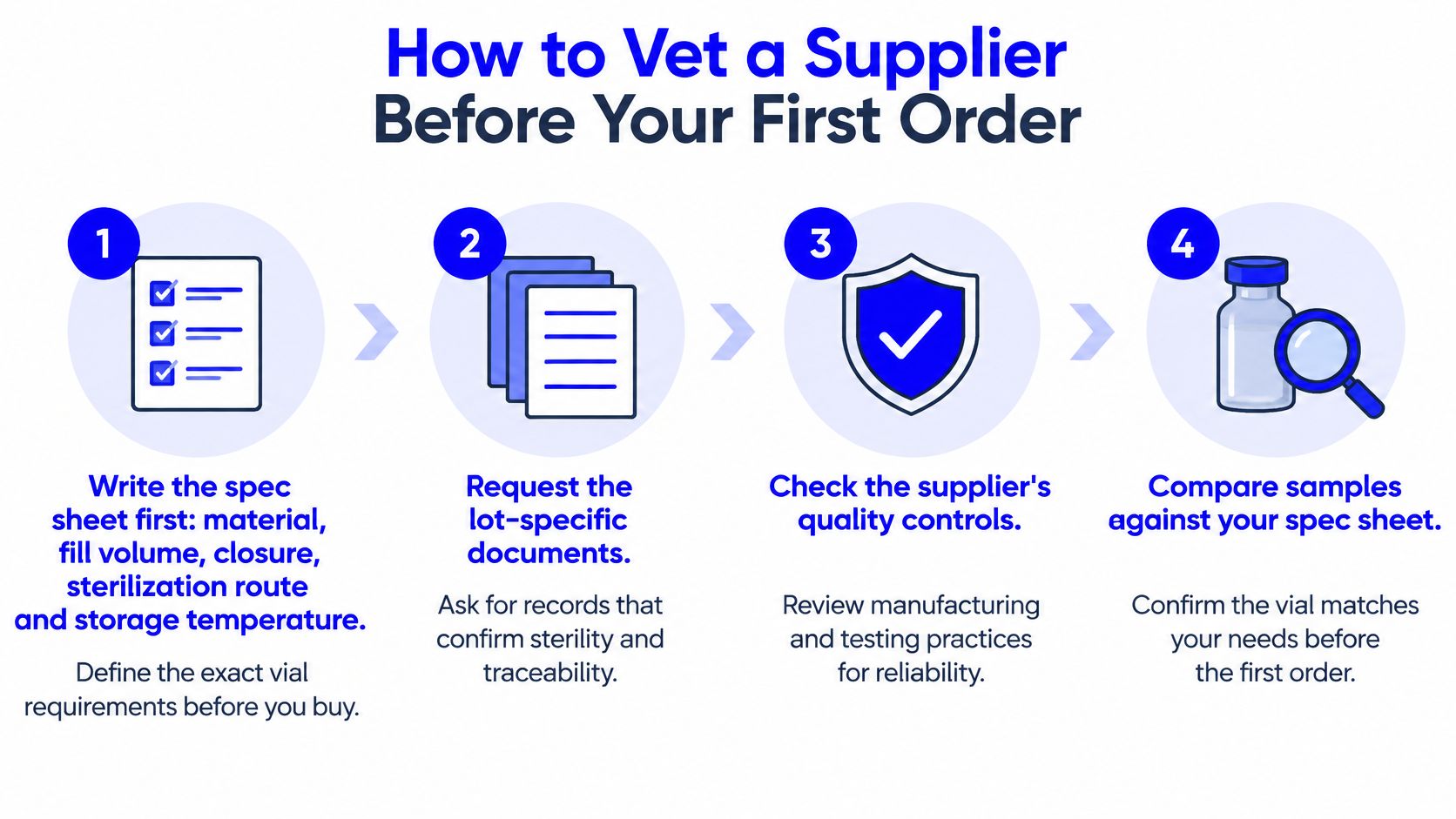
- Write the specification first. Record material, fill volume, closure, sterilization route, and storage temperature. A written spec makes it easier to detect substitutions and compare quotations on the same basis.
- Request lot-specific documents. Ask for the records listed above and confirm that the lot numbers match the product being quoted. A generic certificate may describe a different batch.
- Review the CCI validation. Request the protocol and acceptance criteria, then check whether the validation covers sterilization, shipping, storage, and worst-case dimensions. A sterility claim alone doesn't demonstrate that the seal remains intact through those conditions.
- Check quality credentials and scope. A GMP or ISO claim describes a facility or quality system, not necessarily every product sold under a brand. Ask which products and processes fall within the stated scope.
- Order a small test lot and inspect receipt. Check for cracks, loose crimps, stopper defects, leaks, and visible particulates. Record the lot number, storage temperature, arrival condition, and any deviations so a later issue can be traced.
- Put private-label terms in writing. Specify who retains batch records, how lot changes will be communicated, and what happens if a lot fails acceptance. These details matter when the product carries a reseller's label but manufacturing records remain with a supplier.
A purity claim, such as 99% or higher, is a supplier statement to verify against relevant lot paperwork, not a substitute for it. Herbilabs states that its products are manufactured exclusively for the brand in a dedicated compounding facility and consistently achieve 99% or higher purity. Buyers can also evaluate peptide lab testing standards when building a broader research-material qualification process.
The infographic condenses the initial supplier screen. For a further overview of supplier evaluation, the following video can supplement the written checks:
If a supplier can't provide the lot-specific records and CCI validation in writing, move on to another channel.
Storage, Shipping and the 28-Day Clock
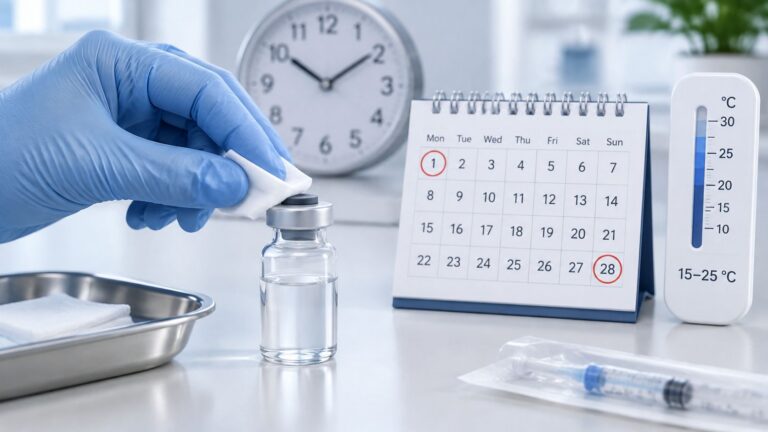
For a multi-dose vial, the post-opening period is separate from the unopened expiration date. CDC guidance summarizing USP General Chapter 797 states that an accessed multi-dose vial should be dated and discarded within 28 days, unless the manufacturer specifies another period. The opened vial's beyond-use date can't extend beyond its original expiration date, and the vial must be discarded if sterility is compromised or can't be confirmed. The CDC's injection-safety guidance also makes clear why product labeling should identify dose format, storage conditions, and any post-puncture period.
The 28-day access limit applies to the multi-dose vial component, not automatically to a sterile preparation made from it. USP clarifies that a compounded preparation may retain its assigned beyond-use date when applicable compounding requirements are met, even when the source vial has been accessed; the USP FAQ on sterile compounding explains this distinction. The lab should keep the source vial's access period separate from the stability and storage period assigned to the final preparation.
A routine handling log helps apply the manufacturer's labeling consistently:
- At first puncture: Write the opening date on the vial and record it in the lab's tracking system.
- At each entry: Use a new sterile needle and syringe, and disinfect the stopper according to the validated procedure.
- When choosing a size: Select a multi-dose vial the lab can use within its stated in-use period. Herbilabs' 10 mL Reconstitution Solution can be used for up to 28 days after first puncture with proper aseptic handling.
- For repeated small reconstitutions: A 10 × 3 mL pack lets the lab open a fresh vial for each reconstitution, keeping each opened vial within its own use window.
- On arrival and during storage: Check the packaging and cap seal, log the arrival condition, and store sealed vials at the labeled temperature. Refrigerate an opened vial only if the label permits it.
For buyers assessing dispatch and storage arrangements, cold chain insights from Herbilabs can inform the logistics review. Any suspected contamination or compromised closure is grounds to discard the vial rather than extend its use.
Research teams seeking sterile RUO diluents can compare Herbilabs' glass vial formats, including individual and multipack options, against their documented volume and handling needs. Review the product labeling and lot documentation before ordering, then visit Herbilabs to select a format for the lab's workflow.