Private Label, White Label, Wholesale partnerships available - EU, USA and UK - Free shipping from €75

30 mL Vials Explained: Formats, Closures, and Multi-Dose Use
A researcher reaches for a 30 mL vial after realizing that a smaller container would require more frequent handling, yet a larger one could leave unused solution sitting past its safe in-use period. The choice looks simple on a catalog page, but the decision involves nominal capacity, headspace, stopper performance, withdrawal frequency, and contamination control.
A 30 mL vial is therefore more than a container with extra room. It's a format shaped by regulatory expectations and supplier standardization, but its practical value depends on whether the contents will be used before the applicable beyond-use date expires.
Table of Contents
- The 30 mL Vial at a Glance
- Why 30 mL Became the Multi-Dose Benchmark
- Comparing 30 mL to Smaller Vial Formats
- Glass Type and Closure Engineering
- Sterile Versus Non-Sterile Use Cases
- Reconstitution and Multi-Dose Workflows
- When a 30 mL Vial Is the Right Choice
The 30 mL Vial at a Glance
A typical 30 mL pharmaceutical vial is a Type I borosilicate glass container with a nominal capacity of 30 mL, a 20 mm neck finish, and a closure system designed for sterile access. Commercial examples show molded dimensions in the general range of 30 to 37 mm in outer body diameter and approximately 62.8 to 75 mm in height, while one 30R vial lists a nominal 30 mL volume and a brimful capacity of about 37.5 to 38 mL (McKesson's catalog listing).
That difference matters. Nominal volume is the labeled working capacity, not the amount that should automatically be filled to the glass rim. The additional brimful space provides room for headspace, closure seating, mixing, and process-specific requirements. A formulation may need less than the full nominal capacity to preserve safe handling and container-closure performance.
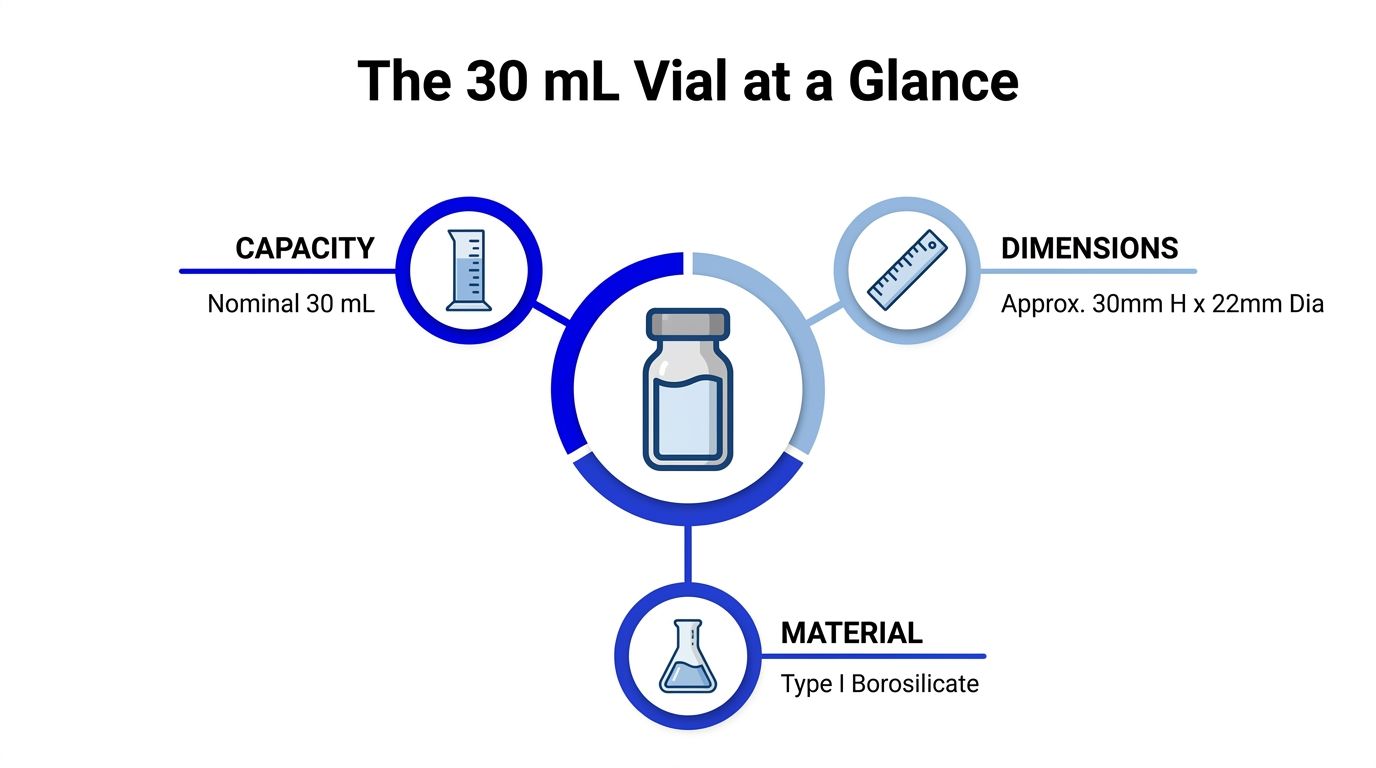
The three specifications buyers should verify
- Capacity: The label should distinguish nominal capacity from usable fill volume. A 30 mL vial may physically hold more than 30 mL to the brim, but that doesn't make brimful filling appropriate.
- Closure: A 20 mm neck finish generally pairs with a matching stopper and seal system. Closure compatibility must be checked before ordering components separately.
- Material: Type I borosilicate glass is widely used for sterile injectables because it offers chemical durability and hydrolytic resistance. Suppliers such as Stoelzle Pharma list 30 mL injection vials as a standard manufactured format.
The format also fits common laboratory storage and handling equipment. Its compact footprint makes it practical for racks, trays, and controlled storage, while its larger internal volume supports repeated withdrawals when the workflow is multi-dose. Researchers evaluating the surrounding preparation process may also benefit from background on how research peptides are made, particularly when deciding how the final container should support reconstitution and sampling.
Why 30 mL Became the Multi-Dose Benchmark
The regulatory importance of 30 mL comes from how authorities approach multiple-dose containers. FDA guidance generally expects a multiple-dose vial to contain 30 mL or less, unless a specific justification supports exceeding that amount. The same guidance states that an opened or entered container has a 28-day beyond-use period unless the label specifies otherwise (FDA guidance on multiple-dose containers).
That pairing creates a practical boundary. A 30 mL vial offers more working volume than smaller formats while remaining within the commonly recognized multiple-dose threshold. The limit isn't a promise that every 30 mL vial will be used safely for the entire period, and it doesn't override the manufacturer's labeling. It functions as a benchmark that connects container size with repeated access and contamination-control expectations.
Why the threshold affects purchasing
Repeated septum punctures increase the opportunity for contamination. A preservative system can help control microbial growth, but it doesn't make poor aseptic technique safe, and it doesn't eliminate the need to discard the vial when the applicable beyond-use date arrives.
The operational question is therefore not solely whether a vial contains enough solution. It's whether the laboratory can consume a useful proportion of that solution before the 28-day clock runs out. A busy workflow may benefit from the format, while an irregular workflow may carry unused volume into the discard decision.
Suppliers also treat 30 mL as a familiar catalog class. Pharmaceutical packaging catalogs commonly pair the format with standardized 20 mm neck finishes, matching stoppers, and aluminum seals. That standardization can simplify component sourcing and reduce the qualification work associated with adopting an established container format.
Practical rule: A 30 mL vial is a packaging benchmark, not a guaranteed utilization target. The withdrawal plan should determine whether the format is efficient.
FDA guidance allows an amount above 30 mL only in special circumstances, such as when the usual dose makes the lower limit impractical. That exception reinforces the main principle: container size should follow the validated use case, not convenience alone.
Comparing 30 mL to Smaller Vial Formats
Smaller vials reduce the amount exposed to repeated access, but they may increase handling frequency and replacement requirements. A 3 mL vial can suit a single-use preparation or a short experiment. A 10 mL vial may fit routine aliquoting. A 20 mL vial can serve as an intermediate option, but it often uses a closure system similar to the 30 mL format.
The comparison changes once the 28-day in-use period becomes the limiting factor. A larger container can reduce the number of units a researcher handles, but it also creates more potential waste if consumption is slow. No format wins automatically.
| Format | Nominal Volume | Typical Headspace | Estimated Withdrawals over 28 Days | Best-Fit Workflow |
|---|---|---|---|---|
| 3 mL | 3 mL | Application-dependent | Depends on aliquot size and technique | Single-use or short-duration preparations |
| 10 mL | 10 mL | Application-dependent | Depends on aliquot size and technique | Routine small-volume reconstitution |
| 20 mL | 20 mL | Application-dependent | Depends on aliquot size and technique | Intermediate multi-dose workflows |
| 30 mL | 30 mL | Application-dependent | Depends on aliquot size and technique | Repeated withdrawals with planned consumption |
The table avoids assigning a universal draw count because aliquot size, needle gauge, stopper design, formulation, storage, and technique all change the result. A 1 mL withdrawal pattern behaves differently from a workflow using very small aliquots, even though both may access the same vial repeatedly.
Choosing by handling burden
A laboratory that uses small amounts sporadically may prefer several smaller containers. That approach can limit the amount discarded when one vial reaches its beyond-use date. A laboratory preparing a working solution for repeated scheduled use may prefer one 30 mL vial to reduce transfers and inventory interruptions.
The deciding calculation is straightforward: estimate the planned withdrawal volume, multiply it by the number of expected access events, and compare the result with the usable fill. If the plan leaves a substantial remainder at the discard point, a smaller format may be more responsible.
For workflows involving a diluent, the reconstitution solution format should be matched to the preparation volume and expected access pattern. The objective isn't to select the largest vial available. It's to select the container that balances practical fill, handling frequency, and the time required to consume the contents.
Glass Type and Closure Engineering
A 30 mL vial may hold the right volume and still be a poor choice if its glass and closure do not suit the workflow. For sterile applications, Type I borosilicate glass is commonly selected for chemical durability and resistance to hydrolytic attack. The classification describes how the glass behaves when it contacts aqueous contents and undergoes pharmaceutical processing, not how clear it looks.
Type I glass also tolerates demanding thermal steps. Its resistance to thermal shock supports sterilization and related manufacturing processes, while its chemical stability can reduce concern about extractables from the container. Suitability still depends on the formulation, process, and supplier qualification.
Why the closure deserves equal attention
The stopper and seal control access after the vial is filled. A common 20 mm system combines the glass neck with a compatible rubber stopper and an aluminum crimp seal. Butyl and bromobutyl elastomers are often considered when low extractables and repeated puncture performance matter.
The assembly works through several connected details:
- Stopper formulation: The elastomer must match the product and the selected sterilization process.
- Flange compression: The stopper must sit firmly against the vial finish without distortion.
- Crimp quality: The aluminum seal must secure the closure and help maintain container-closure integrity.
- Puncture behavior: Repeated needle entries can enlarge or damage the puncture area, particularly when needles enter at inconsistent angles.
Each withdrawal tests the same barrier again. A stopper that reseals well after one puncture may perform differently after repeated access, so closure design belongs in the contamination-control plan, especially when the formulation's preservative protection must last through the in-use period.
Nominal and brimful capacities also affect headspace and the margin available for proper closure seating. Commercial specifications from Fisher Scientific describe 30 mL formats that may use Type I glass, a 20 mm closure system, and dimensions suited to sterile-use handling.
Closure insight: The stopper is part of the container-closure system, not a separate accessory. Its puncture and resealing performance help determine how well repeated access can be controlled.
Review the complete assembly specification before purchasing by volume alone. Material compatibility, closure size, sterilization method, and supporting documentation should all appear in the selection record.
Sterile Versus Non-Sterile Use Cases
A researcher preparing an aseptic reconstitution may need a sterile 30 mL vial with documented sterility, while another storing a buffer for later analysis may need only a clean-packaged, non-sterile container. The two formats can look alike, but they begin different workflows and assign different responsibilities to the laboratory.
| Attribute | Sterile 30 mL Vial | Non-Sterile 30 mL Vial |
|---|---|---|
| Intended entry point | Sterile or contamination-sensitive workflow | General laboratory or controlled non-sterile workflow |
| Documentation | May include sterility and quality records | Usually focuses on material and packaging specifications |
| Closure expectation | Must support the specified sterile container-closure system | Selected for storage, handling, or process needs |
| User responsibility | Follow the supplied handling and storage requirements | Establish suitability and any required preparation |
| Typical decision | Used when contamination control is central | Used when sterility isn't a required starting condition |
A sterile container is supplied with quality information suited to its stated use. A non-sterile vial may suit analytical preparation, buffer handling, or chemical storage, but the user must determine whether cleaning, sterilization, or another preparation step is required. Similar appearance does not make the products interchangeable.
Match the container to the process
A cell culture preparation, controlled research dosing protocol, or aseptic reconstitution places greater demands on the vial than a reagent held for later analytical work. Filtration and clean handling may support some research-use-only workflows, yet the laboratory must define and validate the approach for its materials and procedures.
The bac water handling guidance is useful for repeated withdrawals from a preserved diluent. Preservative protection can support multi-dose use, but it does not make unlimited access safe. Every puncture introduces another opportunity for contamination, so the practical number of withdrawals depends on stopper disinfection, sterile equipment, handling discipline, formulation stability, and the labeled in-use period.
The regulatory 30 mL multiple-dose threshold does not mean a vial should be filled or accessed without limits. The practical question is how many withdrawals the researcher can complete within the 28-day beyond-use rule before contamination risk outweighs the protection provided by the preservative. A smaller fill may reduce exposed material and access frequency, while a 30 mL vial may reduce transfers. The right choice balances those trade-offs rather than treating volume as the only decision.
Documentation supports repeatability and investigations. A system using traceable document processing can organize lot records, certificates, and handling records when several researchers share inventory.
Before purchase, review the supplier's stated sterility method, closure configuration, testing scope, storage instructions, and supporting records. Choose a non-sterile vial for a controlled non-sterile task when that status fits the validated process. Choose sterile packaging when the workflow requires a documented sterile starting condition.
Reconstitution and Multi-Dose Workflows
A researcher preparing a lyophilized peptide, antibody fragment, protein preparation, or reagent pellet may start with a small dry mass but need a larger working solution for repeated assays. A 30 mL vial provides room for that final volume while leaving headspace for gentle mixing and safe stopper handling. The headspace works like clearance around moving equipment: without it, mixing becomes more forceful and closure contact becomes harder to control.
For example, 2 mg of lyophilized material at a target concentration of 1 mg/mL requires 2 mL of solvent before any further dilution. If the preparation is then diluted into assay buffer for repeated use, the working volume may approach the practical range of a 30 mL container. These figures explain the preparation logic, not a universal formulation instruction. The validated protocol must determine concentration, solvent compatibility, stability, and labeling.
One container or several
Use one 30 mL vial when the full working solution is likely to be consumed within its permitted in-use period. It can reduce transfers and provide more mixing room than a smaller container filled close to its capacity.
Dividing the preparation among smaller vials changes the balance. Three 10 mL containers can limit the amount exposed after each opening, while adding filling steps, labels, storage locations, and handling opportunities. One larger vial reduces those interventions, but each puncture still depends on stopper integrity and aseptic technique. The practical question is how many withdrawals the workflow can complete before contamination risk overtakes preservative protection.
A withdrawal record should include:
- Opening date: Record the first entry, because the beyond-use period begins at first puncture unless the manufacturer states otherwise.
- Aliquot volume: Track the amount removed during each access event.
- Needle and technique: Use sterile equipment and disinfect the stopper according to laboratory procedure.
- Storage condition: Follow the product label and validated protocol. Refrigeration alone does not establish stability.
- Discard decision: Stop using the vial at the labeled beyond-use date, or sooner if appearance, closure integrity, or handling history raises concern.
Guidance for bacteriostatic water helps distinguish preservative-supported multi-dose handling from indefinite usability. Preservative protection can support repeated withdrawals, but it cannot compensate for poor stopper disinfection, unsuitable equipment, or excessive access.
A 30 mL vial can reduce unit handling while still imposing an operational limit. When the 28-day rule applies, count planned withdrawals against that period and select a smaller format or separate containers if the expected use is too infrequent.
When a 30 mL Vial Is the Right Choice
A 30 mL vial is a strong candidate when the laboratory can forecast regular use and consume most of the working solution within the labeled in-use period. It becomes a weaker choice when withdrawals are infrequent, storage is uncertain, or the preparation must be divided into single-use aliquots.
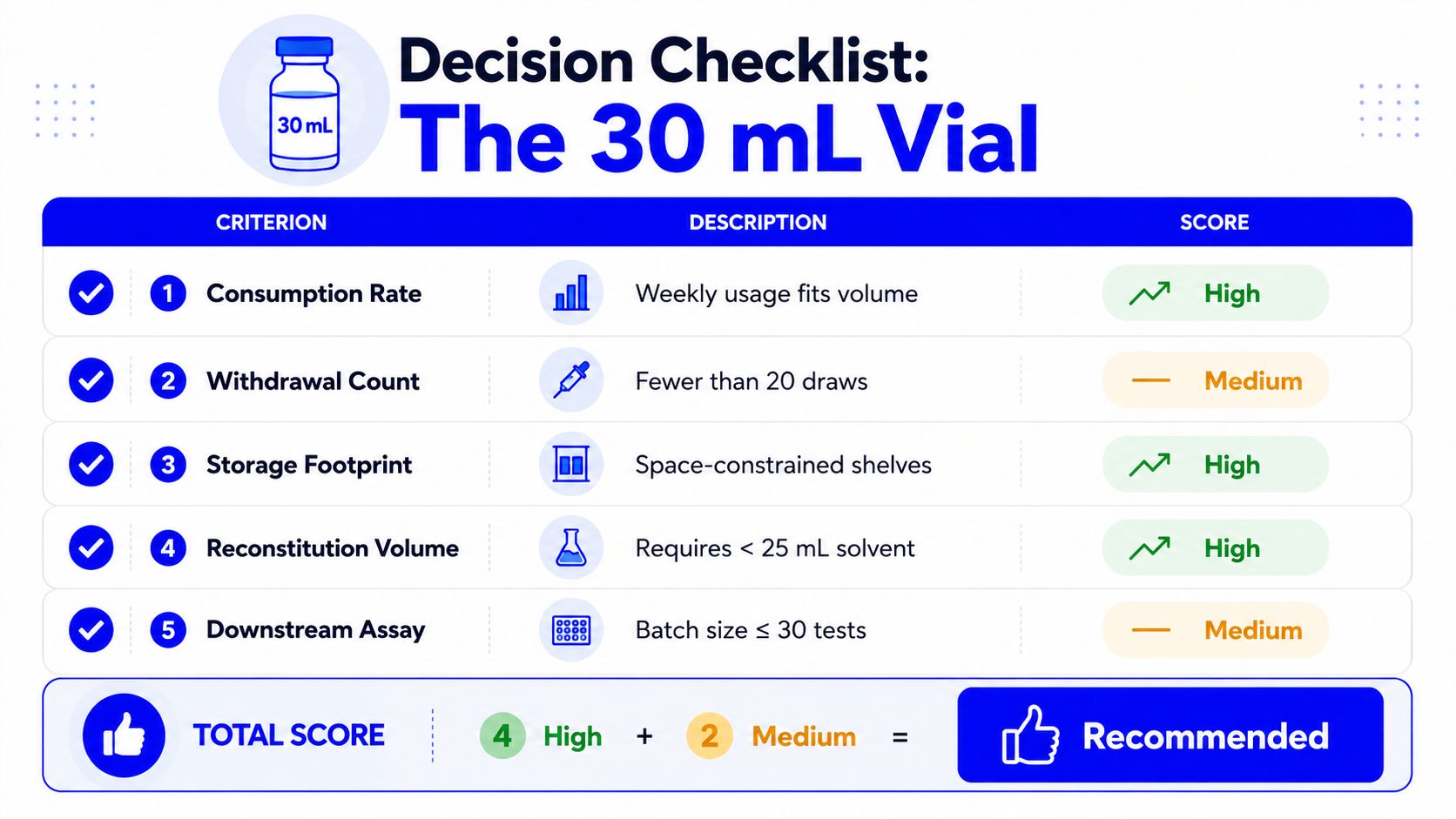
The decision can be made with five practical questions:
- Consumption rate: Will the planned weekly use steadily reduce the contents?
- Withdrawal count: Can the workflow limit repeated access and maintain consistent aseptic technique?
- Storage footprint: Does one vial fit the available rack, tray, or controlled storage system?
- Reconstitution volume: Does the final working preparation need more room than a smaller vial comfortably provides?
- Assay batch size: Will one preparation support the intended run without leaving a large remainder?
Green-light scenarios
A 30 mL format generally fits a multi-week research study with scheduled withdrawals, a screening run that uses one prepared solution across several assay plates, or a lyophilized reagent that will be consumed before the applicable beyond-use date. In each case, the larger container can reduce transfers and simplify inventory.
A smaller vial is often more sensible for a single experiment, a low-frequency workflow, or a preparation vulnerable to repeated temperature changes. Splitting material into smaller single-use units may protect the workflow when the contents won't be consumed quickly.
Decision test: The right vial is the one that reaches useful consumption before the discard date, not the one with the lowest purchase price per container.
Cost per milliliter only improves when the contents are used. A 30 mL vial filled for a slow workflow may create more waste than several smaller containers, even if the larger unit appears economical on the catalog page. The selection should therefore be based on a consumption forecast, not volume alone.
Herbilabs offers research-use-only sterile diluents and reconstitution solutions in multiple vial formats, including 30 mL options, with lot-specific documentation for laboratory purchasing and preparation workflows. Researchers comparing container sizes can visit Herbilabs to review the available formats and choose a solution that matches expected reconstitution volume, withdrawal frequency, and the applicable in-use period.