Private Label, White Label, Wholesale partnerships available - EU, USA and UK - Free shipping from €75

What Is a 0.22 Micron Filter Used for in Labs
A 0.22 micron filter is used to sterilize aqueous solutions by removing bacteria and particulates during lab production and research workflows. It provides a physical filtration barrier for buffers, diluents, media components, and other liquids that must move into a cleaner downstream process.
A bench scientist may already be facing the practical question. A lyophilized peptide is ready for reconstitution, a syringe is filled with diluent, and one pause remains before the liquid enters the vial: is the solution suitable for the next research step?
That question matters because a clear liquid isn't necessarily free of bacteria. A membrane filter can remove microbial contaminants without heating the solution or adding a chemical sterilant, but the filter's printed pore size isn't a complete guarantee by itself. Validation, membrane construction, material compatibility, and aseptic handling all affect the result.
Table of Contents
- Why a 0.22 Micron Filter Matters in the Lab
- How 0.22 Micron Filtration Actually Works
- Where 0.22 Micron Filters Are Used
- 0.22 Micron vs 0.45 Micron Filters
- Material Compatibility and Flow Rate Trade-offs
- 0.22 Micron Filtration in Peptide Reconstitution Workflows
- Choosing and Validating a 0.22 Micron Filter
Why a 0.22 Micron Filter Matters in the Lab
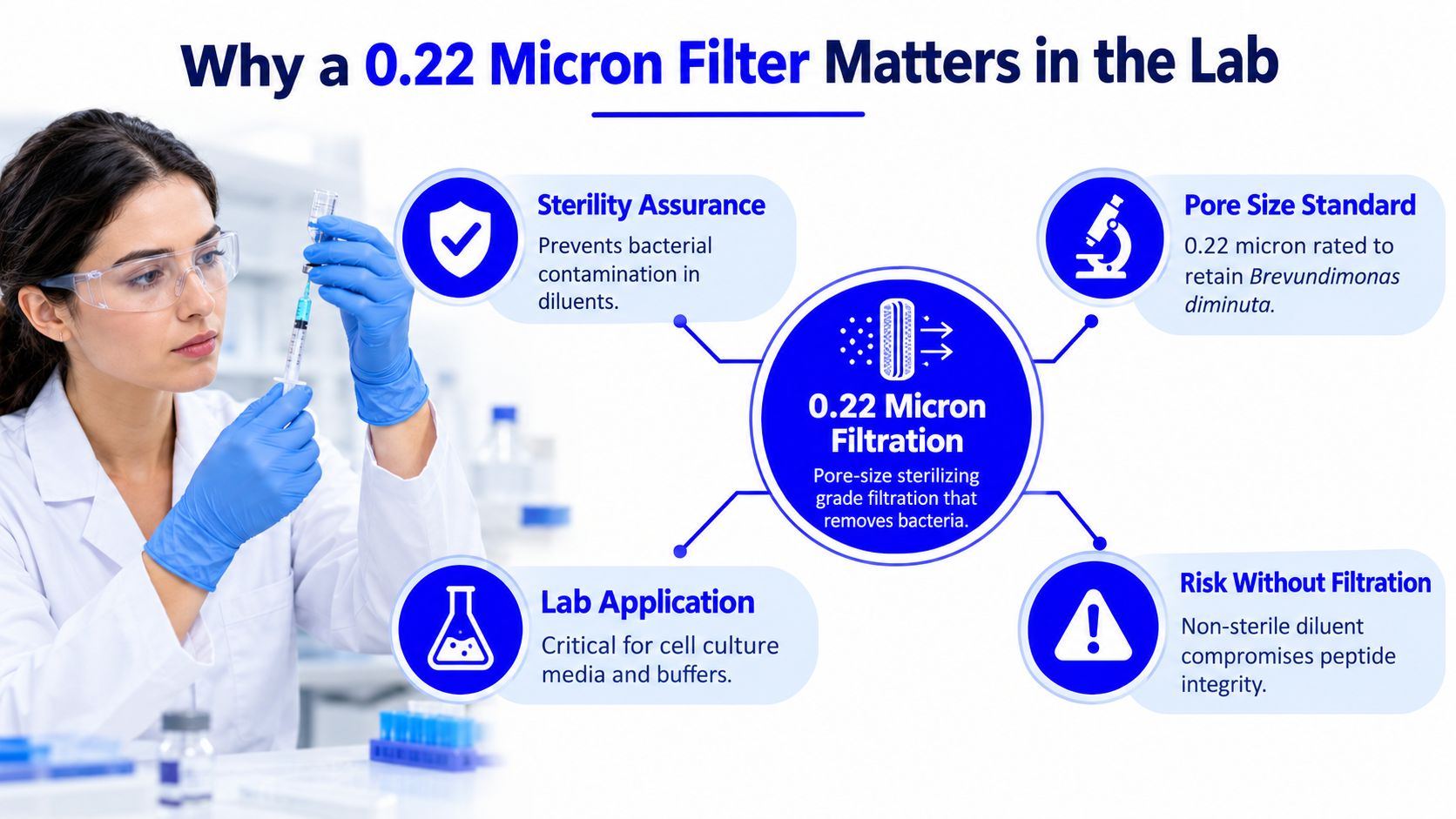
A 0.22 micron filter is a sterilizing-grade filtration device used primarily for aqueous liquids. The membrane contains extremely small passages that allow water and dissolved components to pass while retaining bacteria and larger particulates. In simple terms, it acts more like a highly engineered physical barrier than a chemical treatment.
A useful analogy is a fine mesh screen. A coarse screen may catch visible debris while allowing smaller particles through. A 0.22 micron membrane uses a much tighter, three-dimensional structure. The liquid can move through the membrane, while bacteria encounter a barrier formed by pore dimensions, winding pathways, and the membrane's retention characteristics.
The distinction between sterile filtration and absolute sterilization deserves attention. A filter doesn't make every possible liquid safe for every purpose merely because the label says 0.22 micron. Recent membrane-characterization work found that filters with a nominal 0.2 or 0.22 micron rating can have materially different measured pore structures, which is why validation should focus on demonstrated bacterial retention rather than pore size alone (recent membrane research).
Why downstream work depends on cleaner inputs
Cell culture media, assay buffers, protein solutions, and research diluents can all become compromised if microorganisms enter the workflow. Bacterial contamination may affect optical readings, consume nutrients, alter pH, or interfere with a cell-based experiment. The consequences aren't always visible at the moment of filtration.
For peptide work, the diluent is part of the preparation process, not a minor accessory. A researcher evaluating bacteriostatic water should consider both the liquid's production controls and the handling steps used after the vial is opened.
Practical rule: A 0.22 micron filter is a validated barrier within an aseptic process, not permission to treat every unvalidated setup as sterile.
The answer to what is a 0.22 micron filter used for is therefore precise: it supports the sterile filtration of aqueous research liquids before they reach a sensitive downstream application. The next question is how the membrane achieves that retention.
How 0.22 Micron Filtration Actually Works
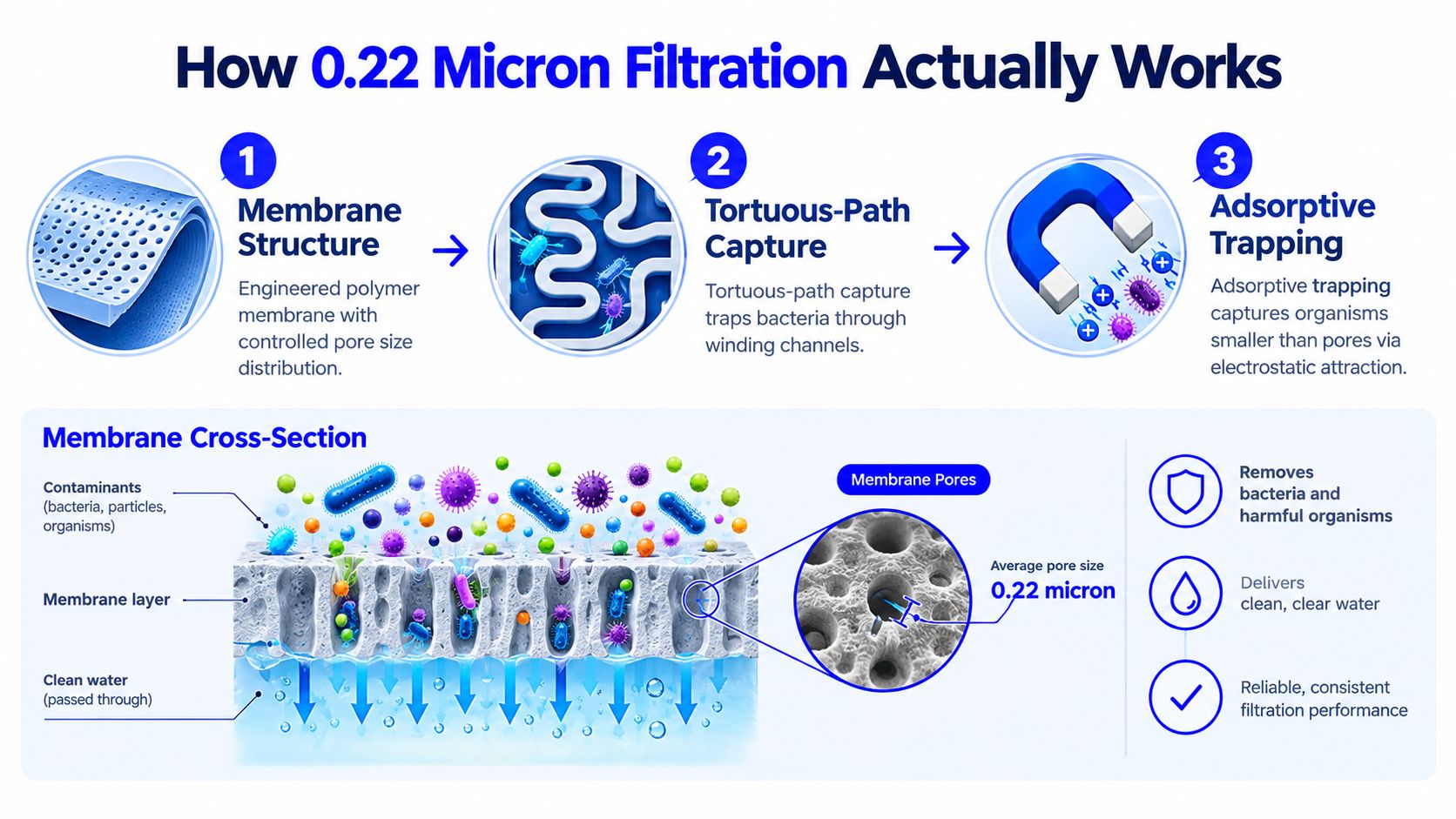
A membrane isn't a flat sheet with identical round holes punched through it. Its internal structure can include a distribution of pore pathways, varying tortuosity, and surface properties that influence how organisms and particles are retained.
As liquid enters, some contaminants are stopped at the membrane surface. Others travel a short distance into the structure and become trapped in narrower or winding channels. This is called tortuous-path capture. The route through the membrane isn't a straight tunnel, so an organism that appears small relative to the nominal rating may still encounter a constriction or an obstructed path.
Surface interactions add another retention mechanism. Adsorptive trapping can hold organisms or particles against the membrane through physical and electrostatic interactions. That doesn't mean the filter relies on adsorption alone. It means retention can involve several mechanisms operating together, which is another reason a pore-size label shouldn't be interpreted as a perfect measurement of every opening.
Why validation matters more than the label
Sterilizing-grade claims are based on performance against a standardized bacterial challenge. The commonly referenced test organism is Brevundimonas diminuta, and bacterial-retention testing is associated with ASTM F838 methods. A filter earns confidence through challenge testing and correlated integrity testing, not through the printed number alone.
The practical interpretation is important for a new researcher:
- Nominal rating: The manufacturer's stated pore-size designation.
- Membrane structure: The actual distribution and geometry of pathways through the material.
- Retention validation: Evidence that the filter retains the relevant bacterial challenge.
- Integrity testing: A non-destructive check, such as a bubble-point or diffusion test, that supports membrane reliability.
A 0.45 micron filter can clarify a liquid, but the smaller 0.22 micron rating is the established choice when a validated bacterial-retention step is required for an aqueous stream. The correct filter still depends on the organism of concern, the solution, the device design, and the process conditions.
The short video below can help visual learners connect the membrane rating with the physical filtration process.
Where 0.22 Micron Filters Are Used
A researcher can decide whether to filter a liquid by asking one practical question: must this solution reach the next step with bacteria and particulates removed? If the answer is yes, a validated 0.22 micron filter may fit. If the goal is only to remove visible debris or protect a downstream instrument, clarification may be sufficient.
Common laboratory uses include:
- Buffers and aqueous diluents: Filtering a prepared buffer can reduce the risk of introducing bacteria into a sensitive assay.
- Cell culture components: Media supplements and other heat-sensitive additives may require filtration when heat treatment isn't suitable for the formulation.
- Bacteriostatic water workflows: A filtered diluent can support an aseptic peptide-reconstitution process, provided the source, packaging, and handling controls are appropriate.
- Protein and peptide solutions: A low-protein-binding membrane may remove particulates while limiting unwanted loss of valuable material.
- Analytical samples: HPLC and mass spectrometry samples are often filtered to protect injection paths and reduce particulate-related disruption.
- Tissue culture additives: Supplements can be filtered before they contact cultures when the formulation and membrane are compatible.
Peptide reconstitution deserves special attention because many generic filtration guides focus on media or industrial fluids and overlook the diluent step. A researcher may filter a prepared bacteriostatic water solution before transferring it into a receiving vial, then evaluate whether the reconstituted peptide needs a second filtration step before an assay. That second decision depends on peptide concentration, membrane binding, formulation stability, and the intended experiment.
A filter also has to match the solution. A membrane that retains bacteria may still bind a peptide, release extractables, or resist flow when the liquid is viscous. The sterile endpoint isn't useful if the filter changes the formulation or reduces the recoverable sample.
For broader context on how filtration relates to sterilization equipment and process planning, the 2026 sterilization market guide offers a separate industry perspective.
| Application | Why 0.22 Micron Fits |
|---|---|
| Aqueous buffers | Supports bacterial retention before assay use |
| Cell culture additives | Helps reduce microbial introduction into cultures |
| Bacteriostatic water preparation | Provides a filtration step for an aqueous reconstitution diluent |
| Peptide and protein solutions | Can remove particulates when a compatible, low-binding membrane is selected |
| HPLC or mass spectrometry samples | Helps limit particulate entry into analytical equipment |
| Tissue culture supplements | Supports cleaner transfer into sensitive biological workflows |
The choice should remain process-specific. A liquid that only needs clarification may not need the added resistance and potential yield loss associated with a finer membrane.
0.22 Micron vs 0.45 Micron Filters
The difference between these filters isn't “small” versus “large.” Each rating serves a different purpose, and the right choice depends on the contaminant the lab needs to remove.
A 0.22 micron membrane is the usual choice for validated sterile filtration of aqueous solutions. It is designed for bacterial retention when supported by appropriate challenge testing. A 0.45 micron membrane is more commonly used for clarification, prefiltration, or reduction of larger particulate loads. It can improve clarity and protect a finer final filter, but it shouldn't automatically be treated as an equivalent sterile-filtration step.
Flow also influences the decision. The larger-pore membrane generally offers less resistance, while the finer membrane can develop more backpressure as contaminants accumulate. A lab may therefore use a coarser prefilter before a final 0.22 micron membrane when the feed contains substantial debris.
Three questions for the bench
- Is bacterial removal required? If the liquid must enter a sterile workflow, the 0.22 micron option is the relevant starting point.
- Is the liquid merely cloudy or particulate-laden? A 0.45 micron filter may be suitable for clarification, depending on the particles and process requirements.
- Does throughput matter? A larger membrane area, a prefilter, or a different device format may improve handling without changing the final retention target.
For peptide reconstitution and bacteriostatic water preparation, a 0.22 micron filter is the conservative choice when the intended outcome is a sterile working solution rather than a visually clearer liquid. That doesn't remove the need to verify compatibility or use aseptic technique.
| Attribute | 0.22 Micron Filter | 0.45 Micron Filter |
|---|---|---|
| Primary role | Sterile filtration of aqueous solutions | Clarification and prefiltration |
| Bacterial retention | Requires validated sterilizing-grade performance | Not automatically a sterile-filtration claim |
| Typical workflow | Buffers, diluents, media components | Particulate reduction and protection of finer filters |
| Flow behavior | Can create greater resistance | Often allows easier flow |
| Peptide use | Suitable starting point when sterility is required, subject to compatibility | Better suited to clarification unless the process specifies otherwise |
| Main caution | May reduce yield or clog with difficult formulations | May not provide the required bacterial-retention assurance |
A pore size isn't a substitute for a process specification. The lab should define the removal target first, then select the membrane and format.
Material Compatibility and Flow Rate Trade-offs
A 0.22 micron filter can retain the intended contaminants and still be the wrong device for a particular formulation. The membrane must tolerate the liquid, avoid excessive binding, and maintain enough flow for the planned handling step.
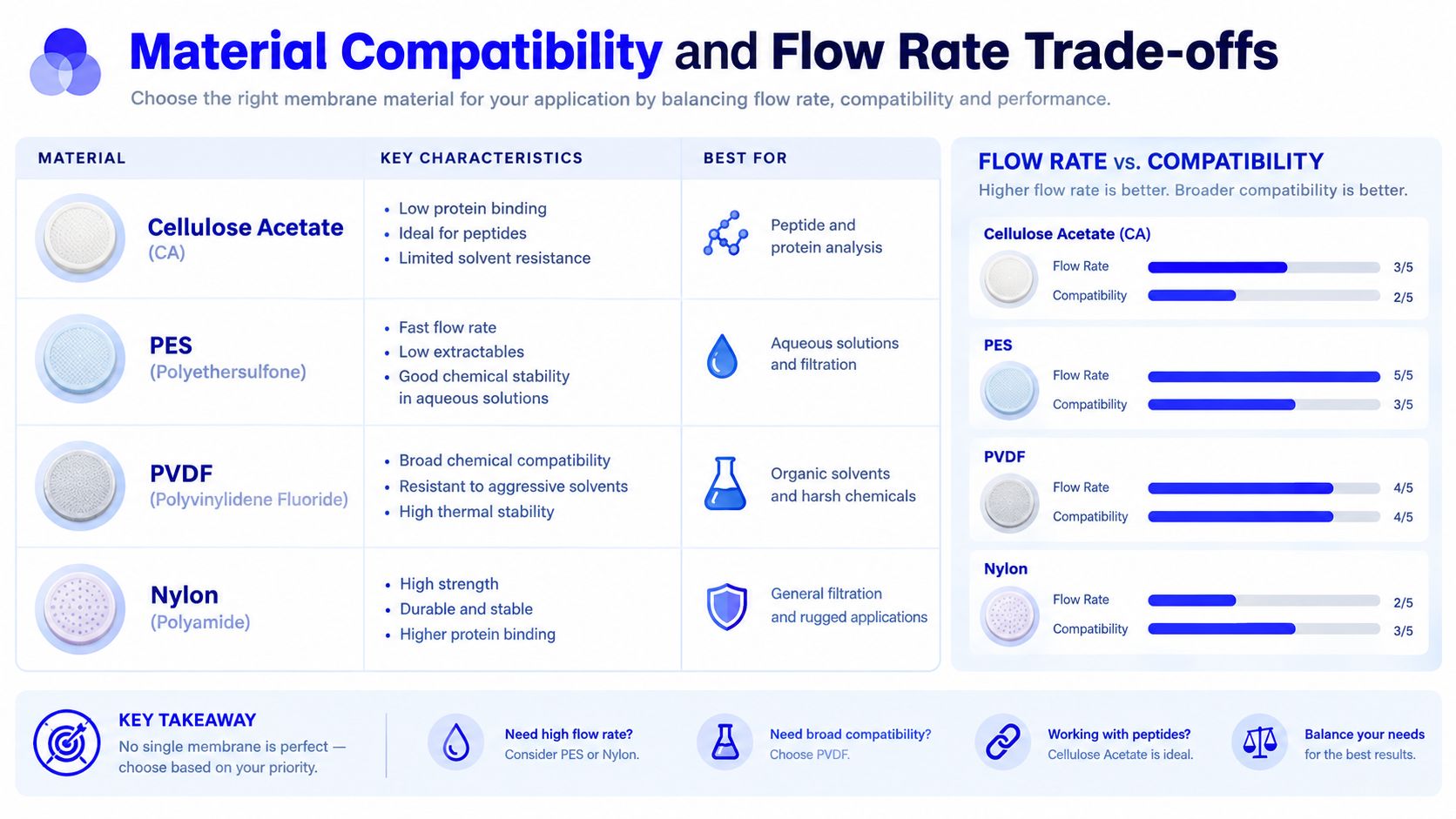
Cellulose acetate, or CA, is commonly considered for low-protein-binding aqueous buffers. Polyethersulfone, or PES, is often selected for aqueous protein and peptide work because it can provide low protein binding and useful flow characteristics. Polyvinylidene fluoride, or PVDF, offers broad chemical compatibility for suitable aqueous and solvent systems. Nylon is mechanically sturdy and versatile, but it can bind some peptides, proteins, and dyes.
Those descriptions are starting points, not universal guarantees. The same membrane family can behave differently depending on the formulation, concentration, pH, contact time, pressure, and device construction.
Flow is a design decision
The membrane area often matters as much as the pore rating. A 47 mm disc used with a vacuum flask can process liquid efficiently because it exposes more filtering surface. A 13 mm syringe filter is convenient for a small sample, but it may stall when the solution is viscous or contains a substantial particulate load.
A researcher should avoid forcing a blocked syringe filter with excessive plunger pressure. Rising resistance can signal fouling, poor compatibility, insufficient prefiltration, or an unsuitable device size. For valuable peptide solutions, a larger compatible membrane can sometimes reduce contact stress and improve recovery.
The housing also deserves review. Laboratory filter units commonly use polypropylene housings, but the housing, seals, and membrane all need compatibility checks. Alcohols, acids, preservatives, and solvent components can interact with the complete assembly rather than the membrane alone.
Bench check: If flow slows sharply, stop and investigate the formulation, membrane, surface area, and pressure. Speeding up the plunger doesn't validate the filter.
Yield is another trade-off. A filter can remove unwanted particles while also retaining some product through adsorption or hold-up volume. For proteins and peptides, the selected material should be evaluated with the actual formulation, not only with water.
0.22 Micron Filtration in Peptide Reconstitution Workflows
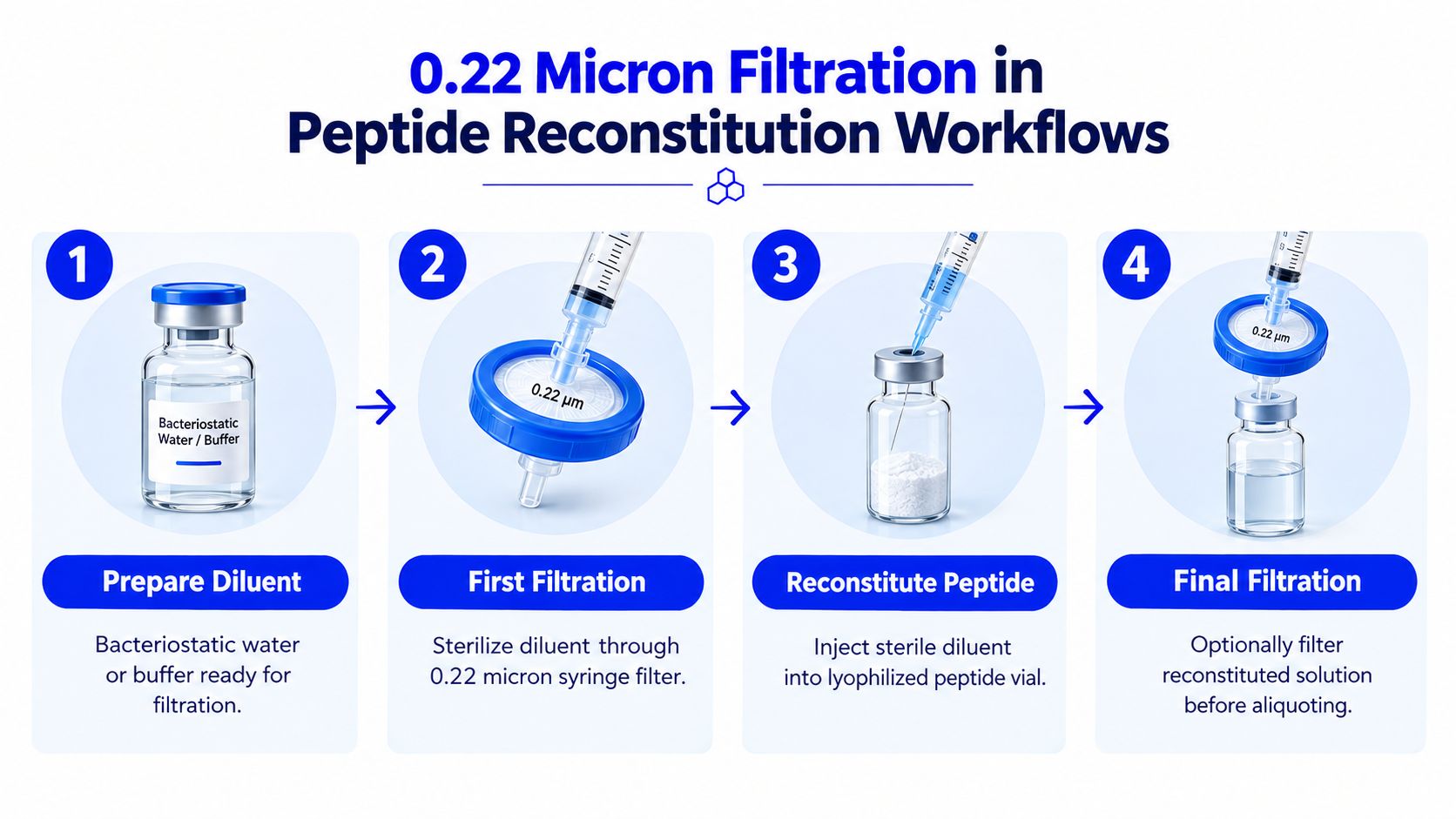
In a research peptide workflow, the 0.22 micron filter may appear at more than one decision point. The first is the diluent. The second may be the reconstituted solution, but only when the formulation, peptide, and assay protocol support that step.
A typical sequence begins with a sterile diluent or a prepared aqueous buffer. The researcher transfers the liquid through a sterile 0.22 micron syringe filter or disc assembly into a sterile receiving vial, using a controlled work area. The filtered diluent then enters the lyophilized peptide vial for reconstitution.
The final solution deserves a separate assessment. A low-protein-binding PES filter may be considered when the reconstituted material must be particulate-free before an assay or aliquoting step. However, filtration can affect recovery, and a membrane that works well for the diluent may not be appropriate for the peptide itself.
Aseptic technique remains part of the filter system
The membrane only protects the liquid that passes through it. It doesn't protect an open receiving vial, an unclean septum, a contaminated syringe, or a workspace that introduces organisms after filtration.
A disciplined workflow includes:
- Sterile components: Use sterile syringes, needles, receiving vessels, and filter units appropriate for the process.
- Clean contact points: Disinfect vial septa and avoid touching sterile connection surfaces.
- Controlled handling: Keep the receiving container closed whenever the procedure doesn't require access.
- Low-stress transfer: Use gentle pressure and replace a filter that becomes blocked or damaged.
- Documented sequence: Record the material, filter lot, formulation, and handling conditions.
A researcher considering a ready-to-use reconstitution solution should still check the product documentation and confirm that its intended RUO use matches the laboratory's protocol. The filter is one link in an aseptic chain, not a replacement for that chain.
The connection between bacteriostatic water and peptide reconstitution is easy to miss. The diluent carries directly into the peptide vial, so its microbial status, preservative compatibility, storage, and withdrawal practice all influence the reliability of the working solution.
Choosing and Validating a 0.22 Micron Filter
The best selection process starts with the liquid and the removal target, not the catalog photograph. A lab should first decide whether the task involves sterile filtration of a finished aqueous solution, clarification of a particulate-heavy feed, or another microbial-control objective.
A practical selection checklist
- Define the target: Identify whether bacteria, particulates, or another contaminant is the concern.
- Match the membrane: Consider PES for low-binding aqueous protein and peptide work, PVDF for broader chemical compatibility, CA for suitable aqueous buffers, and nylon where its binding profile fits the formulation.
- Choose the format: Select a syringe filter, disc, capsule, or larger assembly according to sample volume, viscosity, and available pressure.
- Confirm packaging: Check whether the unit is supplied sterile and whether the packaging protects it until use.
- Review compatibility: Test the membrane, housing, seals, and formulation together, including preservatives such as benzyl alcohol where relevant.
- Verify integrity: Use an appropriate bubble-point, diffusion, or related integrity test when the process requires documented filter performance.
- Check recovery: Confirm that the filter doesn't remove peptide activity or create unacceptable hold-up.
- Record the run: Capture the lot number, pre-wetting or conditioning step, pressure behavior, and sample outcome.
Reproducibility depends on records. A filter rating tells the team what the device is designed to do. A validated, documented process shows what it did in that formulation.
For peptide workflows, a positive control and a recovery check can reveal whether the membrane is retaining the intended material along with contaminants. Teams that need a broader contamination-control framework can review these proven lab sterility steps.
The central answer remains straightforward. A 0.22 micron filter is used to provide validated bacterial-retention filtration for aqueous research liquids, but its success depends on membrane design, compatibility, flow control, integrity testing, and aseptic handling. Recent literature also cautions that widely used 0.2 or 0.22 micron polymer filters may not be well-suited to some larger non-protein biological therapeutics, so the smallest familiar rating isn't automatically the best choice for every high-value formulation (review of sterile filtration for biologics).
Herbilabs offers sterile, non-pyrogenic bacteriostatic water and reconstitution solutions for RUO peptide, protein, antibody, and lyophilized-material workflows, with aseptic filling, 0.22 micron filtration, and lot-specific Certificates of Analysis. Visit Herbilabs to review available diluent formats and supporting labware for a documented reconstitution process.