Private Label, White Label, Wholesale partnerships available - EU, USA and UK - Free shipping from €75
Tirzepatide Reconstitution Chart and Calculator: 5–60 mg Research Vials
Tirzepatide reconstitution chart for research vials from 5 to 60 mg: how much bacteriostatic water to add, the resulting mg/mL, what 10 units on a U-100 syringe holds, and how to reconstitute step by step.
Short answer: divide the mg in the tirzepatide vial by the mL of bacteriostatic water you add to get the concentration. A 10 mg vial with 2 mL is 5 mg/mL. A 30 mg vial with 3 mL is 10 mg/mL. A 60 mg vial with 3 mL is 20 mg/mL. On a U-100 syringe, 10 units is 0.1 mL, so it holds one tenth of the mg-per-mL figure.
Research use only. Tirzepatide is a prescription medicine; research-grade material is sold for laboratory use only. This page covers reconstitution and concentration maths for the lab. It recommends no amount and does not describe use in people or animals.
Tirzepatide reconstitution chart
| Vial | Bac water | Concentration | 10 units (0.1 mL) | 1 unit |
|---|---|---|---|---|
| 5 mg | 1 mL | 5 mg/mL | 0.5 mg | 50 mcg |
| 5 mg | 2 mL | 2.5 mg/mL | 0.25 mg | 25 mcg |
| 10 mg | 1 mL | 10 mg/mL | 1 mg | 100 mcg |
| 10 mg | 2 mL | 5 mg/mL | 0.5 mg | 50 mcg |
| 15 mg | 2 mL | 7.5 mg/mL | 0.75 mg | 75 mcg |
| 15 mg | 3 mL | 5 mg/mL | 0.5 mg | 50 mcg |
| 20 mg | 2 mL | 10 mg/mL | 1 mg | 100 mcg |
| 20 mg | 4 mL | 5 mg/mL | 0.5 mg | 50 mcg |
| 30 mg | 2 mL | 15 mg/mL | 1.5 mg | 150 mcg |
| 30 mg | 3 mL | 10 mg/mL | 1 mg | 100 mcg |
| 60 mg | 3 mL | 20 mg/mL | 2 mg | 200 mcg |
| 60 mg | 5 mL | 12 mg/mL | 1.2 mg | 120 mcg |
Tirzepatide reconstitution calculator
For any vial size and water volume not in the chart, use the peptide reconstitution calculator. Enter the mg on the vial and the mL of water, and it shows the concentration, the amount per unit and a syringe picture. The “How much water to add” tab works backwards: you enter the amount you want at a given unit mark, and it gives the water volume.
How much bac water to mix with 30 mg tirzepatide?
3 mL is the most common choice because it gives a round 10 mg/mL (1 mg in 10 units). 2 mL gives 15 mg/mL. For 10 mg vials, 1 or 2 mL are the usual volumes; for 60 mg vials, 3 to 5 mL.
How to reconstitute tirzepatide, step by step
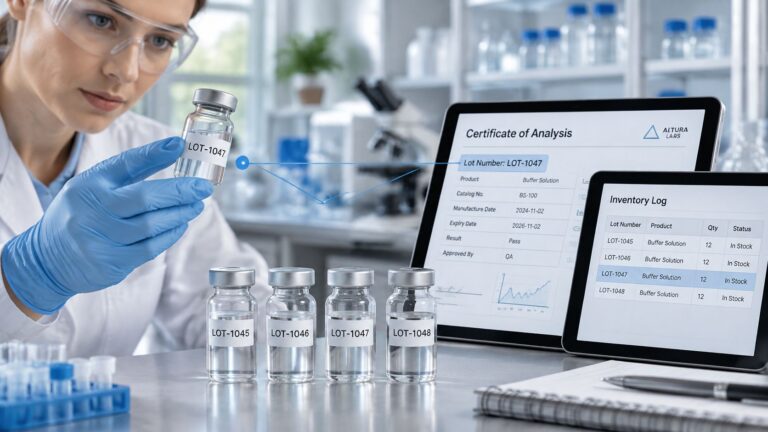
- Check the mg on the label and the batch on the COA.
- Let the vial and the bacteriostatic water reach room temperature.
- Wipe both stoppers with an alcohol swab and let them dry.
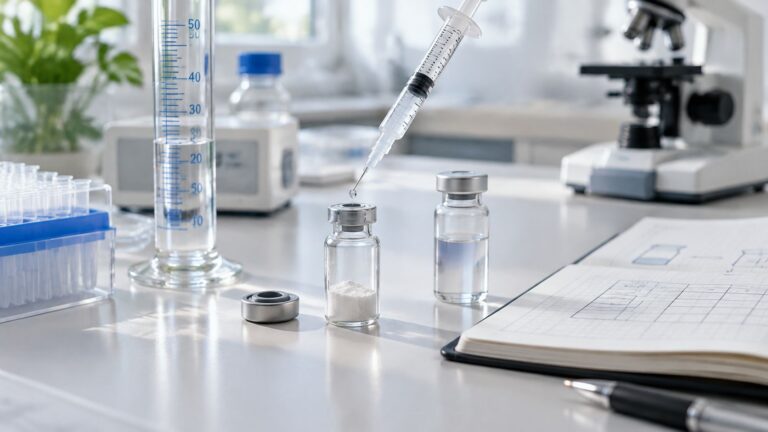
- Draw the planned volume of bacteriostatic water with a sterile syringe.
- Inject it slowly down the inside wall of the vial, not onto the powder.
- Swirl or roll gently until the solution is clear. Don’t shake.
- Label the vial with the date and the concentration.
- Keep it at 2–8 °C, away from light.
Mistakes that change the numbers
- Reading a U-40 syringe against a U-100 chart.
- Confusing mg and mcg (1 mg = 1,000 mcg).
- Forgetting that the concentration changes if you add more water later. Recalculate and relabel.
- Using sterile water for a vial that will be entered many times. Bacteriostatic water contains 0.9% benzyl alcohol to inhibit bacterial growth between entries.
Which bacteriostatic water
Herbilabs bac water comes in 10 mL multi-dose vials and 10 × 10 mL kits. It is made in the EU and every batch has a certificate of analysis. Unopened, it keeps at room temperature (15–25 °C); after the first puncture, use it within 28 days. More background: bac water for peptides and the general peptide reconstitution chart.
FAQ
How do you reconstitute 10 mg tirzepatide?
Add 1 mL (10 mg/mL) or 2 mL (5 mg/mL) of bacteriostatic water slowly down the vial wall and swirl until clear.
How much bac water for 60 mg tirzepatide?
3 mL gives 20 mg/mL; 5 mL gives 12 mg/mL. Check that the volume fits the vial.
Is there a tirzepatide reconstitution chart PDF?
The chart on this page can be printed from your browser (Print → Save as PDF).
Can tirzepatide be mixed with sterile water?
Yes, for single use. For a multi-use vial, bacteriostatic water is the usual choice because of its preservative.
For research and laboratory use only. Not for human or veterinary use. Herbilabs supplies bacteriostatic water only.