Private Label, White Label, Wholesale partnerships available - EU, USA and UK - Free shipping from €75

Sodium Chloride Used for Essential Applications Guide
A lab technician preparing a sample may reach for saline because it seems like a simple, familiar liquid. In another room, a facilities crew spreads rock salt over an icy walkway, while a food preparer uses salt to season or preserve ingredients. Each task involves sodium chloride, but the material's concentration, purity, formulation, and intended use determine whether it fits.
That distinction matters especially in research and pharmaceutical workflows. Sodium chloride can be a food ingredient, a chemical feedstock, or part of a carefully specified solution. The useful question isn't only what sodium chloride is used for, but which form and concentration suit the job.
Table of Contents
- Where Sodium Chloride Fits in Daily Work
- Understanding Sodium Chloride and Its Effects
- Comparing Everyday and Industrial Uses
- How Concentration Changes Sodium Chloride
- Laboratory and Clinical Applications
- Choosing the Right Sodium Chloride Format
- Make Compatibility and Traceability Part of the Workflow
Where Sodium Chloride Fits in Daily Work
At home, a person sprinkles salt over a salad or uses it to help manage ice on a path. In a lab, a researcher may measure sodium chloride into a buffer, or check whether a supplied saline is compatible with a sample. The familiar white crystals can appear in all these situations, but they aren't interchangeable just because they share a chemical name.

Salt's effect changes with its surroundings. In food, it can add flavor and support preservation. On an icy surface, it serves a physical role by helping lower water's freezing point. In solution, sodium chloride supplies dissolved ions that influence the conditions around cells, proteins, and other materials. In industry, concentrated brine can serve as a starting material for chemical production.
For a laboratory worker, those differences make product selection more important than appearance. Food-grade salt, industrial brine, reagent-grade material, and sterile saline may all contain sodium chloride, yet their purity, additives, sterility, and documentation can differ. A solution intended for one task shouldn't be assumed suitable for another.
People comparing salt with other sources of sodium for hydration can consult the NZ Supps hydration guide. That context concerns dietary or hydration choices, not a substitute for checking a laboratory reagent's specifications or a product's validated instructions.
Understanding Sodium Chloride and Its Effects
Sodium chloride's behavior becomes easier to understand once it dissolves. In water, it separates into sodium ions and chloride ions. These dissolved particles affect the solution around them, so a researcher isn't working with an unchanged powder after mixing it into a sample.
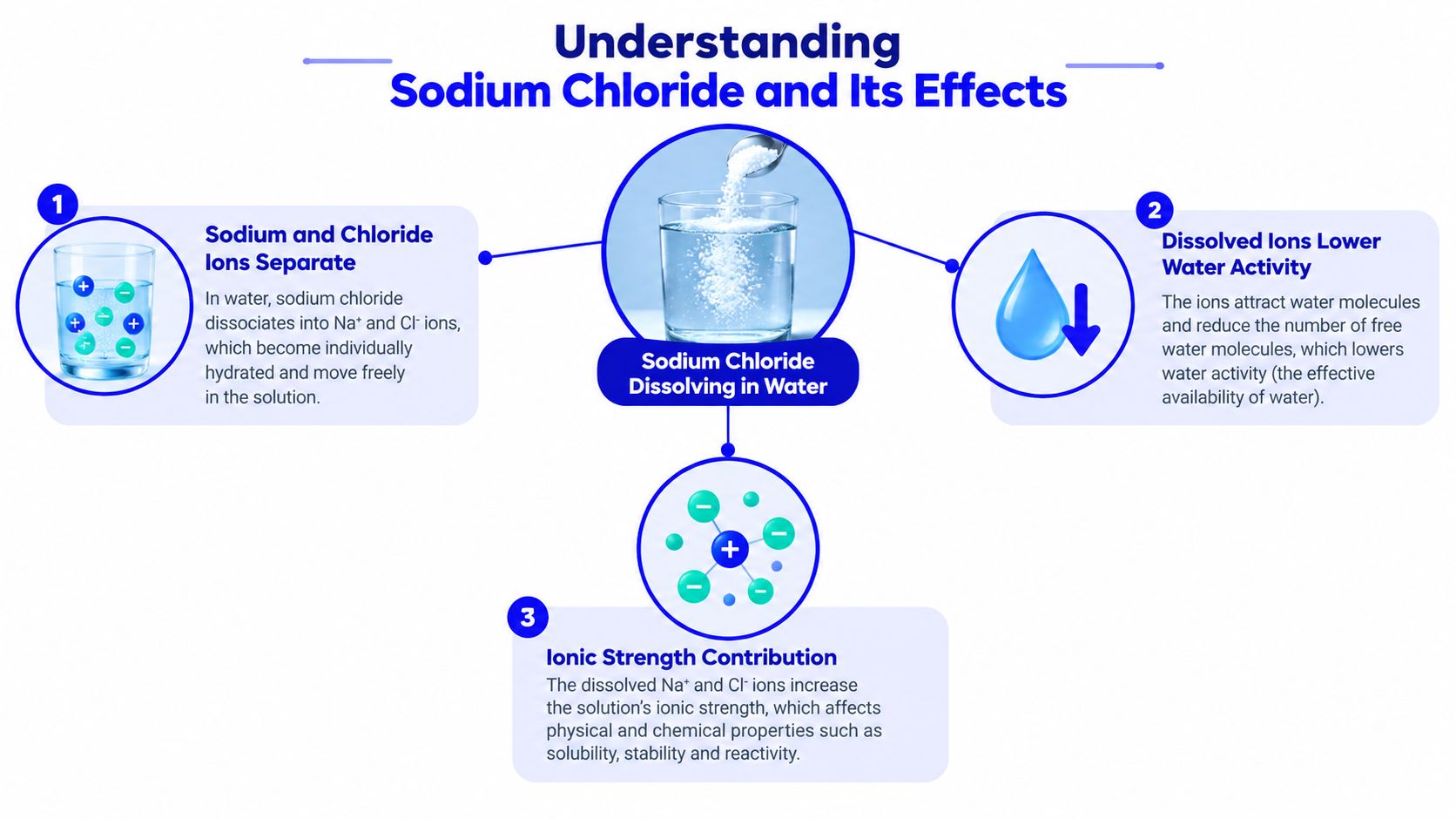
A simple analogy is a room filling with people. The more people enter, the more likely they are to affect movement through the room. Similarly, adding more dissolved sodium chloride increases the number of ions in solution. Those ions can influence how other charged materials interact, a property described in part by ionic strength.
Water activity and microbial growth
Water activity describes how much water is available for processes such as microbial growth, rather than how much water a sample contains. High salt concentrations can draw water out of microbial cells and reduce water activity, slowing or preventing the growth of many spoilage organisms. This is why salting has long helped preserve food, although modern refrigeration and freezing have reduced reliance on salt as the primary preservation method. The historical and preservation context is described by the University of Bristol's overview of sodium chloride.
Osmotic effects and formulation
Osmosis describes the movement of water across a membrane in response to differences in dissolved-particle concentration. For cells and biological materials, changing the surrounding solution can affect water movement and cell volume. Proteins and other molecules may also respond to changes in ionic conditions, so salt isn't always a passive background ingredient.
The word “salt” can refer to the same compound in very different forms: crystals, brine, or a prepared solution at a defined concentration. Mass percentage, grams per liter, and ion concentration describe related but distinct things. Sodium content also isn't the same as the total mass of sodium chloride, because the compound contains both sodium and chloride. For another explanation of the distinction between a compound and a mixture, see NaCl compound or mixture explained.
For readers following health-related discussions of salt, Cardiogram's information about tracking POTS symptoms and salt intake offers a separate context. Dietary decisions and laboratory formulation decisions require different kinds of guidance.
Comparing Everyday and Industrial Uses
Sodium chloride does different jobs depending on whether it's used directly or transformed into something else. In a kitchen, it can season food or help preserve it. On roads and walkways, rock salt is spread for ice control. In chemical manufacturing, brine becomes feedstock for reactions that produce other industrial materials.
The scale of the industrial role is clear in U.S. consumption data. Reported salt consumption reached 51.8 million metric tons in 2019, while domestic production totaled 44.8 million metric tons. Ice control was the largest end use, at 42% of reported consumption. Chemical manufacturing accounted for 38.7%, or approximately 20 million metric tons, with salt supplying ions used in chlorine and caustic soda production. These figures and uses are reported in the U.S. Geological Survey's salt chapter.
Direct use and chemical conversion
The difference between road salt and industrial brine is not merely physical form. Road salt is used directly for ice control. Chemical manufacturers use sodium chloride as a source of ions, converting it through industrial processes into products that support applications such as plastics, paper processing, disinfectants, and solvents.
Food preservation is another direct use, but its purpose differs from deicing. Salt changes the conditions available to microorganisms and can help foods keep longer. A researcher adding sodium chloride to a buffer, by contrast, is controlling the solution environment for a particular method.
These examples also explain why a product's appearance isn't a reliable selection guide. White crystals may look alike but have different grades and impurity limits. Brine intended for industrial processing, food-grade salt, and laboratory reagents should be selected according to the task and the specifications it requires.
Match the material to the job
A useful first question is whether sodium chloride will be used directly or will take part in a controlled process. The next is what properties matter: flavor and preservation, ice control, ionic conditions, or chemical feedstock. The answer narrows the appropriate format before a worker considers a product label.
How Concentration Changes Sodium Chloride
Concentration determines how much sodium chloride is present in a solution. That quantity can be expressed as a percentage or as grams per liter, while osmolarity describes the concentration of dissolved particles that contribute to osmotic effects. These measures are connected, but they answer different questions about a formulation.
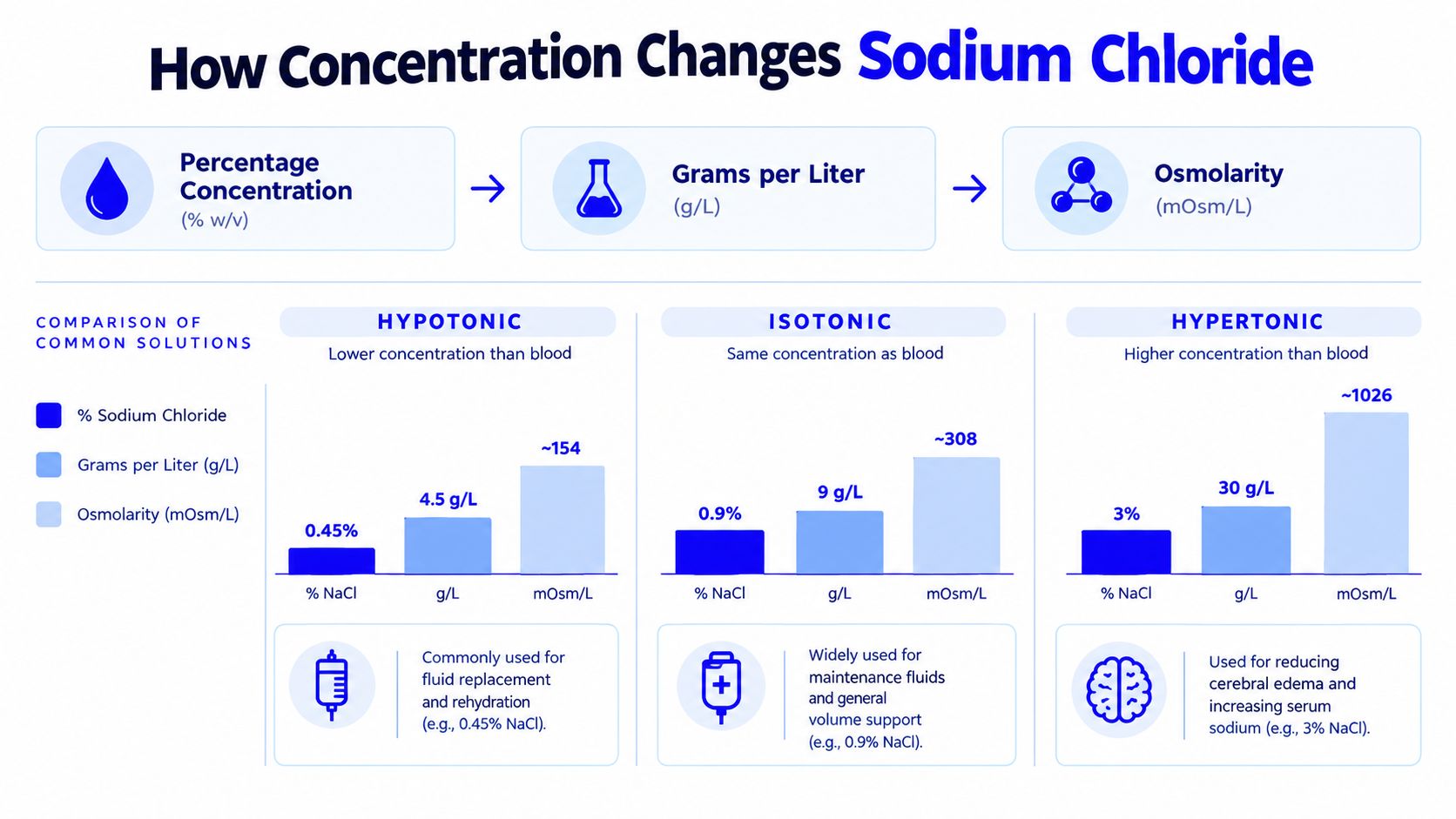
A reference point for physiological applications is 0.9% sodium chloride, which contains 9 g/L and approximately 154 mEq/L each of sodium and chloride, with a calculated osmolarity of about 308 mOsmol/L. That value is close to the osmolarity of extracellular fluid, but it doesn't guarantee compatibility with every sample or assay. The formulation and use context are described in the FDA labeling for sodium chloride injection.
Comparing representative concentrations
| Concentration | Approximate amount per liter | Approximate osmolarity | General description |
|---|---|---|---|
| 0.45% | 4.5 g/L | 154 mOsmol/L | Hypotonic |
| 0.9% | 9 g/L | 308 mOsmol/L | Near-isotonic |
| 3% | 30 g/L | 1,025 mOsmol/L | Strongly hypertonic |
The 0.45% solution is hypotonic relative to the stated physiological reference, while 3% solution is strongly hypertonic. A shift in concentration changes the number of dissolved particles around a cell or sample, which can affect water movement and cell volume. For proteins and other biological materials, salt level may influence solubility, aggregation, or assay behavior.
Practical rule: Treat concentration as a controlled formulation variable, not a label detail that can be ignored.
Calculated osmolarity helps describe a solution, but it can't settle compatibility on its own. A peptide, protein, antibody, cell system, or analytical method may have specific requirements for pH, ionic strength, and other solution components. Saline that suits one protocol may interfere with another, so the target material's instructions and validated method remain decisive.
Laboratory and Clinical Applications
In clinical practice, sterile sodium chloride solutions can provide water and electrolytes, replace extracellular fluid, or act as a vehicle or diluent for compatible parenteral drugs. Those uses depend on the product and the drug's instructions; they aren't general directions for administration. Information about supplies used in care settings can be found in this overview of healthcare industry supplies.
Research laboratories use sodium chloride in different ways. It may be included in physiological saline or buffers such as PBS and SSC, used in DNA-processing workflows, or incorporated into protein crystallization conditions. It can also be selected to reconstitute a lyophilized material, provided the target reagent's instructions allow it.
A controlled background condition
In a buffer, sodium chloride is more like a controlled background condition than a universal replacement for missing ingredients. It can contribute ions and ionic strength, but it doesn't automatically supply the buffering capacity or other components a method needs. Adding saline to a solution that requires a specific buffer may leave important chemical conditions uncontrolled.
A researcher preparing a protein sample, for example, needs to check the method rather than assume that isotonic saline is a neutral choice. The appropriate solution can depend on the protein's solubility, the assay, pH, and the required salt level. For nucleic-acid workflows, salt may support particular steps, but the concentration and buffer recipe still need to match the protocol.
Verify the whole formulation
A label that says “sterile” doesn't answer every laboratory question. The researcher may also need to verify purity, pyrogen status, preservatives, pH, container type, concentration, and compatibility. These characteristics can matter for downstream purification, cell handling, and reproducibility.
Clinical products and research-use-only preparations also serve different purposes. A clinical product must be used according to its authorized labeling and professional direction. A research reagent must match its laboratory protocol and shouldn't be treated as suitable for patient care.
Choosing the Right Sodium Chloride Format
The right format is the one that meets the protocol's requirements, not the one that contains sodium chloride. A sterile saline, a preserved reconstitution solution, dry reagent-grade salt, a prepared buffer, and industrial brine have different specifications and uses.
| Format | Relevant characteristics | Selection question |
|---|---|---|
| Sterile saline | Defined sodium chloride concentration; intended for specified sterile uses | Does the protocol call for this concentration and formulation? |
| Preserved reconstituting solution | May contain a preservative and be intended for a defined reconstitution workflow | Are the preservative and other ingredients compatible with the target material? |
| Reagent-grade salt | Solid material selected according to reagent purity and impurity limits | Does the method require a particular grade or traceability record? |
| Prepared buffer | Contains sodium chloride alongside other ingredients, with a defined formulation | Does the complete buffer composition match the validated method? |
| Industrial brine | Process feedstock with specifications tailored to industrial use | Is it suitable for the process, rather than for laboratory or biological use? |
Herbilabs provides an example of a research-use-only reconstitution option: its described bacteriostatic water is sterile and non-pyrogenic, contains 0.9% benzyl alcohol, and is supplied in multiple vial formats for research workflows. That preserved solution is not automatically interchangeable with plain sterile saline or a buffer. Its ingredients and intended use need to fit the protocol.
A practical selection check should include the sodium chloride concentration, sterility, pyrogen status, preservatives, pH, container format, intended use, and available product documentation. Researchers considering saline for peptide work can also consult these peptide compatibility and osmolarity notes. The key question is whether the complete formulation matches the method, not whether the label contains a familiar ingredient.
Make Compatibility and Traceability Part of the Workflow
Sterility alone doesn't establish compatibility. A solution can be sterile and still have a pH, ionic strength, preservative, or concentration that disrupts a reconstitution or assay. Chloride sensitivity, solubility, adsorption, and precipitation can also matter, depending on the target material and method.
FDA labeling offers a clear reminder for drug preparation: sodium chloride may be used to dilute or dissolve a drug only according to its manufacturer's instructions, because some drugs are incompatible with it. The same principle applies in research. A researcher should follow the target reagent's validated instructions rather than assuming that saline is a universal diluent.
A reliable workflow makes the key checks part of routine preparation:
- Confirm the formulation: Check concentration, pH, additives, and other listed ingredients.
- Check compatibility: Follow the target material's instructions and assess whether the chosen solution suits the method.
- Record traceability: Document the product and lot used, along with relevant preparation details.
- Control handling: Use appropriate aseptic technique and follow the product's in-use guidance.
These checks help distinguish a suitable solution from one that merely looks right. When deciding what sodium chloride is used for in a specific workflow, the answer should identify the required concentration, formulation, purity, and handling conditions, then confirm that the selected material meets them.
Herbilabs supplies sterile diluents and reconstitution solutions for research-use-only workflows, with product documentation and multiple vial formats. Researchers assessing a diluent can visit Herbilabs to review the available options and compare them with their protocol requirements.