Private Label, White Label, Wholesale partnerships available - EU, USA and UK - Free shipping from €75

How to Store Peptide Powder: RUO Lab Best Practices
You pull a vial from the freezer, the label is smudged, the powder looks a little clumped, and the experiment that depends on it is already on the schedule. That's the moment peptide storage stops being a housekeeping task and becomes a data-quality problem. The peptide may still be physically present, but if it picked up moisture, warmed too long on the bench, or got opened cold, the result can be a flat curve, a noisy replicate set, or a wasted week of assay work.
How to store peptide powder well is mostly about preventing invisible damage before anyone notices the reagent changed. The good news is that the best routine is simple, as long as it's disciplined, and it starts with leaving dry peptide in its most stable form until the moment it's needed. That's why the handling choices you make at receipt, during staging, and at the freezer door matter more than most new researchers expect. For a quick primer on the physical form itself, see what lyophilized peptide means.
Good storage is a reproducibility habit. That's true across RUO labs, and it's the same logic behind broader data-quality failures in regulated work, where small process slips cascade into bad decisions, as shown in digna analyzes data quality issues.
Table of Contents
- Why Peptide Powder Storage Decides Your Results
- Setting the Right Temperature for Lyophilized Powder
- Controlling Humidity, Light, and the Warm-Up Step
- Packaging, Labeling, and Freezer Organization
- Managing Reconstituted Peptides and Freeze-Thaw Risk
- Inventory Rotation and Documentation Habits
- Putting It All Together in a Reproducible Workflow
Why Peptide Powder Storage Decides Your Results
A researcher opens a vial expecting clean reconstitution, and the powder looks slightly damp or compacted instead. The assay still runs, but the signal does not behave like the previous batch, and the first instinct is to blame the instrument, the plate, or the cell line. In practice, the problem usually starts earlier, with how the peptide was received, dried, sealed, labeled, and returned to cold storage.
A peptide powder can look fine and still be compromised. That is why storage belongs in the same decision workflow as receipt, staging, and inventory control, not as a loose bench habit that gets handled differently by each person on shift. For a plain-language overview of the physical form, see what lyophilized peptide means.
The failure is usually invisible until the data moves
Dry peptide is kept because the powder state is the most stable state before reconstitution, and peptide handling guidance from peptide storage and handling guidance describes lyophilized material as commonly stored at -20°C for long-term stability, with dry material potentially remaining usable from 3 months to 5 years depending on formulation and handling, as long as moisture is controlled and the vial stays sealed in a desiccated environment. That range is wide for a reason. The freezer is not usually the problem. Moisture, light, and temperature swings are.
Bad peptide work often looks like bad biology. A sequence may still dissolve, yet degraded bioactivity shows up later as weak dose response, poor replicate agreement, or a result that will not transfer to the next run. Storage discipline has to sit at the front of the workflow, before the assay starts and before anyone assumes the reagent is clean because the label still looks intact.
Practical rule: if a peptide has to be questioned later, the answer should be on the label and in the log, not reconstructed from memory.
The best way to run peptide powder is to treat storage as the first quality-control step. A vial that stays dry, dark, and cold gives the assay its best chance of behaving the same way tomorrow as it did today. That is the standard to hold in RUO work, especially when a single reagent failure can send the team back through an entire run. As digna analyzes data quality issues shows, small process slips can become expensive downstream problems, even when the original error looked minor at the bench.
Setting the Right Temperature for Lyophilized Powder
Dry peptide belongs in the freezer, not on a general-purpose bench shelf. For long-term stock, the clearest guidance in the retrieved sources is lyophilized storage at -20°C or lower, with Bachem recommending < -15°C for longer storage and colder temperatures such as -50°C or below for long-term stability, while Sigma states that the most effective way to minimize degradation is lyophilized storage at -20°C or preferably -80°C (Bachem peptide handling guidelines).
Picking a freezer policy that people can follow
A lab doesn't need three different opinions on the same vial. It needs one default rule. For bulk stock, -80°C is the safest long-term choice when the peptide will sit for a while, especially if the sequence is more sensitive or the project timeline is uncertain. For a smaller working stock that will move faster, -20°C is commonly adequate when the peptide will be used within a shorter window and the vial stays dry and sealed.
The important distinction is this, refrigeration at 2–8°C is for reconstituted solutions, not for dry powder. That temperature range belongs later in the workflow, after the peptide has been mixed into a working solution and the storage problem has changed.
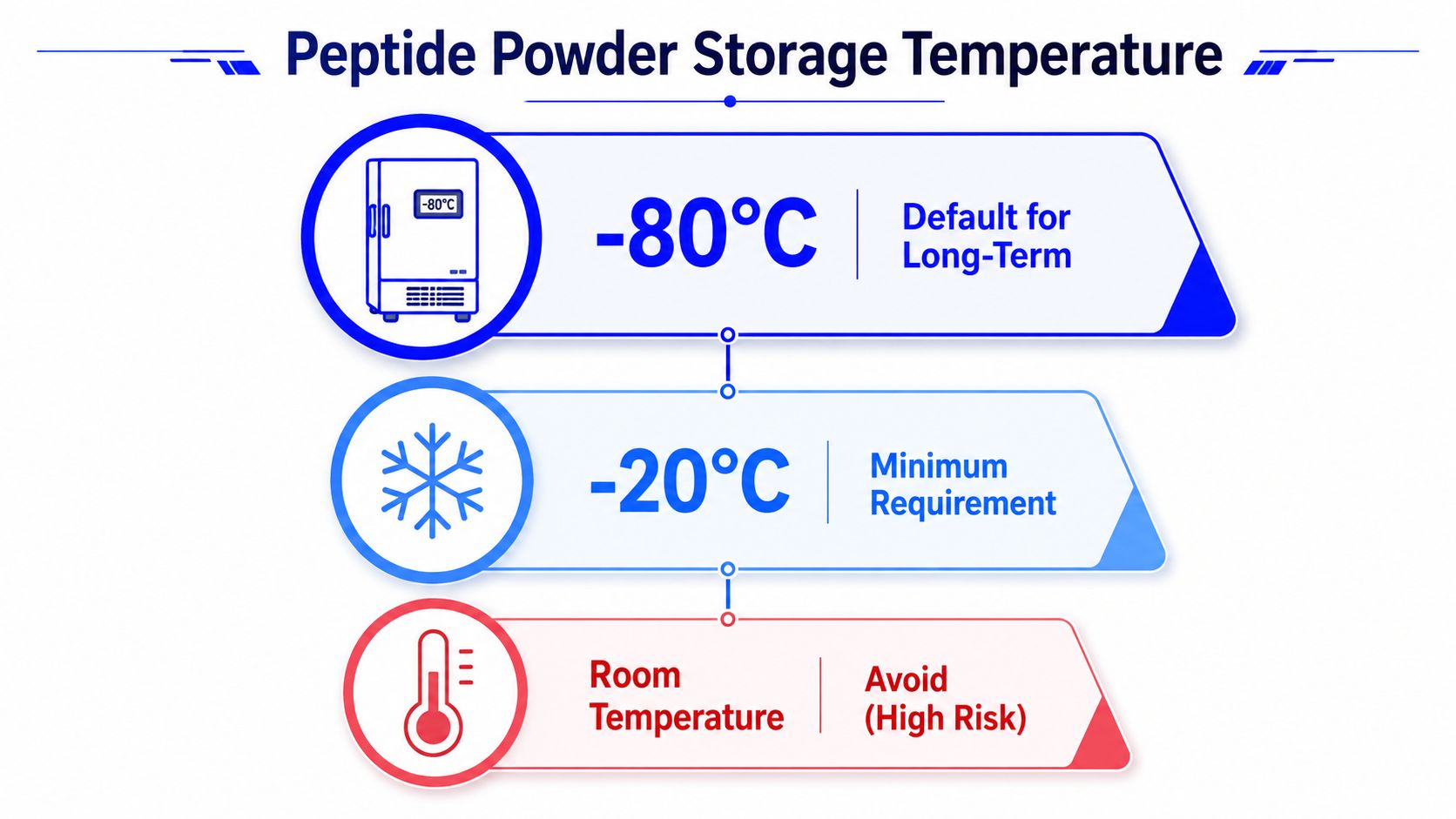
A practical freezer map helps. Keep the master stock at the back of a -80°C freezer in a sealed secondary bag with desiccant. Put short-term working powder in a designated -20°C location if your lab uses that as an intermediate step, and keep the path from freezer to bench as short as possible.
Best default: if the vial will live a long time, use -80°C. If it will move quickly and stay sealed, -20°C can work as a working powder location, but not as an excuse for casual handling.
A frost-free auto-defrost unit is a poor home for primary stock. Every temperature cycle adds avoidable stress, and a freezer that warms and cools itself is not the right place for material that depends on dryness and consistency.
Controlling Humidity, Light, and the Warm-Up Step
A cold vial that gets opened too early is one of the easiest ways to ruin dry peptide. Moisture condenses on the vial walls and on the powder itself, and that small mistake can change how the material handles later at the bench. The safer routine is simple. Let the sealed vial come all the way to room temperature before opening it, so the temperature shift does not pull water out of the air and onto the sample.
Warm sealed, then open once
Keep the vial sealed while it warms on the bench, and do not rush the first opening. In practice, that means leaving it alone until it no longer feels cold, then opening it in a dry area rather than in open room air. A desiccator or dry box gives you a cleaner transition because the vial is not exposed to humid air while the interior is still colder than the room.
That small habit prevents the failure mode that matters here. If a cold container is opened too soon, moisture can form before the powder is even handled, and once that happens the damage is already underway. A hygrometer for air quality is a practical bench check when staff need to confirm whether the room is dry enough for vial handling, not just comfortable to work in.
Light control matters too. Lyophilized peptide should stay protected from light whenever possible, especially sequences that are more sensitive to oxidation or other light-related stress. Amber vials, foil wrap, and dark secondary containers are straightforward protections that do not add much work and can reduce unnecessary exposure during storage and transport.
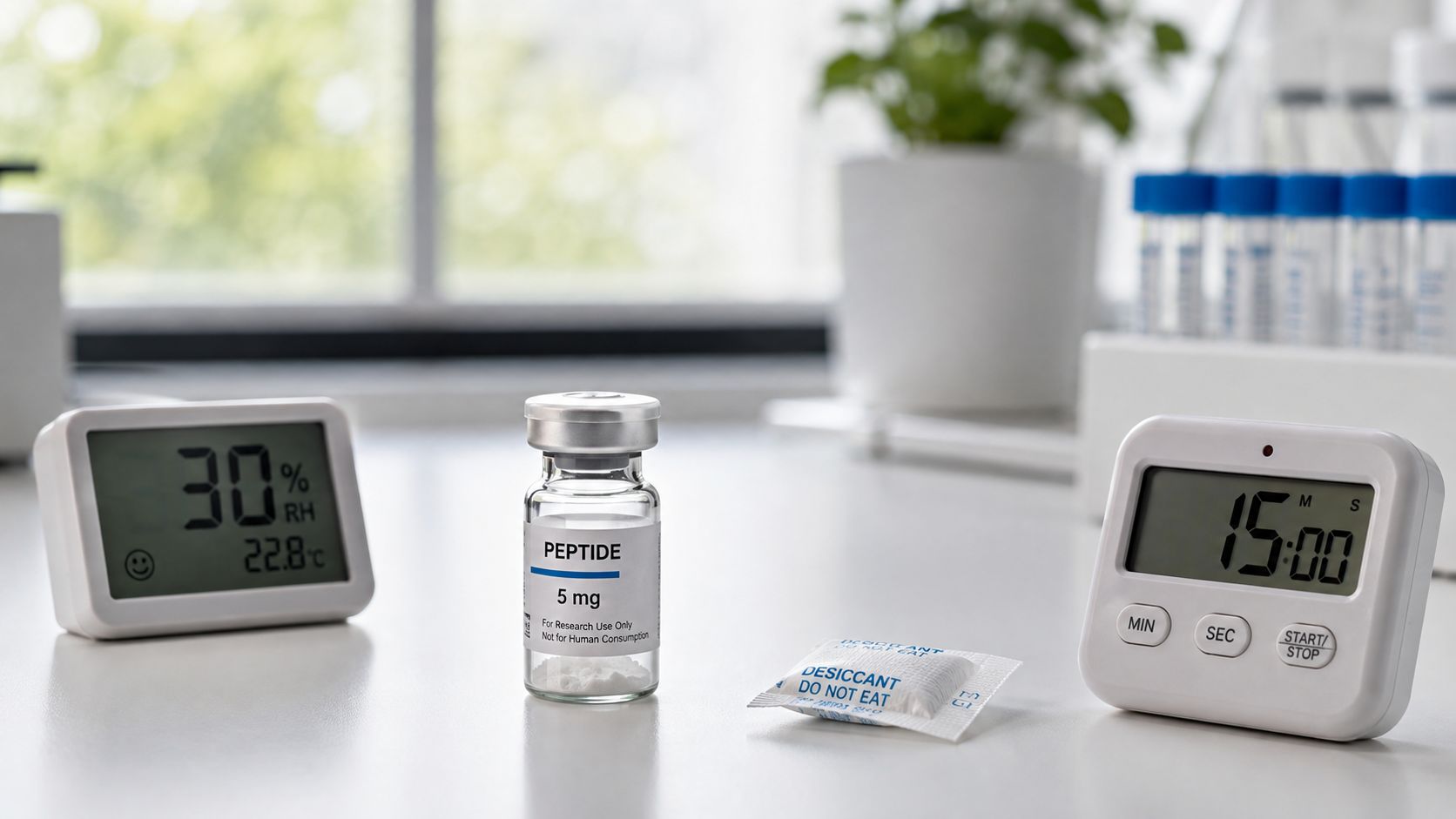
The fastest mistake is the one that looks efficient. Pulling a vial from the freezer and opening it right away saves a minute, then gives you a wet interior, clumped powder, and a sample that no longer reflects how it was stored.
Ten minutes of warm-up time beats ten days of wondering why the peptide behaves differently.
The bench routine should be boring. Keep the vial sealed while it warms, keep the room dry, and keep the open time short once the cap comes off.
Packaging, Labeling, and Freezer Organization
A peptide vial is inventory, not mystery material. The first layer is the supplier's primary vial, the second layer should be a sealed bag or similar secondary barrier with a desiccant sachet, and the third layer should be a labeled box or cryo-box slot that makes the vial easy to find without handling every neighboring tube. That layered setup reduces the odds that one sloppy retrieval spills humidity exposure across the rest of the stock.
What belongs on the label
A label should tell the next person enough to act without guessing. At minimum, that means the peptide ID, lot number, arrival date, reconstitution date if applicable, target storage temperature, and the researcher's initials. If a lab uses barcodes or QR labels in an electronic lab notebook system, the point is the same, the vial needs an identity that survives freezer audits and staff turnover.
The organization rule is physical separation. Keep pre-aliquoted powder away from reconstituted working vials, ideally on different shelves or in different freezers if the inventory is large enough. A withdrawn aliquot should never threaten the master stock, and a master stock should never be opened casually because the working vial ran out.
For teams that manage multiple lots, it helps to group by sequence family or project, not just by arrival order. That way a colleague can find the right material without opening every box in the rack.
The most common failure in freezer organization isn't lack of space, it's ambiguous labeling. A vial without a clear lot link or storage note becomes a question every time someone tries to use it, and questions cost time.
For a practical companion on sample identity and handling records, the labeling workflow in labeling reconstituted samples shows why the same discipline matters once peptide is in solution.
Bottom line: if anyone on the team can't identify a vial in one glance, the label is unfinished.
Managing Reconstituted Peptides and Freeze-Thaw Risk
Once peptide powder is in solution, the storage logic changes. The best-supported benchmark in the retrieved guidance is refrigeration at 2–8°C, with bacteriostatic water-based preparations commonly used for multi-dose handling and an in-use window of about 28 days under aseptic technique, while sterile water without benzyl alcohol is often cited as a much shorter-use option (peptide storage guide).
Choose one workflow and stick to it
Three practical modes show up in real labs. The first is refrigerated working solution, which fits multi-withdrawal routines when the peptide will be used repeatedly over a short period. The second is single-use aliquots for high-sensitivity assays, where any repeat thaw is unnecessary risk. The third is a short cold window for same-day or near-term use, when the solution will be consumed quickly and never needs a long hold.
The common thread is that reconstituted peptides should not be treated like powder. Several expert guides warn against freezing reconstituted solutions because repeated freeze-thaw cycling can damage structure and accelerate degradation. That means the decision belongs at the point of aliquoting, not after the vial has already been thawed and used once.
The bacteriostatic water workflow is useful for RUO teams because it supports routine multi-dose withdrawals when handled aseptically. It doesn't replace aliquoting when experimental sensitivity is high, and it doesn't justify leaving a solution warm on the bench between pulls.
A useful internal rule is simple. If the assay needs consistency more than convenience, aliquot first. If the material needs regular access and short refrigerated use, a bacteriostatic multi-dose approach can fit the job.
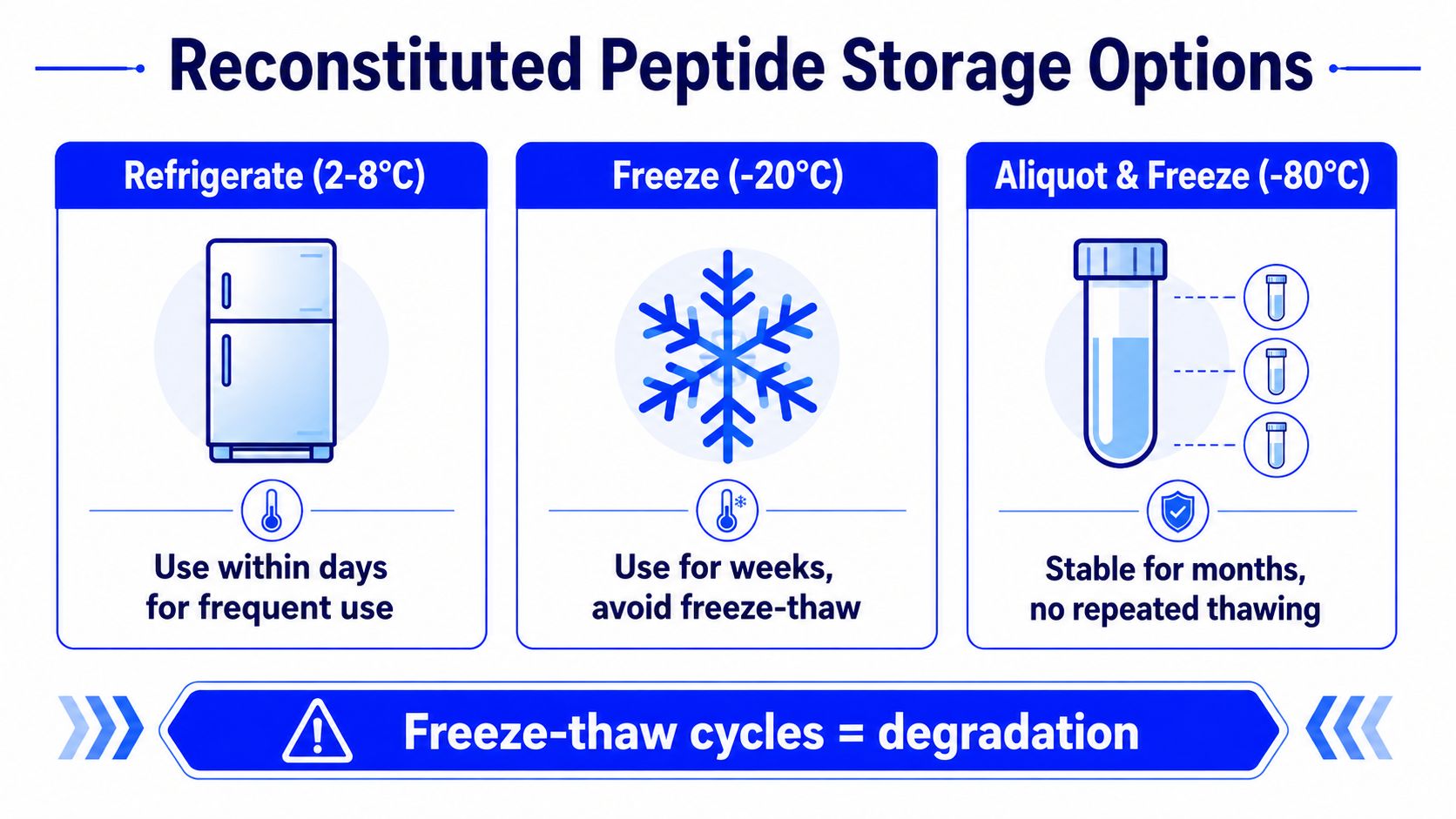
For stepwise solvent choice and preparation notes, mixing peptides with bacteriostatic water is the most relevant companion material for labs that need a multi-dose reconstitution path.
Use-case filter: refrigerate for routine access, aliquot for sensitivity, and never keep warming the same tube just because it's convenient.
The mistake to avoid is mixing storage modes within one study. A peptide that starts as a refrigerated multi-dose solution shouldn't be casually shifted into a freeze-thaw pattern later, because the comparison set stops being clean.
Inventory Rotation and Documentation Habits
Storage works best when it behaves like a system. The cleanest rule is first-expiry-first-out, or FEFO, which means the oldest lot leaves the shelf first and the newest stock stays untouched until it is needed. A freezer shelf organized by expiry date is easier to maintain, and it keeps a fresh vial from being opened while an older one sits forgotten in the back.
A receipt log should be simple enough that people use it, but complete enough to answer questions later. At intake, record the peptide name, supplier, lot, COA link, arrival date, storage location, and intended use. Each withdrawal should add the date, volume or mass removed, and the remaining amount, so the next person can tell whether the vial is still active stock or should be retired.
That record is not just for audits. It is the fastest way to sort out a problem at the bench. If a vial starts to drift in performance, the log helps the team check whether the issue came from storage age, repeated handling, or a label that no longer matches what was used.
Keep a periodic stability review on the calendar as part of routine stock control. The review does not need to predict chemistry. It should flag anything near its known shelf-life window and anything opened often enough that retirement makes more sense than another pull. If a lab uses ELN access, barcodes, or lot tracking, the same information should appear in both the physical inventory and the digital record.
Teams that already manage broader stock control can apply the same discipline to peptide materials through manage lab stock with Verbex, since the same habits, receipt logging, location tracking, and withdrawal records, prevent confusion across the whole shelf.
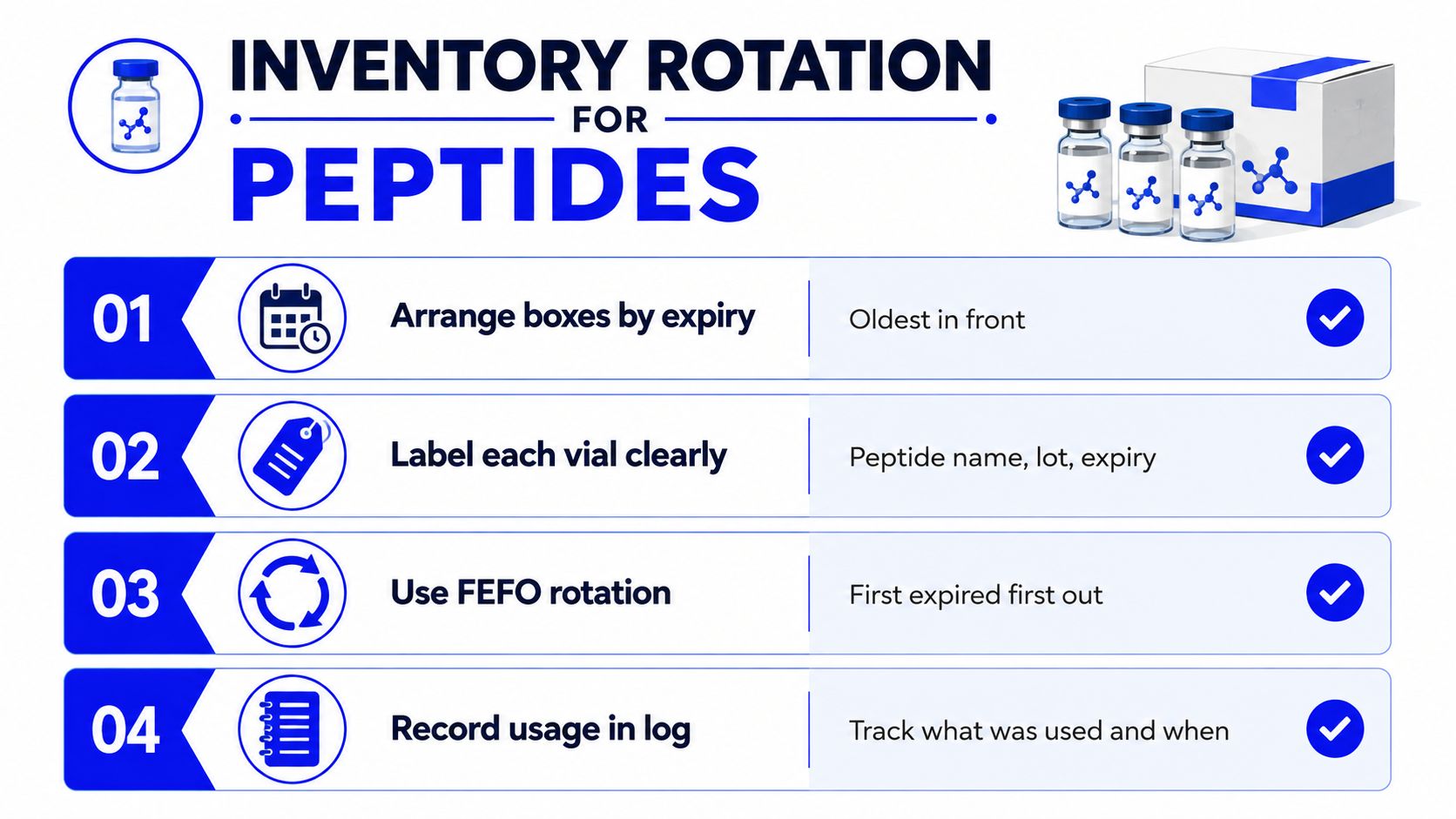
The most reliable freezer is the one with a paper trail. If a colleague cannot trace when a vial arrived, where it sits, and what happened each time it was opened, the inventory is already weaker than it looks.
Putting It All Together in a Reproducible Workflow
A defensible peptide routine is straightforward. When shipment arrives, inspect the cold chain, log the receipt, and let the sealed vial equilibrate to room temperature before opening so condensation doesn't form inside the container. Then aliquot the bulk stock into single-use or small working vials, label each one with the minimum dataset, and return the sealed master stock to -80°C or the lab's chosen cold storage standard.
Reconstitute only what the experiment needs. Use bacteriostatic water when multi-dose access is required, keep the working solution refrigerated at 2–8°C, and avoid repeated freeze-thaw cycling by planning the experiment around the vial, not the other way around. If the solution is only for a short run, label it with the concentration and date, store it under the shortest practical cold window, and retire it once the planned use is complete.
A bench checklist makes the routine repeatable: receive, inspect, log, equilibrate, aliquot, label, store, withdraw, document, retire. That sequence doesn't just protect the reagent, it protects the result.
Herbilabs supplies RUO bacteriostatic water and reconstitution solutions that fit the kind of peptide workflow described here, from first reconstitution through short-term refrigerated use. If your lab wants a practical partner for reliable handling, labeling discipline, and multi-dose preparation, visit Herbilabs and review the product options that match your bench routine.