Private Label, White Label, Wholesale partnerships available - EU, USA and UK - Free shipping from €75

How to Reconstitute Retatrutide: Bac Water Volume Chart for 5–30 mg Research Vials
How to reconstitute a lyophilised retatrutide research vial: how much bacteriostatic water to add for 5, 10, 12, 20 and 30 mg vials, the resulting concentration, and how to read it on a U-100 syringe.
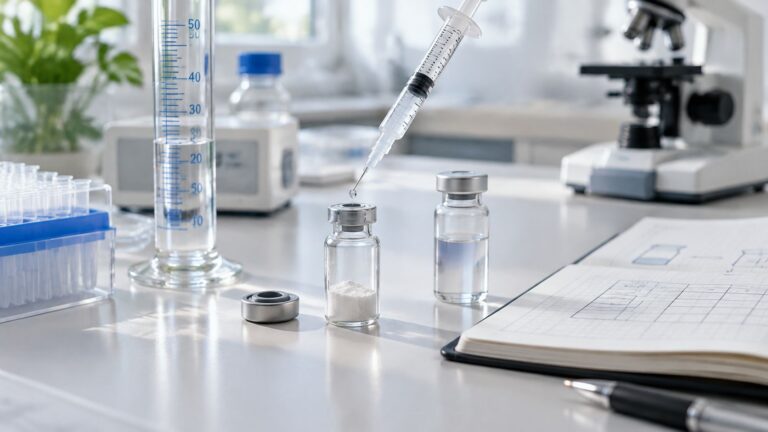
Short answer: to reconstitute a lyophilised retatrutide research vial, add bacteriostatic water slowly down the inside wall of the vial, then swirl gently until the powder has dissolved. The amount of water you add sets the concentration: 2 mL in a 10 mg vial gives 5 mg/mL, so 10 units on a U-100 syringe (0.1 mL) holds 0.5 mg. The chart below covers the common 5, 10, 12, 20 and 30 mg vial sizes.
Research use only. Retatrutide is an investigational compound and is not approved for use in people. This page covers laboratory reconstitution and concentration maths only. It does not describe use in humans or animals and does not recommend any amount.
Retatrutide reconstitution chart
Concentration = mg in the vial ÷ mL of bacteriostatic water. On a U-100 syringe, 100 units = 1 mL, so 10 units = 0.1 mL.
| Vial | Bac water added | Concentration | In 10 units (0.1 mL) | In 1 unit |
|---|---|---|---|---|
| 5 mg | 1 mL | 5 mg/mL | 0.5 mg | 50 mcg |
| 5 mg | 2 mL | 2.5 mg/mL | 0.25 mg | 25 mcg |
| 10 mg | 1 mL | 10 mg/mL | 1 mg | 100 mcg |
| 10 mg | 2 mL | 5 mg/mL | 0.5 mg | 50 mcg |
| 10 mg | 3 mL | 3.33 mg/mL | 0.33 mg | 33.3 mcg |
| 12 mg | 2 mL | 6 mg/mL | 0.6 mg | 60 mcg |
| 12 mg | 3 mL | 4 mg/mL | 0.4 mg | 40 mcg |
| 20 mg | 2 mL | 10 mg/mL | 1 mg | 100 mcg |
| 20 mg | 3 mL | 6.67 mg/mL | 0.67 mg | 66.7 mcg |
| 30 mg | 2 mL | 15 mg/mL | 1.5 mg | 150 mcg |
| 30 mg | 3 mL | 10 mg/mL | 1 mg | 100 mcg |
For any other combination, enter the vial size and water volume in the peptide reconstitution calculator. For the water volume per vial size on its own, see how much bac water for 10 mg retatrutide (and other vial sizes).
How to reconstitute retatrutide, step by step
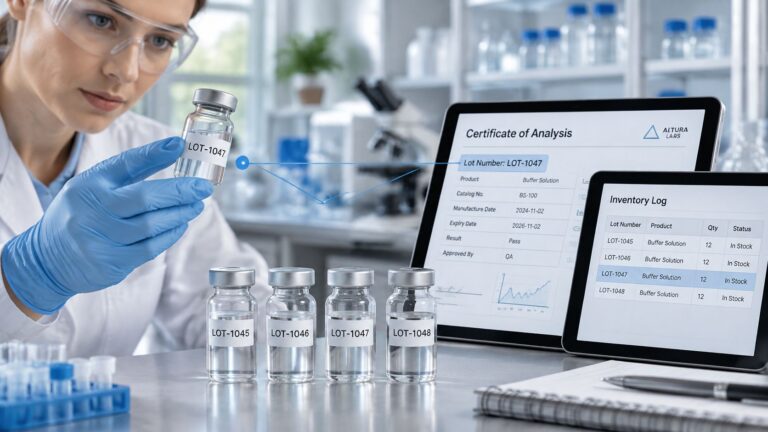
- Check the label and COA. Confirm the mg printed on the vial and the batch number on the certificate of analysis before you work out any volume.
- Let both vials reach room temperature. A cold lyophilised vial draws water in too fast and can foam.
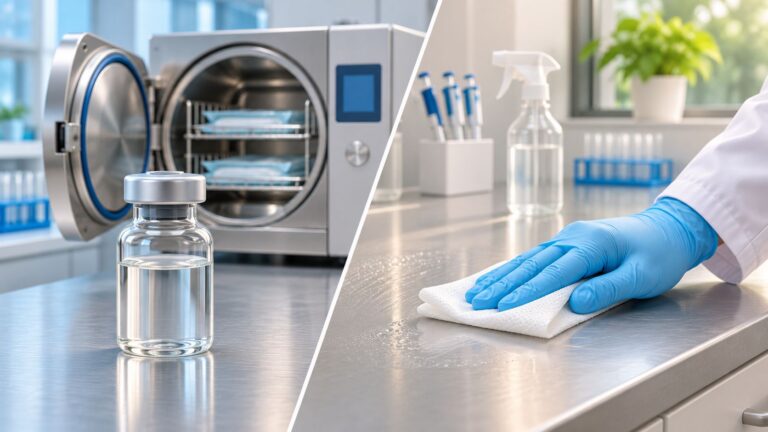
- Wipe both rubber stoppers with a 70% isopropyl alcohol swab and let them dry.
- Draw the bacteriostatic water with a sterile syringe. Use the volume from the chart.
- Add the water slowly down the glass wall, not straight onto the powder cake.
- Swirl or roll the vial gently until the solution is clear. Do not shake; shaking can foam and denature peptides.
- Label the vial with the date, the concentration (for example 5 mg/mL) and the water lot.
- Store the reconstituted vial cold (2–8 °C), protected from light. See how long reconstituted peptides last.
Which water volume should you choose?
There is no single correct volume. More water lowers the concentration, which makes each unit hold less material and makes small volumes easier to measure accurately. Less water keeps the concentration high and the volume per withdrawal small. Many labs pick a volume that gives a round concentration (5 or 10 mg/mL) so the maths stays simple. Whatever you choose, write it on the vial: an unlabelled vial is the most common source of errors.
Why bacteriostatic water for a multi-use vial
Bacteriostatic water contains 0.9% benzyl alcohol, which inhibits bacterial growth after the vial has been punctured. That is why it is the usual diluent for a vial that will be entered more than once over several weeks. Sterile water has no preservative and is meant for single use. Herbilabs supplies Herbilabs bacteriostatic water in 10 mL multi-dose vials and 10 × 10 mL kits, made in the EU, with a COA for every batch. A 10 mL vial covers several retatrutide reconstitutions at 2–3 mL each.
Common mistakes
- Mixing up mg and mcg. 1 mg = 1,000 mcg. Check the unit on every number.
- Using a U-40 syringe with a U-100 chart. The chart assumes U-100 syringes (100 units = 1 mL).
- Shaking the vial instead of swirling it.
- Not labelling the concentration after reconstitution.
- Leaving the vial at room temperature after mixing.
FAQ
How much bac water do you add to 10 mg retatrutide?
Common choices are 1, 2 or 3 mL. 2 mL gives 5 mg/mL (0.5 mg in 10 units); 3 mL gives 3.33 mg/mL (0.33 mg in 10 units).
How do you reconstitute 30 mg retatrutide?
The steps are the same as for smaller vials. 3 mL of bacteriostatic water gives 10 mg/mL; 2 mL gives 15 mg/mL. Check that the volume fits comfortably in the vial before you start.
Can you mix retatrutide with sterile water instead?
You can, but sterile water has no preservative, so it suits a vial that is used once. For a vial entered several times, bacteriostatic water is the usual choice.
How long does reconstituted retatrutide last?
Stability depends on the material and the supplier’s data. As a general lab rule, keep it at 2–8 °C, protected from light, and follow the storage period on the supplier’s datasheet or COA.
Is the chart the same for 20 mg retatrutide?
Yes, the maths is the same for every vial: mg ÷ mL = mg/mL. 20 mg in 2 mL is 10 mg/mL; in 3 mL it is 6.67 mg/mL.
For research and laboratory use only. Not for human or veterinary use. Herbilabs sells bacteriostatic water, not peptides.