Private Label, White Label, Wholesale partnerships available - EU, USA and UK - Free shipping from €75
How to Manage Lab Inventory: A Manager’s Guide
Learn how to manage lab inventory effectively with our comprehensive guide. Boost efficiency, cut costs, and control compliance effortlessly!
TL;DR:
- Effective lab inventory management begins with a precise baseline count and a standardized item catalog to ensure data accuracy. Proper physical organization, labeling, and automated rotation methods like FEFO minimize waste, prevent stockouts, and maintain compliance. Regular audits coupled with integrated technology and enforced logging discipline sustain operational control and inventory integrity.
Lab inventory management is the process of organizing, tracking, and controlling laboratory supplies, reagents, and equipment to maintain operational efficiency, reduce costs, and prevent waste. For laboratory managers and procurement specialists, a poorly controlled inventory translates directly into expired reagents, unplanned stockouts, and compliance failures. This guide covers how to manage lab inventory from baseline setup through digital integration, using tools like Laboratory Information Management Systems (LIMS), barcode scanning, and structured governance frameworks to give your operation full visibility and control.
How to manage lab inventory: prerequisites and baseline setup
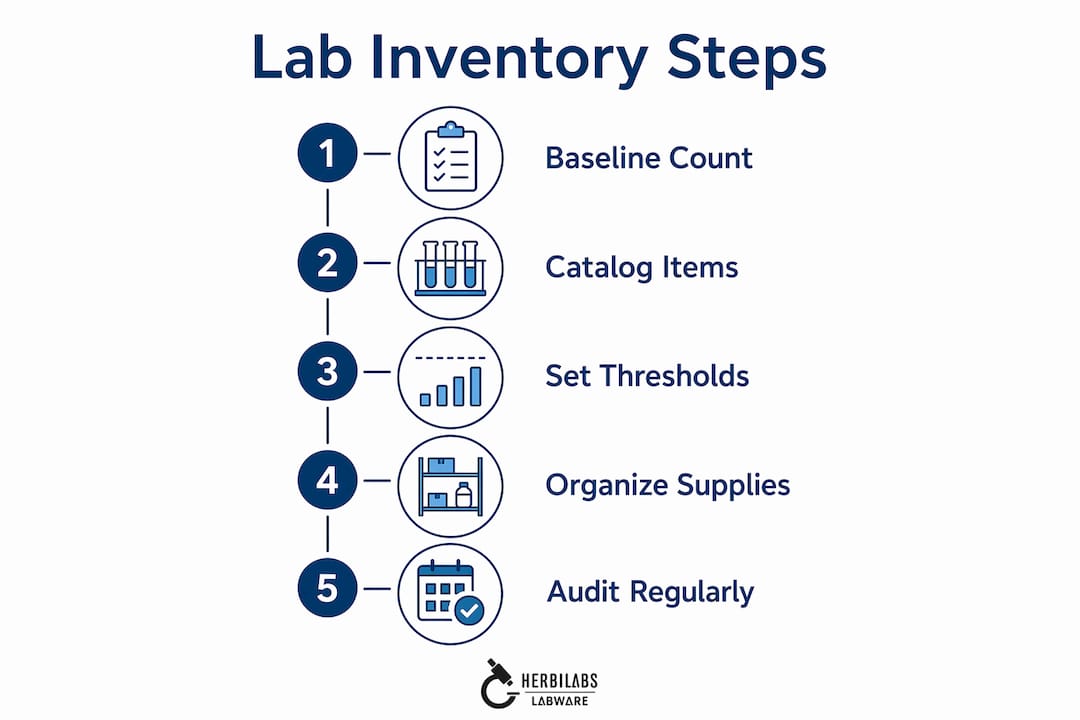
Before any control system can function, you need an accurate picture of what you currently hold. A comprehensive baseline count covers every reagent, chemical, piece of equipment, and consumable in the facility. This step is non-negotiable because any inventory system built on incomplete data will generate inaccurate reorder signals and false compliance records from day one.
The baseline count should feed directly into a structured item catalog. Each entry in that catalog requires standardized metadata: supplier name, part number, storage location, unit of measure, and hazard classification. Consistent item definitions reduce human error and significantly improve budget forecasting, often outperforming reliance on software alone when the underlying data is clean.
Once the catalog is established, set operational thresholds for each item. Min/max stock levels define the acceptable range for each supply, triggering reorders before a stockout occurs and capping purchases before overstocking drives up carrying costs. These thresholds should be calibrated against actual consumption rates, not estimated averages.
The table below summarizes the core components of a functional baseline setup:
| Component | Purpose | Recommended tool |
|---|---|---|
| Item catalog | Standardized naming and metadata | LIMS or structured spreadsheet |
| Baseline count | Accurate starting inventory | Manual count with barcode scanner |
| Min/max thresholds | Reorder and overstock control | Inventory software or LIMS module |
| Storage location map | Physical-digital synchronization | Labeled shelving with digital map |
Pro Tip: Build your item catalog before selecting software. A clean, standardized catalog migrates cleanly into any LIMS or inventory platform. A messy one creates months of remediation work after go-live.
How to organize lab supplies for operational efficiency
Physical organization is the foundation that digital systems depend on. Grouping items by use case and storage requirements improves retrieval speed and supports regulatory compliance by keeping hazard classes separated and storage conditions respected. A reagent stored at the wrong temperature because it was placed in a convenient but incorrect location is both a safety risk and a source of inventory inaccuracy.

Labeling must be durable and consistent across all storage units, from freezer drawers to chemical cabinets. Each shelf, drawer, and storage position should carry a label that matches the corresponding entry in the item catalog. This physical-to-digital alignment is what prevents surprise stockouts, particularly for chemicals stored across multiple locations in larger facilities.
Barcoding and QR code systems take physical organization to a functional level. Barcode scanning workflows reduce manual entry errors and generate real-time audit trails, making it possible to verify stock levels without a full physical count. For university labs managing grant-funded assets, this capability is directly relevant to compliance reporting requirements.
Key principles for physical layout and labeling:
- Assign a fixed storage location to every catalog item and enforce it consistently
- Group items by storage condition first (temperature, light sensitivity, hazard class), then by use case
- Apply machine-readable labels (barcodes or QR codes) to individual containers, not just shelves
- Design shelf layouts to support stock rotation, with newer stock placed behind older stock
- Document the storage location map digitally so receiving staff and auditors reference the same source
For labs managing lab supply storage across multiple rooms or buildings, a centralized digital location map is not optional. It is the only mechanism that keeps physical reality synchronized with inventory records.
What inventory control methods reduce waste and expired stock?
Inventory rotation is where most labs lose money silently. The standard retail approach, FIFO (First In, First Out), issues the oldest stock first based on arrival date. For laboratory environments managing reagents, biological materials, and reconstitution solutions, FEFO (First Expired, First Out) is the correct method. FEFO prioritizes the item with the earliest expiration date regardless of when it arrived, which directly reduces expired waste and the compliance risk that comes with it.
The practical difference matters most when two batches of the same reagent arrive weeks apart but carry different expiration dates. FIFO would issue the first batch regardless of which expires sooner. FEFO corrects this by embedding expiration date as the primary sort criterion at the point of issue. FEFO works best when rotation rules are automated within the inventory system rather than left to individual memory, which prevents the monthly cleanup problem of discovering expired stock that was bypassed in favor of newer arrivals.
The following steps establish a functional inventory control cycle:
- Record the expiration date for every incoming batch at the point of receipt, not retrospectively
- Configure your inventory system to sort issue queues by expiration date ascending
- Set automated alerts for items approaching expiration within a defined window (30, 60, or 90 days depending on consumption rate)
- Define reorder points that account for actual supplier lead times, not assumed averages
- Maintain a supply buffer for critical materials. A five-week buffer for high-priority items is a recognized standard for supply chain resilience during disruptions
Inventory controls tied explicitly to operations and waste management sustain workflows without overspending or generating expired inventory. The goal is not to hold more stock. It is to hold the right stock at the right time.
Reorder points should be reviewed quarterly and adjusted when consumption patterns shift, such as when a new research project increases demand for a specific reagent class. Static reorder points set at implementation and never revised are one of the most common sources of both stockouts and overstock in active research labs.
How to conduct regular audits and maintain inventory accuracy
Scheduled audits are the mechanism that keeps digital records aligned with physical reality. Without them, discrepancies accumulate silently until a stockout or compliance inspection reveals the gap. Regular inventory audits compare physical stock counts against system records, identify shortages and excesses, and verify item condition and expiration status simultaneously.
For federally funded research assets, physical verification is required at minimum every two years, though annual audits are the standard practice for maintaining compliance with grant reporting requirements. University lab inventory best practices consistently recommend annual full audits supplemented by rolling cycle counts throughout the year.
Mobile barcode scanning makes physical verification significantly faster and more accurate. A staff member scanning items on-site generates a timestamped count that reconciles automatically against the system record, flagging discrepancies for immediate review. This approach eliminates the transcription errors that occur when counts are recorded on paper and entered manually later.
Audit best practices for laboratory managers:
- Schedule full audits at least annually, with cycle counts covering high-turnover items monthly
- Use mobile barcode scanners to generate real-time reconciliation data during physical counts
- Document all discrepancies with a root cause note (damaged, expired, misplaced, or consumed without logging)
- Verify storage conditions and compliance documentation during each audit, not as a separate process
- Update system records within 24 hours of completing a physical count to prevent data drift
Pro Tip: Assign audit ownership to a specific role, not a rotating volunteer. Labs that treat audits as a shared responsibility with no named owner consistently find that audits are deferred or incomplete. A named inventory coordinator produces measurably better data quality.
How can technology and communication improve inventory governance?
LIMS platforms with integrated inventory modules are the most capable tools available for lab inventory tracking. They connect item records, consumption logs, reorder triggers, and compliance documentation in a single system, eliminating the data silos that occur when teams manage inventory across disconnected spreadsheets and paper logs. For labs considering a LIMS implementation, integrating from launch avoids the costly data migration and retraining burden that comes with retrofitting a system onto an established but disorganized inventory.
Beyond software, supplier integration adds a layer of real-time visibility that manual systems cannot replicate. When supplier systems connect directly to your inventory platform, restocking triggers can generate purchase orders automatically when stock falls below the defined minimum. This reduces the administrative burden on procurement specialists and shortens the response time between a low-stock alert and a confirmed order.
The table below compares technology options by capability and complexity:
| Technology | Primary benefit | Implementation complexity |
|---|---|---|
| LIMS with inventory module | Centralized tracking and automation | High |
| Barcode or QR scanning | Real-time accuracy, audit trail | Low to medium |
| Spreadsheet with governance rules | Low cost, flexible | Low |
| Supplier integration | Automated restocking | Medium to high |
| AI forecasting tools | Demand prediction, waste reduction | High |
Communication between lab teams and procurement is as important as the software itself. When researchers do not log consumption in real time, system records diverge from physical stock, and reorder signals become unreliable. Establishing clear protocols for who logs what and when is a governance decision, not a technology one. For labs optimizing lab supply management, the combination of a capable system and enforced logging discipline consistently outperforms sophisticated software used inconsistently.
Key takeaways
Effective lab inventory management requires a clean baseline, enforced rotation methods, physical-digital synchronization, and regular audits to maintain accuracy and control costs.
| Point | Details |
|---|---|
| Start with a baseline count | Catalog every item with standardized metadata before implementing any control system. |
| Apply FEFO for perishables | Prioritize stock by expiration date, not arrival date, to reduce expired waste. |
| Set and review thresholds | Define min/max stock levels and reorder points, then revise them quarterly. |
| Audit on a fixed schedule | Annual full audits with monthly cycle counts maintain data accuracy and compliance. |
| Govern your technology | Software only works when logging protocols are enforced consistently by named roles. |
What I’ve learned about lab inventory that most guides skip
I’ve reviewed a lot of lab inventory frameworks, and the consistent failure point is not the software. It is governance. Labs invest in LIMS platforms, configure barcode systems, and set up dashboards, then watch data quality degrade within six months because no one enforced the logging discipline that makes those tools useful. The system records what people tell it. If researchers consume reagents without logging the transaction, the system becomes a fiction.
The second issue I see repeatedly is the assumption that physical and digital records stay synchronized automatically. They do not. A chemical moved to a different freezer for a temporary experiment, a reagent pulled for an urgent run without a system entry, a shipment received and shelved before the receipt is logged. Each of these creates a gap. Maintaining an explicit storage location map and enforcing receipt logging at the point of delivery are the two habits that prevent these gaps from accumulating into a reconciliation crisis at audit time.
My honest recommendation for any lab manager starting this process: fix your item catalog and your logging discipline before you spend a dollar on software. A well-governed spreadsheet with complete, accurate data will outperform a LIMS with incomplete records every time. Technology amplifies what you already have. If what you have is disorganized, the technology makes it disorganized faster.
— Ragnar
How Herbilabs supports reliable lab inventory workflows

Maintaining accurate inventory depends on sourcing reagents and reconstitution solutions from suppliers whose quality controls are consistent enough to trust. Herbilabs manufactures bacteriostatic water, sterile diluents, and research-grade reconstitution solutions to strict purity standards, with rigorous quality control at every production stage. For labs managing high-purity reconstitution solutions as part of their peptide research workflows, Herbilabs provides reliable supply with wholesale pricing for procurement specialists and research institutions across the UK and Europe. Consistent product quality reduces the variability that complicates inventory planning and expiration management.
FAQ
What is the first step in managing lab inventory?
The first step is conducting a comprehensive baseline count of all items in the facility, including reagents, chemicals, equipment, and consumables. This count feeds a structured item catalog with standardized metadata that all subsequent inventory controls depend on.
What is FEFO and why does it matter in a lab?
FEFO (First Expired, First Out) is an inventory rotation method that issues stock with the earliest expiration date first, regardless of arrival order. It reduces expired waste and compliance risk in labs managing perishable reagents and biological materials.
How often should lab inventory audits be conducted?
Full physical audits should occur at least annually, with cycle counts covering high-turnover items on a monthly basis. Federally funded labs are required to verify physical assets against records at minimum every two years.
What technology is most effective for lab inventory tracking?
LIMS platforms with integrated inventory modules provide the most complete tracking and automation capability. For labs with limited budgets, barcode or QR scanning systems offer significant accuracy improvements at lower implementation complexity.
How do you prevent stockouts for critical lab supplies?
Set reorder points based on actual supplier lead times and maintain a supply buffer for critical materials. A five-week buffer for high-priority items is a recognized standard for supply chain resilience during disruptions.