Private Label, White Label, Wholesale partnerships available - EU, USA and UK - Free shipping from €75

Glass Vials 10ml: Complete Selection and Specification Guide
A lab can order a pallet of 10 mL glass vials, confirm the diameter, and still discover that the containers don't work for the intended formulation. The problem may appear during reconstitution, repeated needle access, sterilization, or a quality review when the supplier can't provide the required lot documentation. A vial that looks correct on a purchasing sheet can still be the wrong component for a sensitive sterile workflow.
For procurement teams and researchers, glass vials 10ml should be treated as a specification decision, not a commodity purchase. Material type, hydrolytic resistance, finish dimensions, stopper chemistry, headspace, sterilization route, and traceability all influence whether the vial protects the product and performs consistently. This guide focuses on those overlooked decisions, with practical criteria for RUO laboratories, reconstitution workflows, and multi-dose handling.
Table of Contents
- Why 10ml Glass Vial Specifications Matter More Than You Think
- Understanding Glass Types and ISO Designations
- Closure Systems and Headspace Design for Multi-Dose Use
- Sterilization Methods and Aseptic Filling Considerations
- Quality Documentation and Regulatory Compliance for RUO Workflows
- How to Evaluate Suppliers and Procurement Options
- Making the Right Choice for Your Laboratory Needs
Why 10ml Glass Vial Specifications Matter More Than You Think
A research laboratory orders 10 mL vials for reconstituting peptide standards in bacteriostatic water. The shipment arrives on time, the containers look clean, and the nominal capacity matches the purchase order. During compatibility testing, however, the formulation shows an unexpected pH shift. Investigation points toward insufficient glass hydrolytic resistance and possible alkali release into the aqueous preparation.
That failure doesn't stay confined to packaging. Researchers may lose active material, repeat compatibility work, postpone a study, and place an urgent replacement order. The lab also has to explain why the incoming inspection accepted the lot and whether results generated with the questionable containers remain usable.
The most common procurement mistake is comparing only unit price, nominal volume, and external dimensions. Those fields matter, but they don't answer the questions that determine performance:
- Glass chemistry: Is the vial Type I borosilicate, treated soda-lime, or an unspecified pharmaceutical glass?
- Hydrolytic resistance: Has the supplier provided evidence that the glass resists water-related surface attack?
- Closure fit: Does the stopper match the neck finish and crimp system?
- Headspace: Does the working fill leave enough room for handling, reconstitution, and pressure changes?
- Documentation: Can the supplier trace the vial to a manufacturing lot and provide conformity records?
A useful starting point is to align the container specification with the laboratory's wider facility and workflow requirements. A resource such as warehouse lab equipment specs can help procurement and operations teams review the surrounding environment, storage arrangements, and handling infrastructure rather than evaluating the vial in isolation.
Practical rule: A vial isn't qualified because it holds the target volume. It's qualified when the glass, closure, filling process, sterilization method, and records all support the intended use.
The ISO framework gives buyers a dependable language for this conversation. The next decision is identifying which glass type and designation match the chemistry and handling profile.
Understanding Glass Types and ISO Designations
A 10 mL label does not identify how the vial was made or how it will behave with a formulation. Start by separating tubular glass from molded glass. ISO 8362-1 covers injection vials made from glass tubing, while ISO 8362-4 covers molded glass vials. Both standards define vial shape, dimensions, capacities, and performance requirements for injectable preparations, according to this 10R and 10H vial reference.
That distinction affects procurement. 10R generally identifies a 10 mL tubular-glass vial under ISO 8362-1. 10H identifies a 10 mL molded-glass vial under ISO 8362-4. The designation helps specify the dimensional convention, closure interface, and manufacturing route, rather than serving as a decorative product label.
Match glass chemistry to formulation risk
Type I borosilicate glass is commonly selected for demanding injectable and reconstitution work because it provides high chemical durability. Tubular 10R formats are commonly made from Type I borosilicate glass. Their lower tendency to release alkaline species supports compatibility with many acidic, neutral, and aqueous formulations, as described in this Type I vial product specification.
Treated soda-lime glass may fit less demanding applications, but it should not be treated as interchangeable with Type I. Untreated soda-lime glass has a narrower compatibility range and is generally a poor default for aqueous formulations that remain in contact with the container or undergo repeated access. The lower purchase cost can create more work if compatibility evidence is weak.
The phrase “pharmaceutical grade” does not resolve the specification. Ask the supplier to identify the ISO designation, glass type, finish, and test basis. A certificate that repeats only the marketing description leaves the lab without evidence for a defensible packaging decision.
| Glass Type | Hydrolytic Resistance | Typical Use Cases | Relative Cost | Compatibility Notes |
|---|---|---|---|---|
| Type I borosilicate | High resistance for demanding aqueous and injectable applications | Sensitive aqueous formulations, reconstitution, sterile preparations | Often higher than less resistant glass | Preferred where chemical durability and low interaction are priorities |
| Treated soda-lime | Improved surface resistance compared with untreated soda-lime | Selected aqueous products with established compatibility | Can offer a lower-cost route | Requires formulation-specific evidence and supplier documentation |
| Type III soda-lime | Lower resistance than Type I | Dry powders, non-aqueous contents, less demanding storage | Often economical | Shouldn't be assumed suitable for aqueous multi-dose workflows |
Hydrolytic resistance is a documentation requirement, not just a glass-class label. The United States Pharmacopeia framework includes glass-grains and surface evaluations involving water contact at 121°C for 30 minutes, as described in the USP glass containers chapter. Ask which test was performed, on which lot, and whether the result applies to the supplied vial surface rather than generic raw glass. The next step is matching glass type to formulation risk.
Closure Systems and Headspace Design for Multi-Dose Use
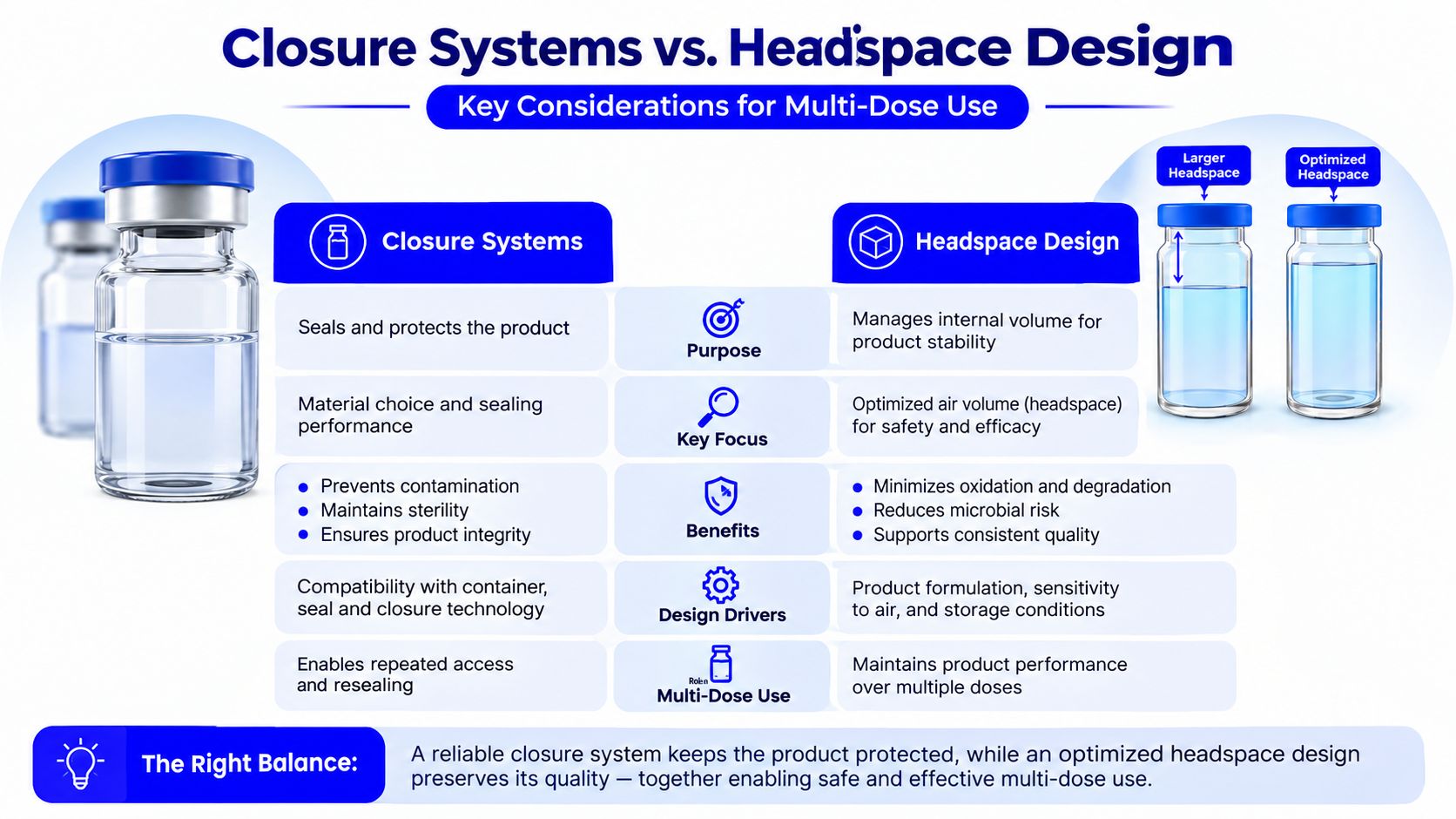
A 10 mL vial filled with 5 mL of solution has substantial unused internal volume. That headspace affects more than appearance. Every withdrawal changes the relationship between liquid volume, internal pressure, stopper resealing, and the amount of air entering the container.
Repeated needle access can expose a weak closure system quickly. Poorly matched elastomers may core, fragment, swell, or lose resealing performance. Silicone treatment can improve needle penetration, but excessive or poorly controlled silicone may introduce particulate or compatibility concerns. The right closure therefore depends on the formulation, access pattern, storage period, sterilization process, and filling configuration.
Read the finish and fill together
A common 10 mL pharmaceutical vial uses a 20 mm crimp finish, an outer diameter of about 24 mm, and a height of roughly 45 mm, according to 10 mL vial dimensional information. The 10R format may have a full-volume capacity around 13.5 mL, so the nominal 10 mL label doesn't mean the internal brimful volume is 10 mL.
That distinction matters during filling. European pharmacopoeial guidance generally places vial filling volume at about 90% of brimful capacity, while the usable working volume and headspace still need to be confirmed for the actual formulation and process. Overfilling can increase closure stress and contamination risk during repeated withdrawals. Underfilling can make dose extraction and handling less convenient.
A supplier quote should state the neck finish, stopper dimensions, cap size, and closure configuration together. A 20 mm finish shouldn't be paired with an assumed 13 mm closure because both are common in laboratory packaging. The cap and stopper must be qualified as a set.
| Workflow scenario | Glass and finish priority | Closure approach | Headspace consideration |
|---|---|---|---|
| Single-use reconstitution | Type I glass where formulation sensitivity warrants it | Sterile stopper and crimp seal | Enough room for transfer and mixing without unnecessary unused volume |
| Repeated RUO access | Chemically durable glass with a validated closure | Elastomer selected for repeated puncture and formulation contact | Model expected withdrawals, pressure changes, and storage conditions |
| Lyophilized material | Vial and stopper qualified for the drying cycle | Stopper geometry must support the cycle and final seal | Headspace supports process requirements and reconstitution handling |
| Ready-to-use sterile solution | Confirmed container closure integrity | Pre-sterilized, lot-documented components | Fill line should preserve handling margin and closure performance |
A multi dose vial guide by Herbilabs provides useful context for repeated-access workflows, but procurement teams still need the supplier's own closure specifications and compatibility evidence. A general multi-dose label doesn't replace a container closure assessment.
Sterilization Methods and Aseptic Filling Considerations
Sterilization is a specification decision, not a final handling detail. The selected process can stress the closure, affect extractables, alter surface cleanliness, and add validation work for the laboratory. Buyers should evaluate the vial, stopper, coating, and cap as a complete assembly.
Steam sterilization uses moist heat and may suit compatible glass and components. The USP hydrolytic resistance method includes water contact at 121°C for 30 minutes, but that test condition does not define a complete sterilization cycle. Load configuration, exposure time, drying, stopper placement, and post-cycle handling still require control. Relevant glass packaging information is available in sterile diluent production standards.
Dry heat depyrogenation uses substantially higher temperatures than steam and may fit workflows where endotoxin control is a major requirement. The glass may tolerate the cycle while elastomer formulations, coatings, or cap components respond differently. Confirm the full container and closure assembly against the intended temperature profile, rather than qualifying the vial alone.
Gamma irradiation and ethylene oxide support different pre-sterilized supply models. Each introduces separate validation and extractables questions. Gamma exposure can affect elastomers, while ethylene oxide requires control of residuals and aeration. Sensitive peptide or protein workflows should request method-specific data instead of treating every “sterile” vial as chemically equivalent.
Select the process around the workflow
| Method | Parameters | Glass Compatibility | Stopper Impact | Best Use Case |
|---|---|---|---|---|
| Steam sterilization | Moist heat around the validated cycle condition | Generally compatible with suitable pharmaceutical glass | May stress or alter elastomers if the assembly isn't qualified | Labs with validated steam capability and compatible components |
| Dry heat depyrogenation | High-temperature dry heat | Suitable for qualified glass | Requires careful assessment of stopper and coating stability | Processes requiring stronger endotoxin-control measures |
| Gamma irradiation | Ionizing radiation | Glass generally remains usable, but the full assembly needs assessment | May affect elastomers or generate extractables | Purchased pre-sterilized components with supplier validation |
| Ethylene oxide | Low-temperature chemical sterilization | Often compatible with glass | Residuals and aeration requirements need control | Components that can't tolerate heat or radiation |
For RUO reconstitution, pre-sterilized ready-to-use vials can reduce handling steps, while placing more documentation responsibility on supplier validation. User sterilization may appear less expensive, but it requires equipment, cycle development, environmental control, records, and release decisions. A lab filling sterile diluent should control the aseptic environment, apply suitable filtration where applicable, and document personnel and environmental monitoring.
Procurement teams should verify that the sterilization claim, package integrity, and release documentation align with the laboratory's actual process. Supplier or contract-partner explanations should support a direct comparison between ready-to-use products and in-house filling.
Quality Documentation and Regulatory Compliance for RUO Workflows
A vial lot can pass visual inspection and still create a quality problem if the supplier can't provide the records needed to release it internally. Documentation should be requested before the purchase order, not after a compatibility failure.
The minimum package depends on the workflow, but the following records usually deserve review:
- Certificate of Analysis: Confirms lot-specific material and performance information, including applicable dimensions, surface or hydrolytic testing, and other agreed specifications.
- Certificate of Conformity: States that the supplied vials were manufactured against the agreed standard, such as the relevant ISO 8362 designation.
- Safety documentation: Identifies handling, storage, and material safety considerations for the supplied components.
- Traceability records: Connects the finished vial lot to manufacturing information and, where available, raw material or component history.
Turn documents into acceptance criteria
A procurement specification should state what the supplier must provide and what the lab will verify. For example, it can require the exact vial designation, glass type, finish dimensions, closure material, sterilization status, lot identification, and visible-defect limits. If extractables or endotoxin information is relevant to the formulation, the request should identify those needs explicitly rather than relying on a broad “pharmaceutical” description.
The lab should also distinguish RUO documentation from documentation intended for IVD or pharmaceutical release. RUO labeling doesn't make quality records unnecessary. Preclinical teams, assay developers, and contract research groups may still need controlled evidence for lot comparability, deviation reviews, and study records.
A missing hydrolytic resistance result can delay QA approval. An incomplete lot number can make a container-related investigation difficult. A change in stopper supplier without notification can force compatibility work to be repeated. These are procurement risks, not administrative inconveniences.
Documentation rule: If a supplier can't identify the lot and the applicable test basis, the laboratory can't reliably compare one vial shipment with the next.
Teams building a controlled purchasing process can use quality systems in sterile diluent production as a reference point for connecting batch review, traceability, and release controls. The final requirement should remain specific to the laboratory's own QMS and intended RUO use.
How to Evaluate Suppliers and Procurement Options
The lowest unit price can become the highest operational cost when a shipment arrives late, fails dimensional checks, or lacks release records. Supplier evaluation should therefore begin with the complete landed and qualified cost, not the number printed beside “per vial.”
Use a staged evaluation
Analyze the quote. Confirm whether the price includes stoppers, caps, sterilization, packaging, certificates, shipping, and any special inspection. A quote for empty glass alone isn't comparable with a ready-to-use sterile assembly.
Compare MOQ with consumption. A minimum order that exceeds the laboratory's realistic use can create storage pressure, aging stock, and unnecessary exposure to lot changes. Smaller orders may carry a higher unit cost but reduce the risk of holding unsuitable inventory.
Test samples before bulk commitment. Incoming samples should undergo dimensional verification, visual inspection for cracks and particles, closure fit checks, and a practical leak or handling assessment using the intended diluent where appropriate. The laboratory should record the lot and test conditions so that acceptance isn't based on informal impressions.
Review reliability and quality systems. Ask how the supplier manages change notifications, lot consistency, deviations, complaints, and replacement stock. ISO 9001 or equivalent quality controls can be useful evidence, but the certificate should be checked for scope and validity rather than treated as a universal guarantee.
Distributor or direct manufacturer
A distributor may offer consolidated purchasing, local inventory, and simpler logistics. A direct manufacturer may provide more technical detail, custom dimensions, or clearer access to production records. Neither route is automatically superior.
The deciding factors are response quality, sample availability, lead-time transparency, change-control discipline, and willingness to provide documentation before purchase. Dual sourcing can improve resilience, but only if both sources meet the same controlled specification. Otherwise, a backup supplier may introduce a second unqualified container system at the moment the primary source fails.
A practical purchase file should include the approved drawing, glass designation, finish and closure details, sterilization statement, sample results, supplier contacts, and change-notification terms. That file turns a repeat order into a controlled replenishment instead of a fresh technical investigation.
Making the Right Choice for Your Laboratory Needs
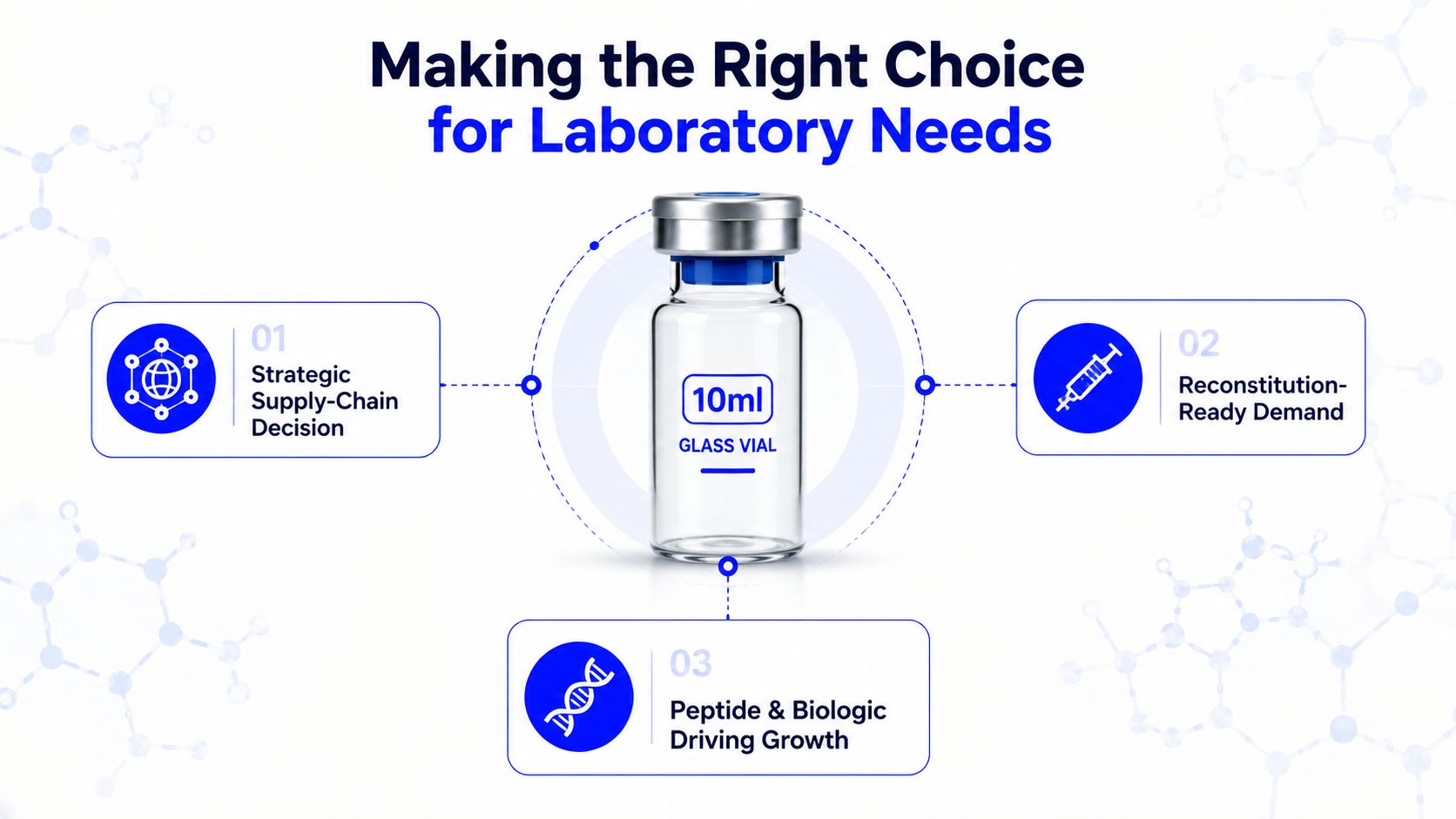
A 10 mL vial can pass incoming inspection and still fail during use. The hidden decisions are hydrolytic resistance, headspace volume, stopper compatibility, and the records needed to release each lot. A Type I designation does not correct an unsuitable closure. A sterile vial without traceable documentation can delay work, while a cheaper container that creates extractables or compatibility questions may waste more material than it saves.
Demand is shifting toward convenient sterile formats. A market forecast from Mordor Intelligence's pharmaceutical glass vials and ampoules market analysis identifies ready-to-use sterile vials as the fastest-growing technology segment, with a 7.12% CAGR through 2031. For procurement, the practical implication is to assess sterility assurance, contamination control, and documentation before comparing unit cost.
Market projections also indicate strong demand for smaller vial formats. A 2026 forecast estimates that vials up to 10 mL may represent about 49.4% of the vials packaging market, and separate estimates place pharmaceutical glass packaging at USD 23.01 billion in 2025, according to Corning's sustainability discussion of pharmaceutical glass packaging. These projections provide market context, not evidence that a particular vial suits an RUO workflow.
Put the specification under control
Write the vial specification so purchasing and the laboratory evaluate the same container:
- Material performance: Glass type, ISO designation, hydrolytic resistance evidence, and any compatibility testing.
- Container geometry: Nominal and brimful capacity, headspace target, finish, dimensions, and tolerances.
- Closure compatibility: Stopper composition, coating or lubrication, cap, crimp, and container closure integrity.
- Process status: Sterilization method, aseptic filling requirements, and release documentation.
- Supply continuity: Approved supplier, lot traceability, change notification, sample approval, and backup arrangements.
Lightweight glass formats may reduce material use and cradle-to-gate emissions by up to 30%. Some designs reduce glass use by 20% and improve filling-line efficiency by up to 50%, according to Corning's Viridian vial information. Review those gains against breakage risk, transport conditions, stopper behavior, headspace requirements, and repeated handling.
Herbilabs supplies RUO reconstitution solutions in 10 mL glass multi-dose formats, with lot-specific COAs and controlled aseptic production. Procurement teams should verify the formulation, labeling, documentation, and intended withdrawal pattern against their approved specification before adoption.
Laboratories that need sterile diluents and 10 mL glass vial formats can visit Herbilabs to review RUO reconstitution solutions, multi-dose kits, and documentation options. Teams can compare fill format, quality records, and supply requirements before approving a container system.