Private Label, White Label, Wholesale partnerships available - EU, USA and UK - Free shipping from €75

Selecting 10 Ml Glass Vials: A 2026 Buyer’s Guide
A researcher opens a shipment of 10 ml glass vials before a peptide reconstitution run and finds three labels that appear interchangeable: 10R, 10H, and “10 ml.” The stoppers fit some vials but not others, the closure options vary, and the supplier's documentation doesn't clearly state the glass class. The problem isn't the liquid volume alone. A mismatch in geometry, glass material, or closure design can create filling-line problems, poor sealing, avoidable contamination risk, or an unreliable preparation.
For RUO workflows, vial selection should begin with the experiment rather than the product title. The researcher needs to connect the vial's dimensions to the filling or crimping equipment, select a glass type suited to the formulation and sterilization process, and decide whether the container will be accessed once or repeatedly. Documentation matters just as much, especially when a lab must trace a lot, review sterility information, or qualify a supplier.
Table of Contents
- Introduction to 10 mL Glass Vials
- Understanding 10 mL Vial Geometry and Dimensions
- Choosing the Right Glass Material and ISO Format
- Selecting Closure Types and Sterilization Methods
- Single-Use Versus Multi-Dose Vial Trade-Offs
- Use-Cases for Reconstitution and Storage
- Quality Documentation and Regulatory Requirements
Introduction to 10 mL Glass Vials
A peptide reconstitution run can stall before the first withdrawal if a vial is chosen by its label alone. 10 mL identifies nominal capacity, not a complete container system. The researcher still needs to check ISO geometry, glass type, neck finish, stopper material, cap design, and whether the vial arrives sterile or requires later processing. Capacity is only the starting label, much like a shoe size that does not specify its width or sole.
For a lyophilized peptide, the vial needs room for diluent and a stopper that tolerates the planned needle access. An antibody working solution may instead place greater weight on chemical compatibility and low-particle handling. An analytical sample may need predictable withdrawal and storage between runs. These differences make workflow, access frequency, and formulation part of the specification.
A 10R or 10H format can affect equipment fit and available headspace. Glass selection must suit the formulation and sterilization method, while the closure system determines how well the package handles piercing, sealing, and repeated access. A vial that fits the volume requirement can still fail the workflow if its closure or documentation is unsuitable.
Practical rule: Treat the vial, stopper, and cap as one system. A suitable bottle with an unsuitable closure is still an unsuitable package.
For RUO selection, confirm volume and headspace first, then geometry, glass class, closure access pattern, and quality documents. This order helps new researchers compare complete systems rather than capacity labels.
Understanding 10 mL Vial Geometry and Dimensions
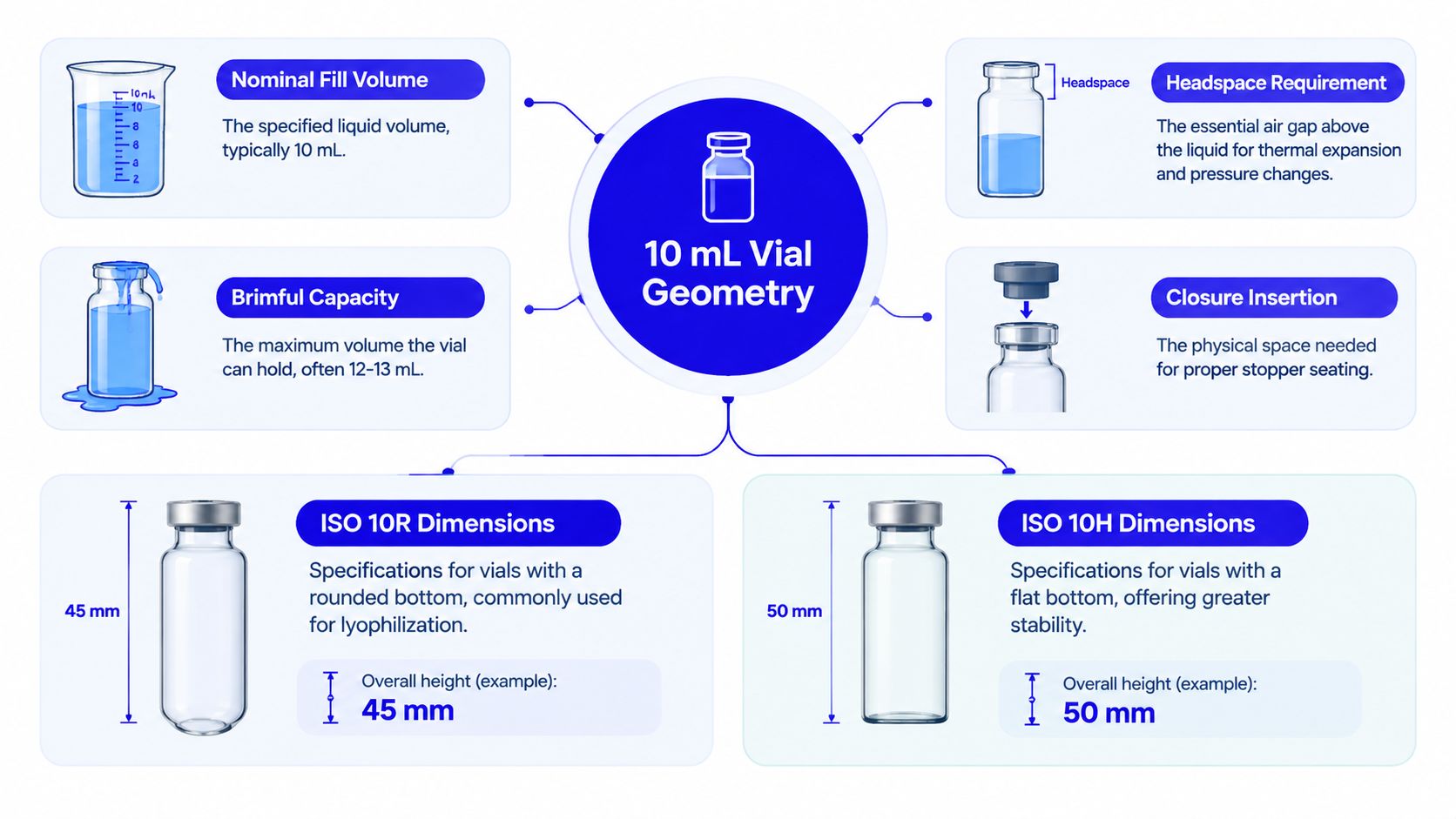
A vial's stated capacity works like the fuel rating on a vehicle. It describes the intended usable amount, not necessarily the total physical space inside the container. A standard pharmaceutical vial made to ISO 10R geometry has an overall height of about 45 mm, an outer body diameter of about 24 mm, and a 20 mm crimp finish. Its brimful capacity is roughly 13.5 mL, according to this 10 mL ready-to-use vial specification.
Nominal volume and brimful capacity
Nominal fill volume is the specified working volume, usually 10 mL for this format. Brimful capacity is the amount the vial can hold when filled to the physical rim. Those values differ because the container needs an air gap, called headspace, above the liquid.
Headspace serves several practical purposes:
- Closure insertion: A stopper occupies physical space as it enters the vial neck. Filling to the rim would leave no room for proper seating.
- Thermal movement: Liquids can expand or contract with temperature changes. The air gap reduces pressure created by a nearly full container.
- Mixing and withdrawal: A researcher needs enough internal space to swirl or invert the vial without splashing into the stopper.
- Safe handling: Excess liquid near the finish can wet the stopper and compromise the sealing area.
A useful check is to compare the intended fill with the vial's brimful capacity, then confirm the supplier's recommended fill range. A 10 mL label shouldn't be interpreted as permission to fill every vial to exactly 10 mL under every process condition.
Reading 10R and 10H
The 10R and 10H designations identify different standardized vial formats. The number refers to the nominal volume class, while the letter distinguishes tubular glass from molded glass. The relevant ISO system was first published for injection containers in 1989, and the current published dimensional reference includes ISO 8362-1:2018, as described in West Pharmaceutical Services' explanation of vial standards.
A 10R vial may suit equipment designed around tubular-glass dimensions, while a molded 10H vial may have different body and base characteristics. The finish must also match the stopper and cap assembly. Before purchasing, the lab should compare the supplier's dimensional drawing with the crimper, capper, rack, tray, and filling head specifications.
Choosing the Right Glass Material and ISO Format
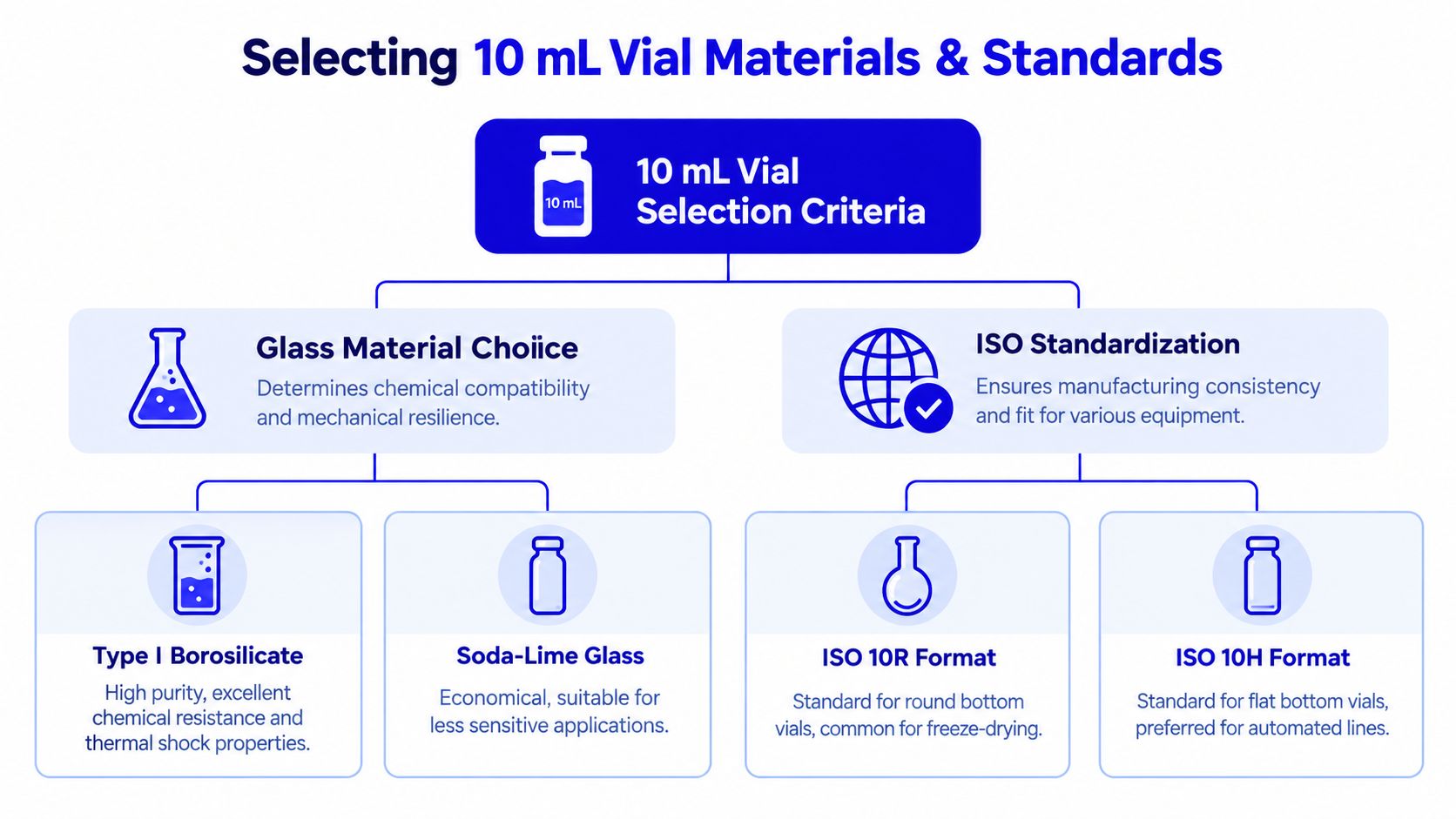
Glass selection begins with the formulation and process, not with appearance. Type I borosilicate glass is commonly chosen when a lab needs strong chemical resistance, low surface reactivity, and resilience during demanding thermal treatment. Soda-lime glass can be appropriate for less sensitive applications, but it shouldn't be treated as automatically equivalent to Type I pharmaceutical glass.
A recent PDA study found that Type I borosilicate vials exposed to 400°C for 72 hours showed no measurable degradation in hydrolytic resistance, including conditions involving imperfect internal drying, as reported in the PDA Journal study on vial hydrolytic resistance. That finding supports confidence in the glass surface during severe depyrogenation exposure. It doesn't remove the need to evaluate the stopper, cap, closure integrity, or the formulation itself.
Material choice for RUO workflows
For a peptide or protein preparation, the lab should ask whether the formulation may interact with the glass surface, whether the vial will undergo heat exposure, and whether the supplier identifies the glass as Type I. The term “glass vial” by itself doesn't answer those questions.
A practical comparison looks like this:
| Material | Useful selection question | Typical RUO consideration |
|---|---|---|
| Type I borosilicate | Does the workflow require strong hydrolytic and thermal resistance? | Often preferred for sensitive or demanding preparations |
| Soda-lime glass | Is the application less chemically and thermally demanding? | May suit simpler, non-critical handling if compatibility is confirmed |
Format choice and equipment fit
The ISO designation helps the lab identify the container design, but it isn't a substitute for reviewing the full drawing. A buyer should confirm the body dimensions, base style, neck finish, stopper dimensions, and cap compatibility in the same purchase review.
A round-bottom format may support a particular freeze-drying or filling process, while a flat-bottom molded format may provide different handling stability. The correct choice depends on the equipment and process design. If a supplier lists only “10 mL glass vial,” the purchasing team should request the exact ISO designation and glass class before approving the order.
Selecting Closure Types and Sterilization Methods
The closure determines how the vial behaves after filling. A crimped aluminum seal can provide a firm, tamper-evident package, while a flip-off button makes the stopper easier to access without removing the entire seal. A self-locking screw cap can simplify manual handling, but only if its thread and liner system match the vial finish.
The closure review should cover four parts:
- Finish diameter: The cap and stopper must match the vial neck and crimp dimensions.
- Stopper composition: The elastomer should be compatible with the formulation and intended puncture pattern.
- Access method: A single withdrawal has different requirements from repeated needle entries.
- Processing route: The full assembly must tolerate the chosen sterilization or depyrogenation method.
A cap that fits mechanically may still fail operationally. For example, a stopper can seat correctly yet shed particles during repeated puncture, while a seal can remain intact but become difficult to access in a manual aseptic workflow.
Sterilization method selection should be made for the complete container closure system. Autoclave exposure, gamma irradiation, and ethylene oxide processing can affect glass, elastomer, liner, label, or packaging components differently. The supplier should provide compatibility information rather than leaving the lab to infer it from the vial's appearance.
A closure should be selected by the number and nature of planned interventions, not just by the lowest unit price.
For automated lines, the finish drawing and closure tolerances should be reviewed with the equipment owner. For manual RUO handling, the priority may shift toward reliable stopper resealing, clear tamper evidence, and a cap that supports clean access without unnecessary manipulation.
Single-Use Versus Multi-Dose Vial Trade-Offs
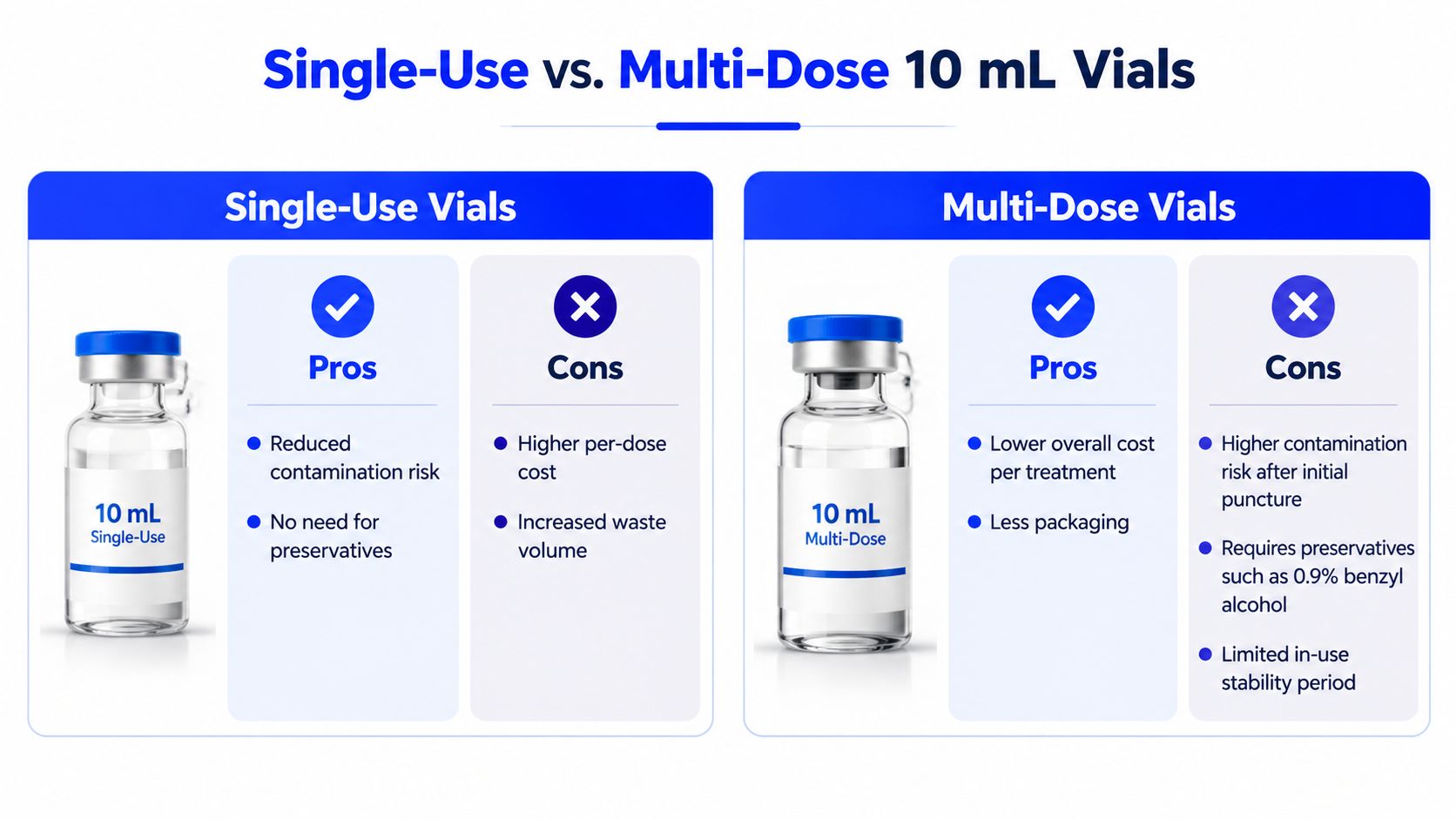
Single-use and multi-dose formats solve different problems. A single-use vial limits the time and number of interventions after opening, which can simplify contamination control. A multi-dose vial reduces packaging repetition and may suit workflows that require repeated withdrawals, but each puncture creates another opportunity for contamination or closure damage.
The decision shouldn't be framed as “reusable is cheaper.” A multi-dose design only makes sense when the lab can control aseptic access, store the vial under defined conditions, and validate the period during which the contents remain suitable for the intended RUO workflow. Preservatives can support a multi-dose design, but they may also affect formulation compatibility and experimental interpretation.
Where the trade-off appears
| Single-use approach | Multi-dose approach |
|---|---|
| Fewer post-opening interventions | Repeated withdrawals from one container |
| Lower contamination exposure after access | Greater dependence on aseptic technique |
| More packaging and disposal | Requires closure and preservative compatibility review |
| Straightforward allocation to one preparation | Requires an in-use handling and storage policy |
Research on vial reuse adds an important sustainability dimension. A 2026 study found that machine dishwashing reduced environmental impacts by 44–88% compared with hand washing, while also removing contaminants more consistently than hand washing or chemical baths, as reported in this study of vial cleaning methods. Environmental gains don't establish sterility, however. Reused vials still require cleanliness validation, and contamination research has associated repeated puncture systems with microbial risk when access points aren't controlled.
For non-critical laboratory work, validated washing and inspection may be reasonable. For sterile diluents, sensitive preparations, or workflows where contamination would invalidate a run, a new sterile container is usually the more defensible choice. The diluent itself also matters. Labs using bacteriostatic water should verify preservative compatibility and follow the product's stated RUO handling instructions.
Use-Cases for Reconstitution and Storage
A vial's best specification depends on what happens inside the lab. Three common workflows show why the same nominal capacity can require different decisions.
Lyophilized peptide reconstitution
A researcher adding diluent to a lyophilized peptide needs room to direct the liquid onto the vial wall or cake without aggressive spraying. Headspace supports gentle swirling after the stopper is accessed, while a compatible elastomer helps reduce coring and maintains closure integrity during withdrawal.
The lab should confirm that the vial's nominal fill suits the planned preparation, then check whether the closure supports the intended number of punctures. A sterile, non-pyrogenic reconstitution solution in a 10 mL format is one example of a product designed for this type of RUO preparation. It remains the researcher's responsibility to verify compatibility with the specific peptide, storage protocol, and laboratory procedure.
Antibody working solutions
Antibody preparations can be sensitive to agitation, adsorption, temperature changes, and repeated handling. A Type I borosilicate vial may be selected where the formulation and process call for a chemically resistant container, but the glass alone doesn't protect the sample from poor storage or excessive manipulation.
A practical workflow uses a closure that supports the planned access pattern and a vial size that avoids unnecessary empty volume. The researcher should document the vial lot, solution identity, preparation date, storage condition, and access events. Those records help distinguish a formulation issue from a container or handling issue when assay results change.
Analytical sample storage
Analytical runs often involve multiple withdrawals, short-term staging, or transfers into another vessel. In that setting, the finish and stopper may matter more than the vial's external appearance. A seal that resists leakage and a closure that allows controlled access can protect the sample while reducing handling complications.
Before a run, the lab can use a simple decision check:
- Mixing required: Confirm adequate headspace and a closure that tolerates the planned access.
- Repeated sampling: Evaluate stopper puncture performance, resealing behavior, and contamination controls.
- Sensitive formulation: Confirm glass class and chemical compatibility with the supplier.
- Traceability required: Record the vial and closure lots alongside the sample record.
Quality Documentation and Regulatory Requirements
A purchase file should show what the supplier shipped, how the lot was released, and whether the container system fits the planned workflow. A product page that lists only capacity and color leaves too many questions open. Confirm ISO format, glass class, and closure compatibility, then match those details to the intended RUO process.
Documents to request
| Document | Purpose |
|---|---|
| Lot-specific Certificate of Analysis | Links the shipment to defined test results and release criteria |
| Sterility report | Records whether the container or component received a sterility assessment |
| Endotoxin report | Supports endotoxin-control review where the workflow requires it |
| ISO or GMP certificate | Documents the supplier's applicable quality framework |
| Dimensional drawing | Confirms vial geometry, finish, and equipment compatibility |
| Closure compatibility statement | Identifies suitable stopper, cap, and processing combinations |
| QA release record | Shows that the lot passed the supplier's internal release review |
Document availability and timing vary by supplier and configuration. Request these records before an order becomes urgent. Quality staff can then compare certificate details with the incoming lot, instead of finding a mismatch after the vials enter an experiment or production process.
A procurement mapping framework, such as Procright's AI procurement mapping, can connect specifications, suppliers, approval steps, and required records. This helps when purchasing, quality assurance, and laboratory operations each hold part of the decision.
For RUO teams, “research use only” still calls for controlled records. Define how the lab will assess GMP standards for biotech R&D, and use this GMP compliance guide for pharma professionals as a reference when reviewing suppliers and internal procedures.
The final checklist should name the ISO format, glass class, dimensions, finish, stopper, cap, sterilization status, lot documents, and intended access pattern. It should also state whether the workflow involves single access, repeated withdrawals, or reconstitution. These fields turn “10 mL vial” from a broad product label into a specification that purchasing and the lab can review together.
Herbilabs supplies RUO sterile diluents and reconstitution solutions in 10 mL premium glass multi-dose vials, with lot-specific Certificates of Analysis and QA review for product release. Researchers, independent labs, and biotech procurement teams can visit Herbilabs to review available formats and request supply information for peptide, protein, and antibody workflows.