Private Label, White Label, Wholesale partnerships available - EU, USA and UK - Free shipping from €75
Private Label vs White Label: Lab Sourcing Guide 2026
The most repeated advice in the private label vs white label discussion is that private label buys control and white label buys speed. Pay more, wait longer, and the product becomes yours. That framing survives because it sounds like a purchasing decision. It isn't one. It's a branding argument wearing procurement clothes, and it leaves the three questions a laboratory buyer has to answer untouched: who holds the specification when the stopper material changes, who signs the lot release, and who owns the tooling after the contract ends.
Private label doesn't automatically deliver better quality or tighter control. It delivers exactly what the agreement says it delivers. A buyer can commission a bespoke vial, fund the sampling and approval work, sit through a longer cycle, and still end up with release criteria the manufacturer sets alone, change notices that never arrive, and a formulation the supplier is free to sell to another customer next quarter. Control is written into paper. It isn't purchased with a label.
What follows treats the choice as an operational control decision rather than a marketing one. The two models get set side by side, the difference gets converted into a procurement control matrix, and the decision gets priced in total landed cost. Every section ends with something a buyer can paste into a request for quote or an agreement.
Table of Contents
- Private Label and White Label Side by Side
- Control Matrix and Quality Controls for Lab Materials
- Exclusivity, Ownership and Brand Rights in the Contract
- Cost, Lead Time and Minimums in Total Landed Cost
- Which Model Fits Your Lab Situation
- Confirm the Model and Request Your Quote
Private Label and White Label Side by Side
Most comparisons of private label vs white label stop at the label itself. They describe one model as printing a buyer's name on a stock item and the other as building a product to a buyer's brief, then leave the reader to conclude that the second is the serious option. The split that decides the outcome isn't branding. It's who owns the product specification before the first purchase order is signed.
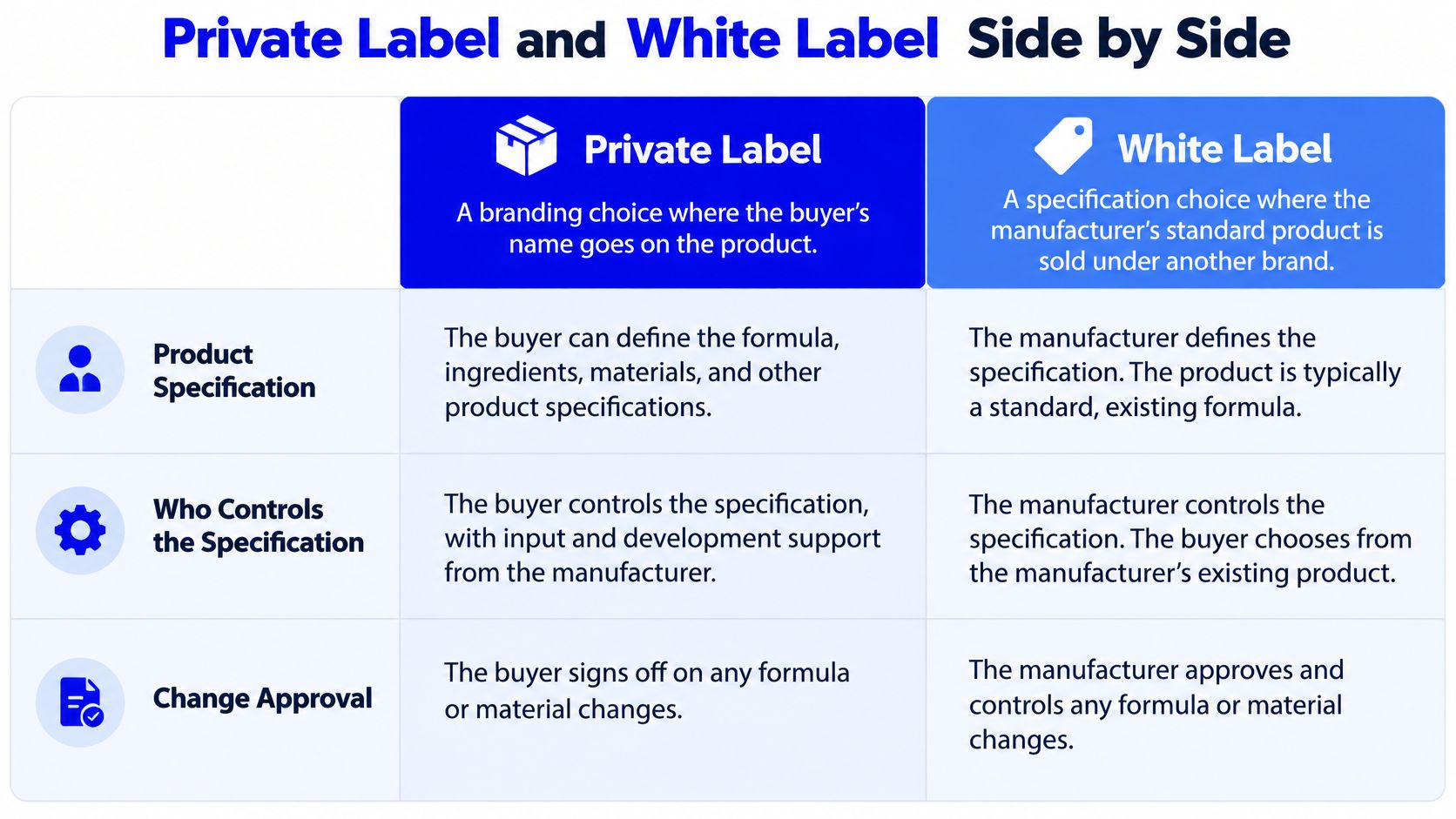
Read the table below by column, not by row. In the white-label column the manufacturer develops and keeps the base formulation, tooling or process and supplies substantially the same product to several sellers, with the buyer controlling branding, labeling and selected packaging. In the private-label column the buyer specifies at least some attributes, whether that's material grade, dimensions, vial components, test requirements or packaging configuration. Once the buyer has written part of the specification, the rest of the column becomes negotiable. When it hasn't, nothing in the column is negotiable, including the parts the buyer assumed were standard.
Private label vs white label at a glance
| Criterion | White label | Private label |
|---|---|---|
| Who owns the base specification | Manufacturer develops and keeps the formulation or process | Buyer specifies at least some attributes |
| Typical lead time (reported) | About 1 to 4 weeks | About 8 to 16 weeks |
| Minimum order quantity | About 25 to 500 units in one comparison | Higher in most programs, quoted per program |
| Exclusivity | Same standard product may go to several sellers | Intended to be unique to one brand when contracted |
| Branding and labeling | Buyer controls labels and selected packaging | Buyer controls branding plus the specified attributes |
| Development effort | Minimal, because the product already exists | Formulation, sampling, approval and custom production |
| Best fit | Catalog-matched specifications and a fast launch | Differentiated specifications and controlled release criteria |
What each row changes in practice
Lead time and minimums follow from ownership, not from supplier efficiency. A catalogue item ships on a catalogue cycle. A specified item waits for formulation, sampling and approval before production is even scheduled, which is why the ranges in the table sit weeks apart. Minimums move the same way: a manufacturer already tooled for a standard product can take small runs, while a specified program has to absorb setup, component purchasing and a first-article check.
Branding and development effort are the two rows buyers overvalue. Label control feels like product control, and it isn't. A buyer who controls artwork, carton copy and label layout still has no say over stopper material, preservative system or the acceptance limits printed on the COA unless those sit inside the specification.
Exclusivity is the commercial row and carries the most misunderstanding. A white-label manufacturer may sell the same standard product to several sellers, while a private-label line is intended to be unique to one brand. A Shopify guide to private label adds the caution that matters in negotiation: exclusivity shouldn't be assumed from the label, and the agreement should state whether it covers the finished product, the formulation or design, geographic markets, sales channels, duration and competing customers.
Those reported figures are directional rather than universal, so use them to shape a plan and let each supplier quote its own numbers. Reading a supplier's capability list against a requirement is the same discipline buyers apply in other categories, for instance when they compare shrink and stretch film capabilities before appointing a packaging partner.
Classify the need first. It's either catalog-matched, meaning an existing item already satisfies the documented method, or specified, meaning at least one attribute has to be written and approved. That single classification points to a model before any supplier call happens.
Control Matrix and Quality Controls for Lab Materials
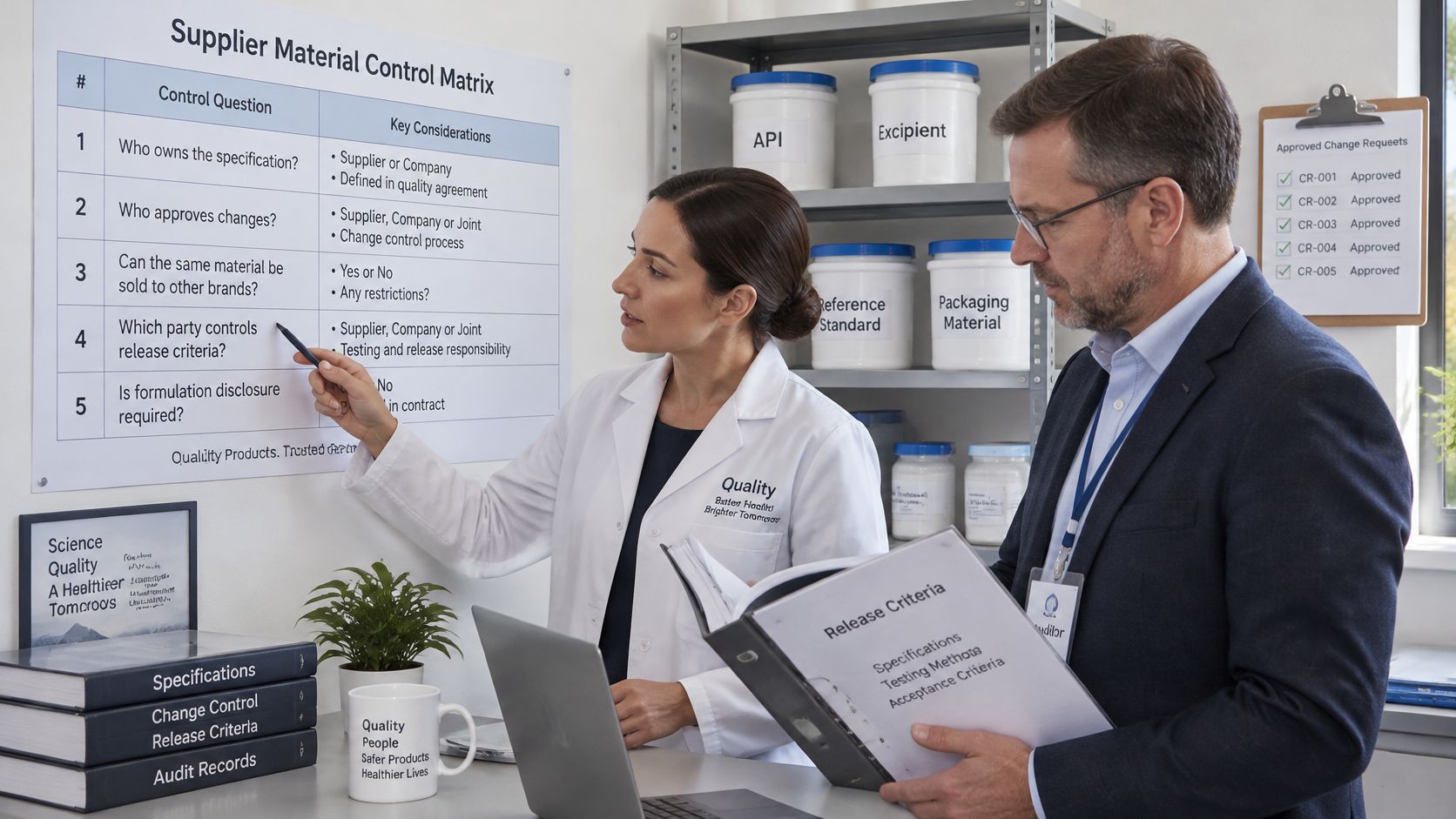
A side-by-side breakdown of white label and private label sourcing treats the distinction as control of the product specification and recommends converting it into a procurement control matrix instead of a brand discussion. For a laboratory, the matrix reduces to five questions. Who owns the specification. Who approves changes. Can the same material be sold to other brands. Which party controls release criteria. Does each lot need batch-specific documentation.
The five questions in the order they get asked
- Specification ownership. Name the document that holds the specification and the party that owns it. If the supplier owns it, the buyer is renting a product.
- Change approval. State who signs off before a formulation, component or test method changes, and how much notice arrives first.
- Shared supply. Ask whether the same material goes to other brands. The answer sets price pressure and continuity risk at once.
- Release authority. Decide who releases a lot and against which written criteria, then confirm that the buyer can reject a lot that fails them.
- Lot documentation. Confirm that a COA is issued for every lot and carries the lot number, not that it exists on request.
White label carries no penalty when the required material, vial format, preservative system, labeling and documentation already match the laboratory's SOPs, because the buyer is purchasing a known quantity and the qualification work is mostly document review. Private label earns its extra cycle time when the buyer needs differentiated vial components, a specific packaging configuration, labeling controls, sampling plans or acceptance criteria that no catalogue item offers.
The quality file matters more than the product photograph at this stage, and it's the first thing a procurement analyst should open.
Private label doesn't automatically mean better quality, and it doesn't automatically mean tighter control. Retail Dive's reporting on record private-label sales puts U.S. private-label sales at $282.8 billion in 2025, up 3.3% year over year, against 1.2% growth for national brands. That figure describes shelf space and shopper trust, not specification discipline. A private-label buyer who never writes the quality system, the testing package, the approved materials, the lot-release process, the deviation and complaint routes, the recall process and the supplier-change notification period has bought a label with extra steps.
Lot traceability as the worked example
A single lot number and a COA per lot let a lab trace each vial back to its documentation, which is what an audit trail needs and what a drift investigation needs. Multi-use vials make this concrete. When results shift across a study, the question is whether the material changed or the handling did. A lot number lets the lab separate the two by comparing the COA for each lot against handling records for the same period. Without one, both explanations stay on the table and neither can be ruled out.
Practical rule: Request a sample lot with its COA before committing to volume, then compare the COA against your SOP line by line. Test names, methods, specifications and acceptance limits should match what the method requires, not merely resemble it.
The quality checklist, row by row
Each row below is a control point to write into the agreement. The warning-sign column is the tell that a supplier hasn't built the process yet, whatever the sales conversation claims.
| Control point | What the buyer should define | Warning sign |
|---|---|---|
| Lot release | Who releases each lot and against which criteria | Release decided by the supplier alone with no criteria |
| Certificate of Analysis | A COA issued for every lot, carrying the lot number | COA available only on request or for some lots |
| Storage and in-use instructions | Storage conditions, shelf life and first-use instructions fixed on the label and product sheet | Instructions missing from the label or product sheet |
| Container and stopper changes | Written notice before any change to vial, stopper or preservative system | Changes made without notice |
| Test method changes | Notice and revalidation before a test method changes | Method changed without record |
| Complaints and recalls | Response times and the process for deviations and recalls | No named contact or documented process |
Score each row as met, partly met or not met against the evidence the supplier supplies, which is how a compliance matrix with yes, no and partial scores keeps a review objective and comparable between two quotes.
Apply the relabel test to any quote that arrives described as private label. Has the supplier changed the specification, or only applied a customer label to an unchanged catalogue item? Three things separate the cases: whether the supplier can name the attributes the buyer set, whether the COA reports those attributes, and whether a change to any of them needs the buyer's approval first.
Certificates deserve the same scrutiny as the product. Check the scope, the issuing body and the standard behind the certificate, which is the discipline covered in what supplier certificates actually prove, rather than accepting the logo on the sheet as evidence.
A missing control point is a gap to negotiate while the agreement is still a draft. Once the first shipment lands, the same gap becomes a change request the buyer pays for.
Exclusivity, Ownership and Brand Rights in the Contract
A brand label creates no ownership. Commissioning a customised product does not automatically hand the buyer the underlying design, formula, tooling or manufacturing asset, and Printify's comparison of white label and private label agreements lists the assets that need an express owner: brand artwork, product specifications, formulations, molds, tooling, packaging designs, and related listings or content. Give every item on that list a name, an owner and a clause. Anything left unnamed tends to default to whoever is holding it.
Continuity is the test that exposes the gap. If the supplier can supply the same formulation to another brand the month after the contract ends, the buyer holds a branded product rather than a controlled specification. Ask the question directly during negotiation: after termination, can this formula, mould or component set appear in another customer's catalogue? A yes is workable when it carries a defined non-compete window or a buy-out price for the tooling.
Usage limits that travel with the product
Herbilabs products may not be repackaged, relabeled or resold for use in food, pharmaceuticals, cosmetics or medical applications. All products are strictly intended for laboratory research purposes and are not designed, tested or approved for human consumption, therapeutic, diagnostic or clinical use. An agreement that places a partner's brand on the vial should carry those restrictions forward in the same words, because the buyer's customer sees the label, not the supply chain behind it.
Clauses to draft or check
- Asset ownership schedule. One line per item, naming the owner, the buyer's rights and what happens on termination.
- Exclusivity scope. Which finished specification, which markets, which channels, for how long.
- Change control. Notice period, approval rights and revalidation duties for formulation, container, stopper, preservative system and test method.
- Tooling and documentation return. Who holds drawings, specifications and batch records, and what transfers when the relationship ends.
- Resale restrictions. The permitted applications, stated on the label and repeated in the agreement.
Component substitution is where ownership gets tested in practice. When a stopper or container is discontinued, the party that owns the specification decides the equivalent and the party that owns the brand carries the consequence. Buyers judging equivalent items in other supply categories use the same lens, for instance when they check Labs USA casework substitution options to see how a supplier documents an approved substitute rather than a convenient one.
Cost, Lead Time and Minimums in Total Landed Cost
Unit price is the wrong comparison across a private label vs white label decision, because the two quotes rarely cover the same work. Published supplier benchmarks show the shape of the trade-off. A comparison of private-label and white-label program terms reports white-label lead times of roughly 1 to 4 weeks, with minimum order quantities around 25 to 500 units in one comparison, against private-label lead times of roughly 8 to 16 weeks once formulation, sampling, approval and custom production are counted. Treat both ranges as directional planning figures rather than promises.
White label minimizes development time, qualification effort and the cash tied up in initial inventory, because the product already exists. The cost sits elsewhere: the same base product may be available to competing sellers, which compresses price differentiation and makes supplier continuity the thing to protect. Private label carries more upfront coordination and often higher minimums, and it earns that when the requirement is a controlled specification, an exclusive configuration or a differentiated quality-document package.
A worked comparison makes the difference visible. A lab buying a standard catalogue item holds less safety stock, because a reorder can land inside a normal procurement cycle. A lab that needs a custom packaging configuration plans reorders around the sampling and approval window instead, carries buffer stock through qualification, and qualifies a second source before the first run, since a container or stopper change can restart part of the approval work.
Rule of thumb: If a minimum order forces a lab to hold material past the point its storage conditions support, the discount is a waste rather than a saving.
The go and no-go gate
Run the control checklist before the cost comparison, not after. Any control point a supplier cannot meet is a cost, because renegotiation, rework or a revalidation lands later and lands on the buyer's timeline. Lot release criteria, COA availability per lot, packaging compatibility, storage requirements and a written notification period for formulation or component changes belong in the same evaluation as the unit price.
The per-unit calculation worth running
- Total the one-off costs on each quote: samples, artwork, testing, qualification, and the obsolete stock a specification change would create.
- Divide by the units expected to be bought over the contract term, not the first order.
- Add the recurring costs the quote hides, such as safety stock carried through a longer lead time and staff time spent on change reviews.
- Compare the two per-unit results, then compare the two risk profiles, because the cheaper figure on a shared specification is only cheaper while continuity holds.
Buyers comparing volume terms can set bacteriostatic water wholesale arrangements against the same calculation. The per-unit number is the one to defend in a budget review. The control points are what make it hold.
Which Model Fits Your Lab Situation
Most labs don't need a supplier conversation to choose a model. They need to recognize which of four situations they're in, because each one carries a single trade-off that the buyer lives with for the length of the contract.
The four situations below cover most of the buying patterns in a laboratory supply calendar.
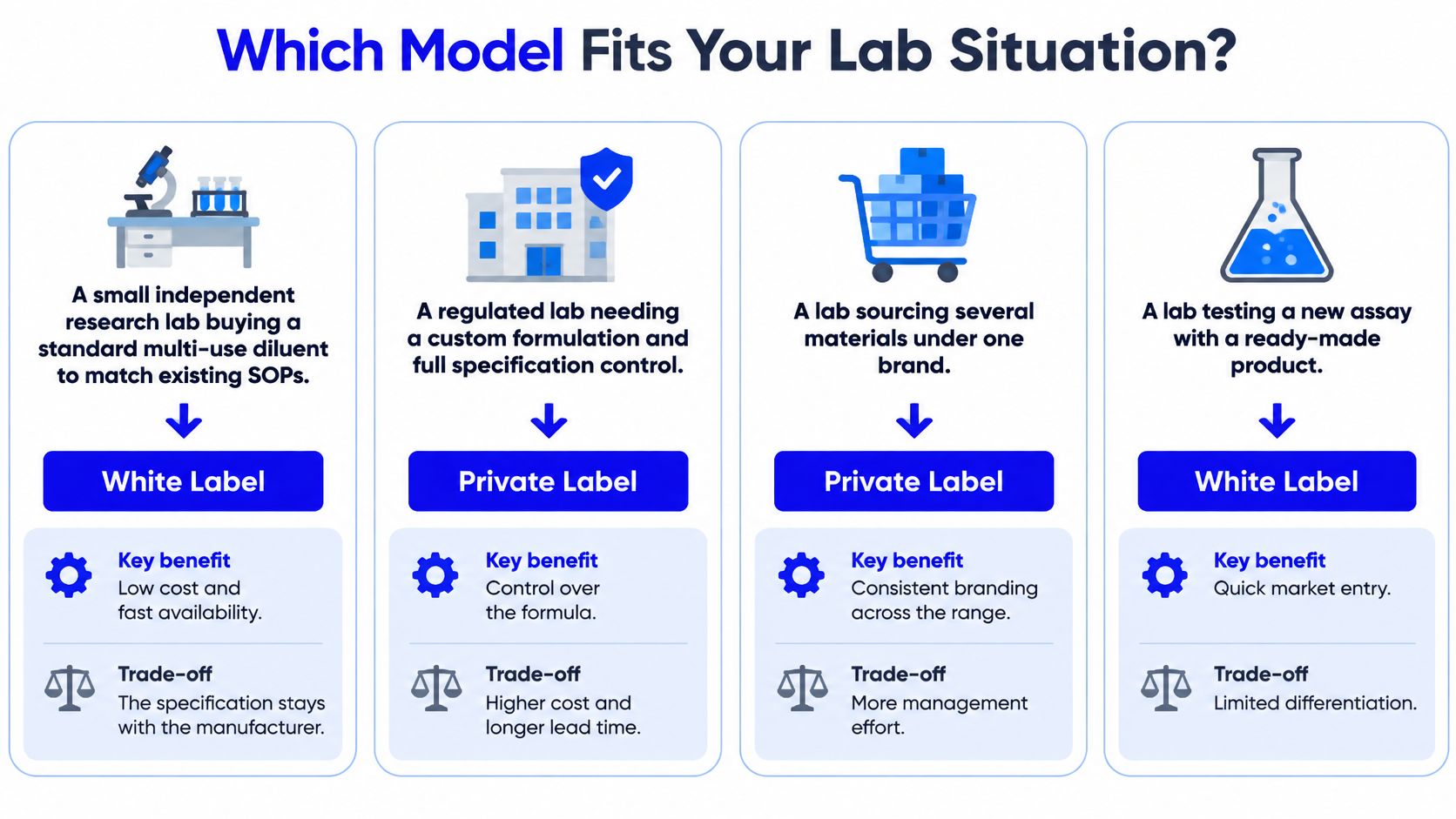
A small independent research lab buying a standard multi-use diluent to match an existing SOP. White label. The documented method already names the material, the concentration and the handling steps, so a catalogue item that matches those documents removes weeks of qualification work. The trade-off is the shared base product: the specification stays with the manufacturer, and a supplier-side component change arrives as a notice rather than a decision.
A small private laboratory needing its own packaging configuration and a sampling plan for a repeated protocol. Private label, with the specification, the sampling plan and the acceptance criteria written into the agreement before the first run. The trade-off is time and sampling budget, both paid upfront and neither returned if the program is cancelled.
A lab manager who has to evidence batch-level documentation for an audit. Private label, or a white-label item whose lot COA has already been checked against the lab's SOP. The trade-off here is administrative rather than commercial: either route works, but only if someone has read the COA against the method and recorded that the check happened.
A wholesale or distribution buyer selling into several accounts. Usually white label, unless exclusivity to their own brand is central to the offer. Where it is, exclusivity has to be negotiated at the level of the finished specification.
A unique carton over a shared formulation is a branding purchase. It isn't a specification.
Two situations that get misfiled
A buyer who wants a new assay tested quickly reaches for private label when a ready-made catalog item would answer the question sooner. Conversely, a buyer who wants a house brand across a full range reaches for white label and then spends the savings managing suppliers whose documentation doesn't match. Where a range spans several packaging formats, the manufacturing route matters as much as the label, and labs that need one supplier to hold a specification across formats can review custom solution manufacturing for labs before the range is defined.
The test is short. Which of the four situations matches, and which minimum has to be written into the contract before the first order goes out?
Confirm the Model and Request Your Quote
A sourcing model only delivers control when the agreement assigns it clearly. For a catalog-matched product, verify that the lot documentation supports the lab's release process. For a specified product, record the specification, sampling plan and exclusivity terms before sampling begins. Then compare those requirements with the control matrix, contract clauses and lot-documentation checklist.
Choose white label when the lab's SOP matches a standard product and its documentation supports release. That keeps the qualification work focused on document review. Choose private label when the lab needs different packaging, label control or acceptance criteria, and put the specification and exclusivity terms in the agreement.
Use four steps to prepare the request:
- Set out the RFQ requirements. Specify ownership, change approval, release authority, per-lot COA requirements and permitted applications.
- Request a sample lot and its COA. Compare the document with the SOP before pricing a volume order.
- Review the agreement. Address the finished specification, lot release, change notice and IP ownership in the contract.
- Compare total landed cost. Include one-off costs spread across contract units and recurring costs not shown in the quote.
Herbilabs supplies bulk, wholesale and private label orders. Customers can request wholesale pricing or contact the business for it. Send the relevant requirements with the request so the quote can be assessed against the intended model.
Herbilabs supplies bacteriostatic water in 10 mL multi-use vials and 10 x 10 mL kits for laboratory research, with a lot-specific Certificate of Analysis for every lot. Review the current lots and COAs, then send the specification behind the method with your quote request. Products are for research use only.