
Procurement decisions in laboratory environments carry consequences that extend well beyond budget considerations. A reagent labeled “reagent grade” or even “ACS grade” may appear compliant on paper yet fail to meet the legally enforceable purity thresholds required for regulated research in the UK and Europe. The gap between assumed and actual reagent quality is a persistent source of invalidated results, failed audits, and, in some cases, regulatory penalties. This guide clarifies the major international standards, explains what certified reference materials actually guarantee, and provides practical steps for vetting suppliers and maintaining compliance in day-to-day laboratory operations.
Table of Contents
- What are laboratory reagent standards and why do they matter?
- Key international reagent standards: USP, EP, and ACS explained
- Certified reference materials (CRMs) and traceability: What makes a reagent truly reliable?
- Legal and practical compliance in UK and European labs
- Choosing and auditing suppliers: Practical steps for quality assurance
- Ensure quality and compliance with trusted reagents
- Frequently asked questions
Key Takeaways
| Point | Details |
|---|---|
| Lab reagent standards matter | Choosing certified reagents directly impacts experimental success and compliance. |
| Understand main standards | USP, EP, and ACS standards differ in strictness, scope, and legal force. |
| Trust accredited CRMs | Certified Reference Materials with ISO 17034 traceability are essential for reliable results. |
| Audit suppliers continuously | Regularly verifying supplier credentials and document chains keeps your lab audit-ready. |
What are laboratory reagent standards and why do they matter?
Laboratory reagent standards are formally defined specifications that govern the purity, identity, stability, and traceability of chemical substances used in scientific research and analysis. They are not interchangeable marketing labels. A standard specifies the minimum acceptable concentration of the active substance, the maximum permissible levels of specific impurities, and the analytical methods used to verify both. Without adherence to these specifications, the reliability of any downstream result is fundamentally compromised.
The core attributes that define a compliant reagent include:
- Purity: Quantified minimum assay values and defined impurity limits
- Identity: Confirmed chemical structure and molecular characteristics
- Traceability: Documented chain of custody from raw material to finished product
- Certification: Third-party or pharmacopoeia-verified testing with issued documentation
A common misconception among procurement teams is that the term “reagent grade” carries uniform legal weight. It does not. As noted in USP and EP standards analysis, not all designations are legally enforceable or suitable for high-stakes research. Only pharmacopoeia-designated grades carry binding regulatory authority in the UK and EU. Understanding the importance of high-purity reagents is therefore not optional for laboratories operating under GMP or GLP frameworks.
“Reagent grade” is a commercial descriptor. “Ph. Eur. grade” is a legal requirement. Conflating the two is one of the most common and costly errors in laboratory procurement.
The practical stakes are significant. Laboratories that used non-certified reagents in method validation have had entire study datasets rejected during regulatory inspections, requiring full repetition of experiments at substantial cost and time.
Key international reagent standards: USP, EP, and ACS explained
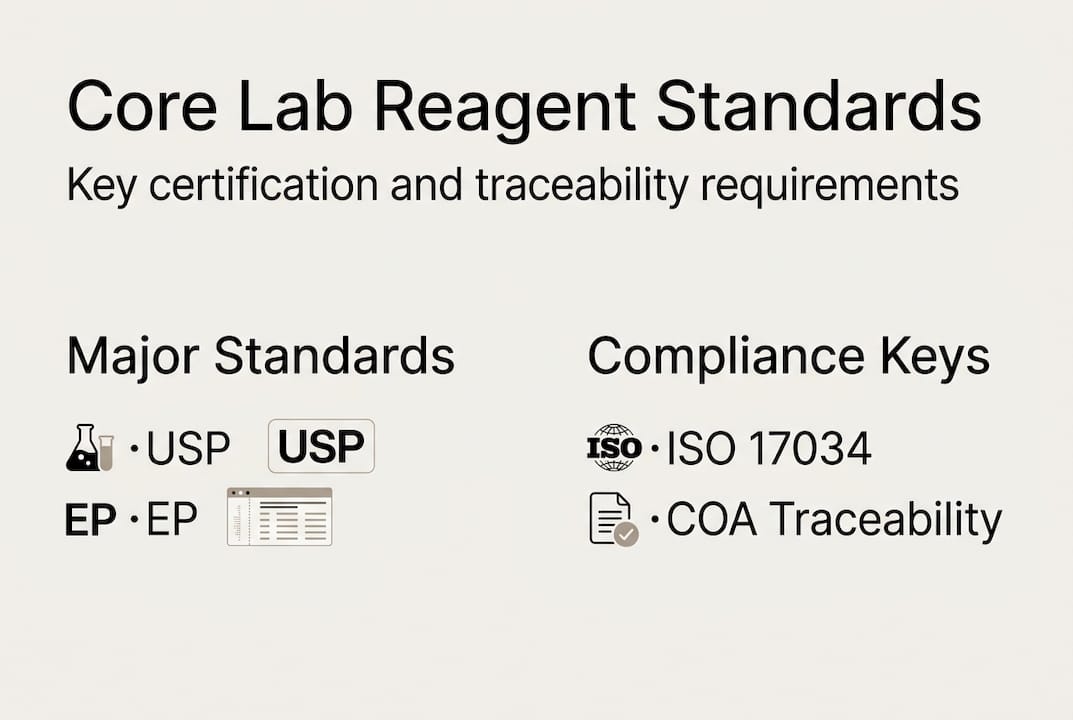
Three standards dominate reagent procurement decisions for UK and European laboratories: the United States Pharmacopeia (USP), the European Pharmacopoeia (EP, also written as Ph. Eur.), and the American Chemical Society (ACS) standard. Each serves a distinct purpose and carries a different level of regulatory authority.
| Standard | Governing body | Legal binding in EU/UK | Primary application |
|---|---|---|---|
| EP (Ph. Eur.) | EDQM / Council of Europe | Yes, for pharmaceuticals | Pharma QC, regulated biomedical research |
| USP | United States Pharmacopeial Convention | Partially (recognized) | Pharma, clinical, and compounding labs |
| ACS | American Chemical Society | No (voluntary) | General analytical chemistry |
The EP and USP standards are legally binding in the EU and UK for pharmaceutical applications, and both are updated on a regular cycle to reflect advances in analytical methodology. For European laboratories, Ph. Eur. takes precedence in any regulated context. USP is widely recognized and often accepted in cross-border research collaborations, but it does not replace Ph. Eur. compliance for EU-based submissions.

ACS grade, by contrast, is a voluntary standard. It defines minimum purity thresholds for general analytical use but carries no legal enforceability. For non-regulated research, ACS grade is often sufficient. For GMP-compliant work, it is not.
Key considerations when selecting a standard:
- Use Ph. Eur. for all regulated pharmaceutical and biomedical research in the UK and Europe
- Use USP when collaborating with US-based institutions or submitting to FDA-regulated pathways
- Use ACS for general analytical chemistry where regulatory compliance is not required
- Always confirm that safe reagent handling protocols align with the grade selected
- Verify that water purity standards used in reagent preparation match the grade requirements
Certified reference materials (CRMs) and traceability: What makes a reagent truly reliable?
Certified Reference Materials, commonly abbreviated as CRMs, are substances with one or more property values that are sufficiently homogeneous, stable, and well-characterized to be used for instrument calibration, method validation, or quality control. They are not simply high-purity chemicals. They are metrologically certified materials with documented uncertainty values.
CRMs for reagents must comply with ISO 17034, the international standard governing reference material producers, ensuring homogeneity, stability, traceability to NIST or IUPAC reference values, and full metrological certification. ISO 17025 governs the testing and calibration laboratories that characterize these materials. Both accreditations are essential markers of supplier credibility.
| CRM supplier | Accreditation | Parameters covered |
|---|---|---|
| Reagecon Diagnostics | ISO 17034, ISO 17025 | pH, conductivity, concentration standards |
| Merck/Sigma (EMSURE) | Ph. Eur., ACS, ISO | Solvents, salts, acids, bases |
| LGC Standards | ISO 17034, UKAS | Organic and inorganic reference standards |
To verify CRM authenticity before use, follow these steps:
- Request the Certificate of Analysis (COA) and confirm it references ISO 17034 accreditation
- Cross-check the accreditation number against the issuing national body (e.g., UKAS in the UK)
- Confirm the stated uncertainty values and traceability chain (NIST, BIPM, or IUPAC)
- Verify the expiry date and storage conditions match your laboratory’s capabilities
- Retain all documentation for audit readiness
Pro Tip: Always request COAs with explicit ISO traceability statements. A COA that lists purity without a traceability chain is insufficient for regulated work and will not satisfy an EMA or MHRA inspection.
For laboratories managing certified reagents across multiple projects, maintaining a centralized COA registry linked to sample traceability records significantly reduces audit preparation time.
Legal and practical compliance in UK and European labs
Compliance in UK and European laboratories is governed primarily by the European Pharmacopoeia for pharmaceutical-grade reagents and by EMA GMP guidelines for manufacturing environments. Post-Brexit, the UK has retained Ph. Eur. standards through the British Pharmacopoeia, which incorporates Ph. Eur. monographs by reference. This means the practical compliance requirements for UK laboratories remain closely aligned with EU expectations.
The EMA GMP Q&A guidance explicitly warns against paper audits as a substitute for verified supplier compliance. Method validation must follow USP<1225> or equivalent Ph. Eur. chapters, and reagent stability must be monitored post-certification to confirm that materials remain within specification throughout their use period.
Common compliance pitfalls to avoid:
- Accepting supplier declarations without COA verification: Always cross-reference against accreditation databases
- Using expired CRMs: Stability data does not extend beyond the certified expiry date
- Failing to document reagent receipt and storage conditions: Gaps in chain-of-custody records are a frequent audit finding
- Assuming commutability: CRMs validated for one matrix may not perform equivalently in a different sample type
- Neglecting method revalidation after reagent lot changes: A new lot number may introduce variability that invalidates previous validation data
Pro Tip: Cross-validate all supplier compliance claims against official accreditation databases such as UKAS (UK), DAkkS (Germany), or COFRAC (France) before onboarding any new reagent source. Paperwork alone is not sufficient evidence of compliance.
For laboratories managing reconstitution workflows, following a rigorous aseptic preparation checklist and actively avoiding contamination pitfalls are equally important components of a defensible compliance posture.
Choosing and auditing suppliers: Practical steps for quality assurance
Supplier selection is one of the highest-leverage decisions a laboratory manager or procurement specialist makes. A single non-compliant supplier can compromise an entire study, trigger a regulatory finding, or require costly repeat testing. Rigorous supplier qualification is therefore a core quality assurance function, not an administrative formality.
For UK and European procurement, prioritize suppliers such as Reagecon (ISO 17025 and ISO 17034 accredited) and Merck/Sigma EMSURE (Ph. Eur., ACS, and ISO compliant), as these accredited suppliers provide the traceability and documentation infrastructure required for regulated research.
Steps for selecting and onboarding a new reagent supplier:
- Define the regulatory requirements for the intended application (Ph. Eur., USP, ACS, or ISO)
- Request the supplier’s current accreditation certificates and scope of accreditation
- Review a representative COA for the specific reagent, confirming traceability and uncertainty values
- Conduct a documented supplier questionnaire covering batch traceability, stability monitoring, and deviation handling
- Place a qualification order and perform independent verification testing before full adoption
- Establish a re-qualification schedule, typically annual, to confirm ongoing compliance
Red flags to watch for during supplier audits:
- COAs that lack specific uncertainty values or traceability statements
- Accreditation certificates that are expired or cover a different product scope
- Inability to provide batch-specific stability data
- Vague or generic responses to questions about deviation and out-of-specification handling
- No documented change control process for raw material or process changes
Pro Tip: Rotate supplier audits annually and include at least one unannounced documentation request per cycle. This practice identifies process gaps that scheduled audits may miss and reinforces supplier accountability.
For laboratories working with reconstitution workflows, understanding reconstitution solution standards and following established lab reagent handling steps ensures that even compliant reagents are used in ways that preserve their certified properties.
Ensure quality and compliance with trusted reagents
Applying the standards and supplier qualification frameworks outlined above requires access to reagents and solutions that are manufactured to the same rigorous specifications you are now equipped to demand. Herbilabs provides high-purity reagents and reconstitution solutions manufactured to ISO, EP, and GMP-aligned standards, with full documentation available for audit readiness.
For laboratories managing complex reconstitution workflows, Herbilabs offers detailed guidance on handling reagents safely and provides reagent dilution guidance to support accurate preparation at every stage. Whether you are qualifying a new supplier, preparing for a regulatory inspection, or standardizing your procurement criteria, Herbilabs is positioned to support your compliance requirements with verified, research-grade products and responsive technical support across the UK and Europe.
Frequently asked questions
What is the difference between USP, EP, and ACS standards for reagents?
USP and EP are legally binding pharmacopoeia standards with regular updates applicable to pharmaceutical and regulated research contexts, while ACS sets voluntary purity thresholds primarily for general analytical chemistry without regulatory enforceability.
Why are certified reference materials (CRMs) important for laboratory reagents?
CRMs provide verified traceability, documented stability, and metrological homogeneity, all of which are essential for method validation and quality control. ISO 17034 compliance ensures that the certified values are defensible under regulatory scrutiny.
How can I check if a reagent supplier is truly compliant?
Request ISO-accredited Certificates of Analysis and verify the supplier’s accreditation status directly through official national databases such as UKAS or DAkkS. Per EMA GMP guidance, documentation alone is not sufficient evidence of compliance.
Is “reagent grade” always enough for compliance in regulated labs?
No. In the UK and Europe, only reagents certified to Ph. Eur. or the relevant pharmacopoeia meet legal standards for regulated pharmaceutical and biomedical research. Generic “reagent grade” labeling carries no binding regulatory authority.