Private Label, White Label, Wholesale partnerships available - EU, USA and UK - Free shipping from €75

GHK-Cu Reconstitution: How Much Bac Water for 50 mg and 100 mg Vials
GHK-Cu reconstitution for research: how much bacteriostatic water to add to 50 mg and 100 mg vials, the resulting mg/mL, and U-100 syringe readings.
Short answer: a 50 mg GHK-Cu vial is commonly reconstituted with 3–5 mL of bacteriostatic water (16.7–10 mg/mL). A 100 mg vial is commonly reconstituted with 5–10 mL (20–10 mg/mL). The solution is blue, which is normal: the colour comes from the copper in the GHK-Cu complex.
Research use only. This page covers laboratory reconstitution and concentration maths only. It recommends no amount and describes no use in people or animals.
GHK-Cu reconstitution chart
| Vial | Bac water | Concentration | 10 units (0.1 mL) | 1 unit |
|---|---|---|---|---|
| 50 mg | 2 mL | 25 mg/mL | 2.5 mg | 250 mcg |
| 50 mg | 3 mL | 16.7 mg/mL | 1.67 mg | 167 mcg |
| 50 mg | 5 mL | 10 mg/mL | 1 mg | 100 mcg |
| 100 mg | 3 mL | 33.3 mg/mL | 3.33 mg | 333 mcg |
| 100 mg | 5 mL | 20 mg/mL | 2 mg | 200 mcg |
| 100 mg | 10 mL | 10 mg/mL | 1 mg | 100 mcg |
Need another combination? Use the peptide reconstitution calculator.
How much bac water for 50 mg GHK-Cu?
Larger volumes are common with GHK-Cu because the vials hold a lot of material. 5 mL gives a round 10 mg/mL, which keeps the maths simple: 1 unit = 100 mcg, 10 units = 1 mg. 3 mL gives 16.7 mg/mL if you want a smaller volume per withdrawal. Check that the vial can hold the volume with some headspace.
How to reconstitute GHK-Cu
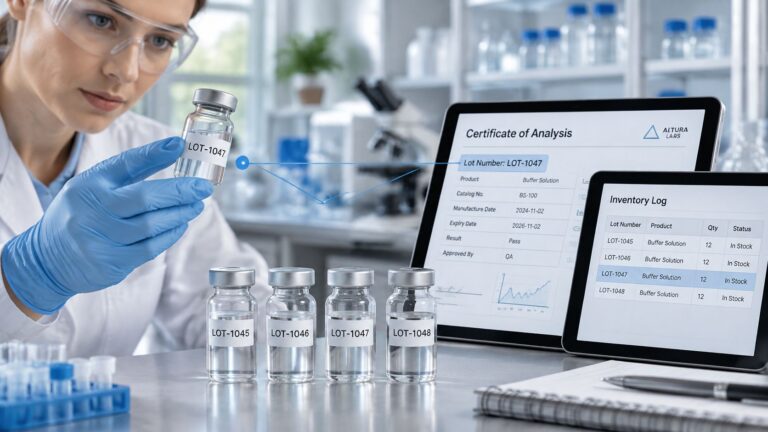
- Confirm the vial mg and batch on the COA.
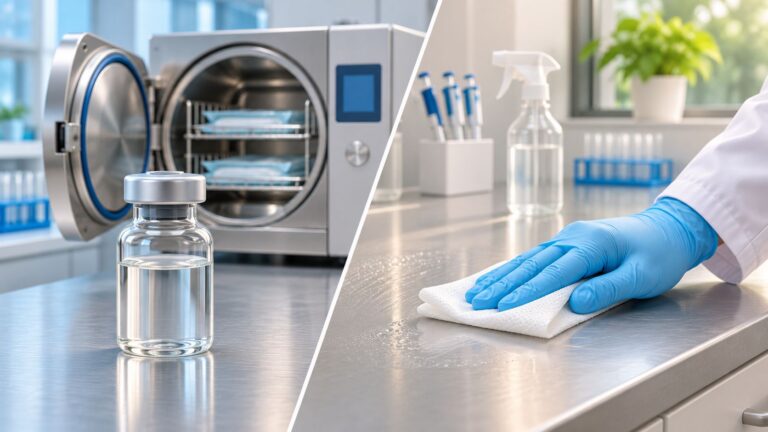
- Bring vial and water to room temperature.
- Swab both stoppers and let them dry.
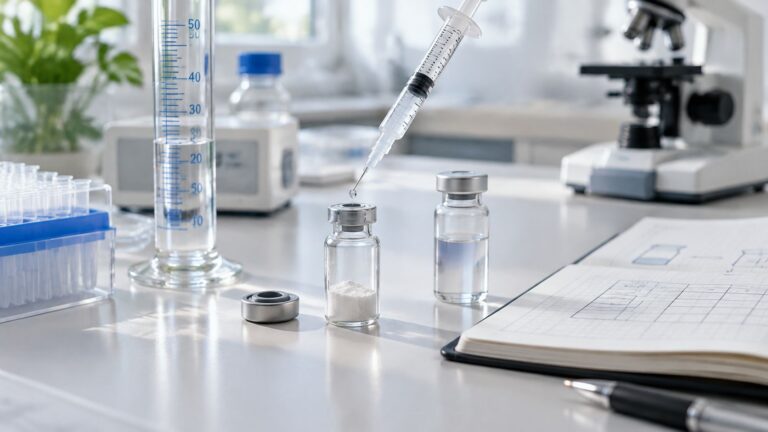
- Add the bacteriostatic water slowly down the vial wall.
- Swirl gently until fully dissolved; the solution turns clear blue.
- Label with date and concentration.
- Store at 2–8 °C, protected from light.
What to look out for
- Colour: clear blue is expected. A green or brown shift, cloudiness or particles are reasons to stop and check the batch COA.
- Metal contact: copper peptides can react with some metals, so keep contact with metal parts short. Draw and transfer with standard sterile syringes.
- Concentration labels: because GHK-Cu volumes are larger, the mg-per-unit figure is easy to misread. Write it on the vial.
Bacteriostatic water for GHK-Cu
A 3–10 mL reconstitution uses a large share of a vial of diluent, and the vial is usually entered many times. A diluent with 0.9% benzyl alcohol, which inhibits bacterial growth, is the standard choice. Herbilabs bacteriostatic water is supplied in 10 mL vials and 10 × 10 mL kits, made in the EU with a COA for every batch. Background: bac water for peptides.
FAQ
How much bac water for 100 mg GHK-Cu?
5 mL gives 20 mg/mL; 10 mL gives 10 mg/mL.
Why is GHK-Cu blue?
GHK-Cu is a copper complex of the GHK tripeptide, and copper(II) gives the solution its blue colour.
Can GHK-Cu be reconstituted with sterile water?
Yes, for single use. For a vial used over several weeks, bacteriostatic water is the usual choice.
For research and laboratory use only. Not for human or veterinary use. Herbilabs supplies bacteriostatic water only.