Private Label, White Label, Wholesale partnerships available - EU, USA and UK - Free shipping from €75

10 Ml Glass Vial Guide for Lab and Peptide Use
A researcher has a lyophilized peptide on the bench, a measured volume of diluent in a syringe, and a 10 mL glass vial that looks interchangeable with the others in the cabinet. It isn't. The vial's dimensions determine whether the stopper and crimp fit correctly, while the glass class and closure materials influence how the sample interacts with its container during storage and repeated withdrawal.
The useful question isn't which 10 mL vial holds the required volume. It's which container-closure system matches the formulation, process, equipment, and handling schedule. A sound selection considers the vial profile, finish, glass composition, stopper design, sterilization status, and supplier documentation as one connected system.
Table of Contents
- Why the 10 mL Glass Vial Matters in Real Lab Workflows
- Understanding ISO Dimensions and the 10R vs 10H Naming
- Glass Composition and Hydrolytic Resistance Explained
- Stopper and Closure Options That Fit a 10 mL Glass Vial
- Sterilization Status and Ready-to-Use Formats
- Best Practices for Filling and Handling the Vial
- Choosing a Supplier and Verifying Documentation
Why the 10 mL Glass Vial Matters in Real Lab Workflows
A researcher may have a lyophilized peptide, a measured diluent volume, and several apparently identical vials on the bench. The selection still matters. A 10 mL vial must work as a container-closure system, not merely provide a stated capacity. Its internal geometry, glass composition, stopper, seal, and handling process all affect reconstitution and storage.
For peptide work, start with the procedure rather than the label. The diluent volume should allow the material to dissolve with controlled motion, leave usable headspace, and support the planned withdrawal method. The neck influences needle access and the chance of striking the wall. The body must sit securely in the rack, tray, or holder used by the laboratory. A stopper and crimp that do not match the finish can compromise an otherwise suitable vial.
Geometry affects more than storage
The internal profile can influence where a dried cake forms during lyophilization and how readily liquid can be withdrawn afterward. Headspace provides room above the formulation for vapor and air, while the neck bore affects access during repeated withdrawals. Base diameter and height also determine whether the vial remains stable in a rack, training device, cryogenic setup, or automated filling station.
These dimensions affect equipment fit as well as sample handling. A vial that fits the nominal volume requirement may still fail at the rack, filling, sealing, or inspection stage if its external profile differs from the equipment specification. For that reason, procurement should identify the vial profile, outer diameter, total height, neck and finish configuration, glass type, and compatible closure.
Practical rule: Evaluate the vial, stopper, seal, and cap together. Capacity alone cannot confirm that the package will work with the formulation, withdrawal method, or equipment.
The size sits at a useful market crossover
The broader vial market includes capacity bands covering 6 mL to 10 mL and 10 mL to 20 mL, placing the 10 mL format between commonly supplied small-volume ranges for injectable drug packaging. According to a market analysis from Fortune Business Insights, the global vials market was valued at USD 12.2 billion in 2023 and is projected to reach USD 26.5 billion by 2032, at a 9.1% CAGR. The same linked analysis also reports a projection of USD 16.33 billion in 2026 rising to USD 35.51 billion by 2034, at a 10.20% CAGR, as presented in the vials market analysis from Fortune Business Insights.
Those figures describe market demand, not peptide compatibility. Their practical relevance is that standardized small-volume formats remain widely supported across pharmaceutical and laboratory supply chains. For the researcher, a familiar format can simplify compatibility with existing filling, sealing, storage, and inspection equipment, provided the complete closure system matches the process.
Understanding ISO Dimensions and the 10R vs 10H Naming
A vial that fits a 10 mL specification can still fail at the equipment interface. 10R and 10H labels describe a vial profile, not merely a fill volume. Treat the container as a standardized tube with defined body, shoulder, neck, and finish dimensions, then confirm how that profile fits the intended process.
The “R” designation is commonly associated with tubular glass, while “H” identifies molded glass within the ISO 8362 family. Both may represent a 10 mL format, but their external dimensions should not be assumed to match. The supplier's controlled drawing remains the procurement reference, especially when the vial must fit a lyophilizer, filling line, tray, labeler, or rack.
The dimensions buyers should verify
Industry references commonly place this format near a 20 mm crimp finish, with an outer diameter near 24 mm and an overall height near 45 mm. Catalogued versions may reach 47 mm or 50 mm, depending on the design, as shown in the 10 mL vial dimensional reference.
The purchasing record should state more than “10 mL.” Specify the vial profile, outer diameter, total height, neck and finish configuration, glass type, and compatible stopper and seal. This prevents a common procurement error: receiving the expected nominal capacity in a body that does not seat correctly in existing equipment.
For peptide reconstitution, this distinction affects more than storage. The vial must leave enough clearance for the intended needle or transfer device, while its finish must support a stopper and crimp seal that remain seated during handling. A dimensional match is therefore one part of the container-closure system, alongside glass and closure behavior.
Why small dimensional differences cause trouble
A few millimeters in height can affect shelf spacing in a lyophilizer or clearance beneath a filling head. A larger outside diameter can keep the vial from entering a rack or tray pocket. The finish determines whether the stopper and crimp seal sit squarely, while the shoulder profile affects label application and visual inspection.
| Dimension | 10R, regular tubular profile | 10H, molded profile |
|---|---|---|
| Glass designation | Tubular glass, “R” designation | Molded glass, “H” designation |
| Nominal format | Commonly identified as 10 mL | Commonly identified as 10 mL |
| Typical outer diameter | Near 24 mm | Near 24 mm, confirm supplier drawing |
| Typical overall height | Near 45 mm | May use a different body profile or height |
| Finish consideration | Often paired with a 20 mm crimp format | Confirm finish and closure compatibility |
| Procurement check | Verify dimensional drawing and equipment fit | Verify molded profile, finish, and equipment fit |
Use the table as a screening aid, not as a replacement for a controlled drawing. Before ordering, compare the supplier's dimensional specification with the actual equipment interface and the selected closure. Nominal capacity alone cannot confirm that the complete package will work for peptide reconstitution, filling, sealing, or storage.
Glass Composition and Hydrolytic Resistance Explained
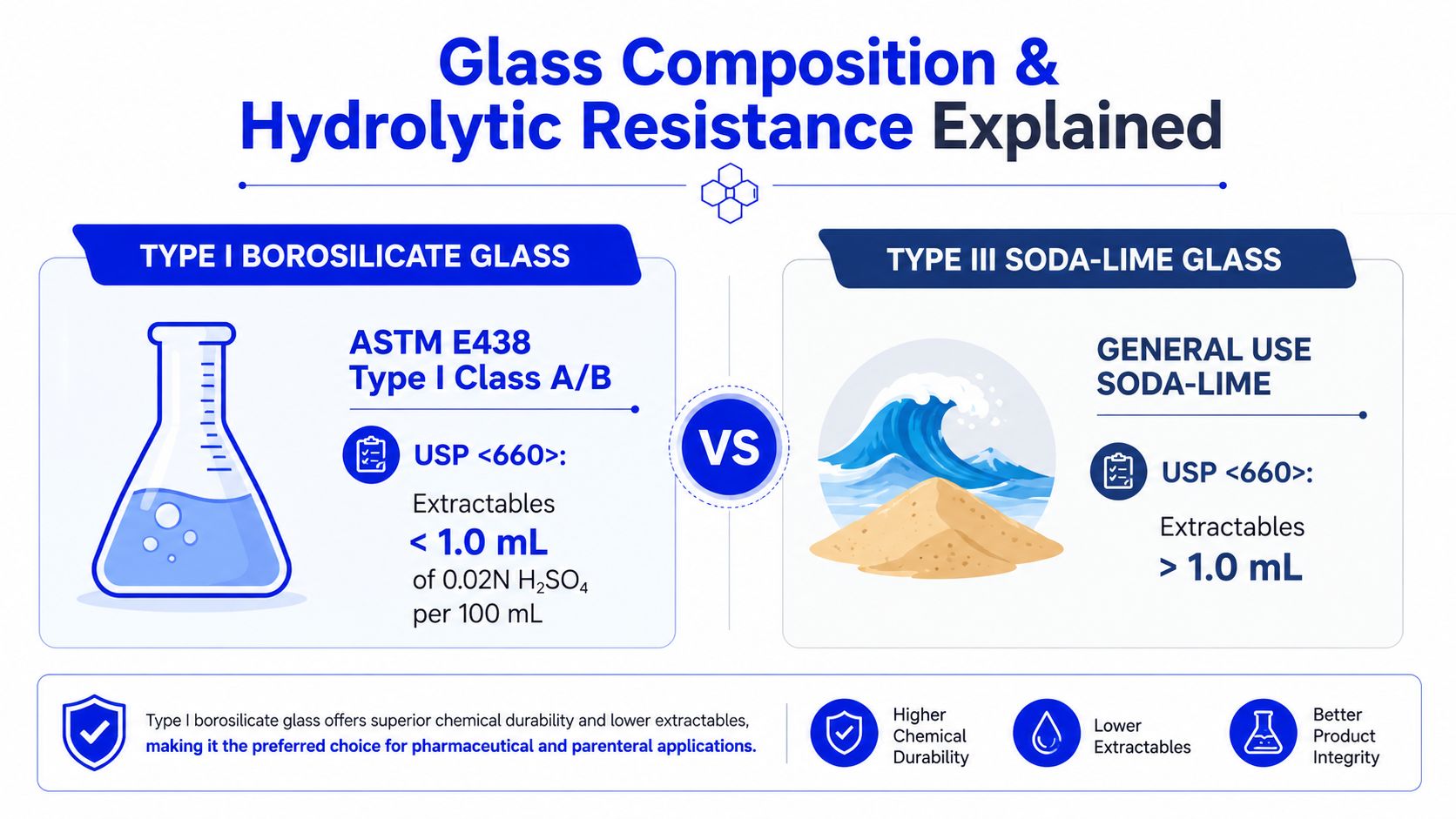
For peptide-adjacent work, glass composition is a compatibility decision. Type I borosilicate glass has the highest hydrolytic resistance in USP and Ph. Eur. classifications, and that resistance comes from the glass composition rather than a surface treatment. Type III soda-lime glass has lower resistance and may be appropriate for less demanding, short-contact applications, but it shouldn't be selected by capacity alone.
Hydrolytic resistance describes how strongly the glass resists releasing alkaline components into an aqueous formulation. With repeated contact, lower resistance can increase the risk of alkali leaching and formulation pH drift. That risk matters when the sample is sensitive to pH, trace-element exposure, or long storage.
The pharmaceutical glass packaging guidance from Pharmastate Academy identifies Type I borosilicate as the benchmark for demanding aqueous, peptide-reconstitution, and injectable-adjacent applications. It also connects container classification with hydrolytic resistance testing for vial-type containers.
Type I and Type III serve different priorities
Type I borosilicate is generally the safer choice when the vial directly contacts a peptide formulation, particularly where storage duration, repeated access, and batch consistency matter. Its chemical durability reduces the likelihood that the container will materially change the aqueous environment.
Type III soda-lime may suit a buffer that remains in the vial only briefly, or a noncritical preparation where the formulation and exposure conditions have already been qualified. The label “glass” doesn't establish compatibility. The glass class, formulation, contact time, temperature, and closure system must be considered together.
Material rule: If the vial directly contacts a sensitive aqueous peptide preparation, documented Type I status deserves priority over a lower purchase price.
A supplier should provide a material designation and relevant compliance documentation, rather than relying on “clear glass” or “pharmaceutical glass” as a complete description. If the certificate doesn't identify the glass class, the buyer has an unresolved compatibility question.
Stopper and Closure Options That Fit a 10 mL Glass Vial
A vial can have the right glass and capacity yet fail at the closure. The stopper must match the finish, the process, the needle access pattern, and the formulation. For peptide work, the important distinction is whether the vial will undergo lyophilization or will receive an already liquid formulation.
Match the closure to the process
Lyophilization stoppers are positioned partially in the vial before freezing and drying. Their design permits vapor movement during the cycle, after which the stopper is fully seated under vacuum or controlled conditions and the vial receives its crimp seal. This arrangement requires a finish and crimp system designed for the lyophilizer and closure tooling.
Serum stoppers are seated fully before use and are commonly selected when no lyophilization step is planned. They support repeated needle entry, but the formulation and access schedule still determine whether the stopper material and seal performance are suitable.
Split-stoppers, including two-leg and three-leg designs, provide a compromise for certain freeze-drying processes. The legs help maintain mechanical stability while leaving a path for vapor escape. They aren't automatically interchangeable with every lyophilization tray or crimp system, so the supplier's closure drawing matters.
Finish size changes the available options
A commonly referenced 10 mL vial format uses a 20 mm crimp finish, while some vial configurations and closure systems use a 13 mm finish. A 20 mm opening accommodates larger closures often associated with lyophilization, whereas a 13 mm finish is commonly associated with serum-style septa and aseptic withdrawal. The buyer should confirm the actual finish rather than infer it from the vial volume.
Stopper composition also deserves review. Bromobutyl and chlorobutyl rubber can differ in gas permeability and extractables, which may affect a lyophilized peptide, an aqueous solution, or an oil-based compound in different ways. The final choice should be based on formulation compatibility data, seal requirements, and the number of planned punctures.
For secondary protection during shipment and storage, a packaging engineer may also review resources on how to choose protective bottle packaging. External packaging doesn't replace container-closure qualification, but it can help protect the vial from impact, abrasion, and handling damage.
Sterilization Status and Ready-to-Use Formats
“Sterile vial” doesn't always mean the same thing operationally. A lab must distinguish among non-sterile bulk, sterile-only, and ready-to-use, or RTU, formats before ordering. Each format assigns different preparation and validation responsibilities to the end user.
Non-sterile bulk vials may arrive clean but not sterilized. The facility then owns the washing, depyrogenation, sterilization, inspection, and release steps. That option can suit an academic lab with suitable equipment and validated procedures, but the vial's arrival condition shouldn't be confused with a sterile container.
Sterile-only products have undergone a sterilization treatment, such as gamma irradiation or ethylene oxide, but may still require additional preparation for the specific filling process. The user must confirm what the supplier means by “sterile,” how the packaging was handled, and whether washing or depyrogenation remains necessary.
RTU reduces preparation work
RTU vials are supplied pre-washed, depyrogenated, and pre-sterilized, often in nested tub packaging intended for aseptic filling lines. Depyrogenation is a thermal process aimed at reducing endotoxin contamination. It isn't another name for microbial sterilization, so the supplier should document both processes separately.
Gamma treatment can be used with glass and compatible rubber components, but the buyer should request the actual irradiation documentation and confirm that the closure system has been included in the qualification. A vial's glass class and the closure materials can respond differently to processing, packaging, and storage conditions.
A capacity-focused market breakdown places the up-to-10 mL segment at roughly 49.4% share of the vials packaging market, with that market projected to reach about US$9.7 billion in 2026 and US$13.1 billion by 2033, according to the Persistence Market Research vials packaging analysis. The commercial importance of small formats helps explain the growing availability of RTU options, but it doesn't eliminate the need to verify release records.
For a peptide lab, bulk may fit a validated facility with an autoclave and controlled depyrogenation process. RTU is more suitable when the operator needs documented cleanliness and sterility without building those preparation steps into the local workflow. A reconstitution workflow may also require a compatible reconstitution solution, selected and documented separately from the vial itself.
Best Practices for Filling and Handling the Vial
Handling technique determines whether a well-selected vial remains useful after it reaches the laboratory. The operator should treat the outer container, septum, needle, diluent, and work surface as parts of one aseptic process. A sterile label on the package doesn't protect the sample from poor access technique.
Prepare the vial before access
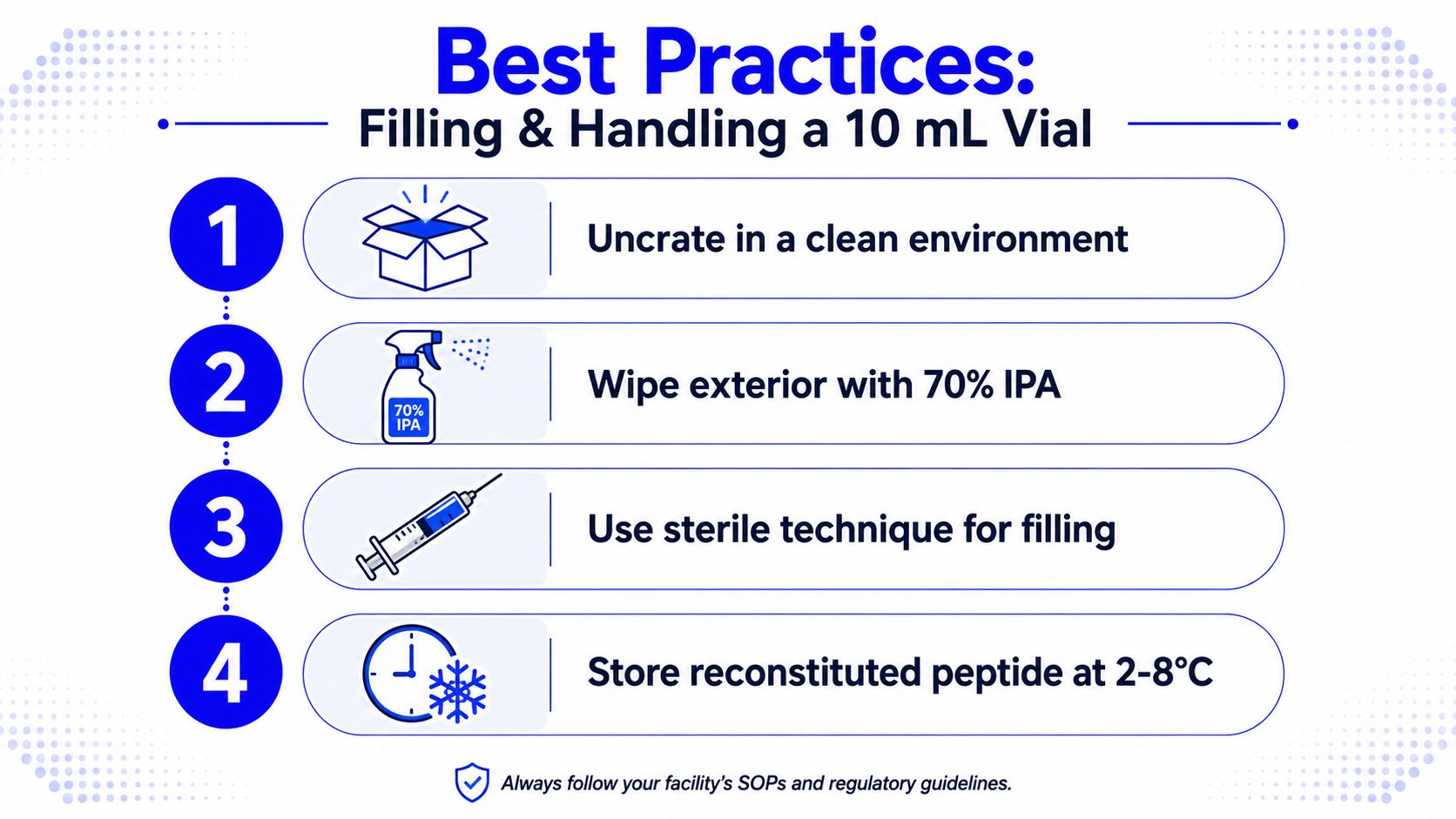
The vial should be uncrated in a clean environment and inspected for cracks, chips, loose components, damaged seals, or unclear lot identification. The exterior can be wiped with 70% isopropyl alcohol, then allowed to dry. Room-temperature equilibration before opening helps limit condensation beneath the crimp, especially when the container has moved from a cooler storage area.
The septum should receive the same 70% IPA treatment, with enough contact time for the disinfectant to work. A quick pass followed by immediate puncture is weaker practice than a deliberate swab and drying period. The operator should use a new sterile needle and syringe for each aseptic transfer.
Fill and withdraw without stressing the sample
A liquid fill should leave practical headspace for needle withdrawal and mixing. For lyophilization, excess fill can interfere with cake formation and drying behavior, so the process should use a validated fill volume rather than filling to the brim. The vial's nominal 10 mL capacity is a maximum container description, not an instruction to use that entire volume.
During withdrawal, the needle bevel can be directed toward the vial wall and the liquid removed slowly. Gentle movement helps limit foaming, which can be particularly undesirable for fragile peptide preparations. If pressure builds or the vial begins to resist withdrawal, a second venting needle may help equalize pressure when the approved procedure allows it.
The video demonstration of vial handling can supplement written training, but each facility should follow its own validated aseptic procedure.
Storage and disposal need the same discipline
Reconstituted peptides stored at 2–8 °C have an in-use window of up to 28 days when handled with proper aseptic technique, as described in the Herbilabs product information. Beyond that window, sterility and potency can't be guaranteed, even when a bacteriostatic diluent has been used. The operator should record the reconstitution date, formulation identity, vial lot, diluent lot, and storage conditions.
For disposal, the label should be defaced, the stopper should be depunctured where local procedure requires it, and the vial should go into the designated sharps or laboratory waste stream. Glass vials with punctured septa shouldn't enter ordinary recycling because they may retain residues and present a handling hazard.
Handling rule: Every puncture creates another opportunity for contamination. A written access limit and a clear discard date protect the workflow better than relying on memory.
Use of bacteriostatic water should follow the product instructions and the lab's research-use-only procedures. The diluent doesn't remove the need for clean access, appropriate storage, or documented discard timing.
Choosing a Supplier and Verifying Documentation
A reliable purchase begins with a document review, not a product photograph. The supplier should identify the vial's glass class, profile, finish, sterilization status, closure materials, and lot information in a way that allows the receiving lab to connect the physical package to its records.
Read the Certificate of Analysis line by line
The COA should be checked against the intended workflow. A peptide-focused review can include:
- Glass class: Confirm documented Type I borosilicate status when the vial directly contacts a sensitive aqueous formulation.
- Dimensional identity: Verify the ISO 8362 profile, such as 10R or 10H, along with the supplier drawing and finish designation.
- Chemical durability: Look for USP or Ph. Eur. hydrolytic-resistance documentation rather than a generic “pharmaceutical grade” statement.
- Closure identity: Record stopper composition, finish compatibility, cap type, and any available extractables or leachables information.
- Sterilization record: Confirm whether the product was treated by dry heat, gamma irradiation, ethylene oxide, or another stated method.
- Lot release data: Review particulate, endotoxin, sterility, and packaging-release information where those specifications apply to the product.
A Certificate of Irradiation should accompany a gamma-sterilized claim. For RTU formats, the supplier should explain the washing, depyrogenation, packaging, and sterile-release controls rather than combining all of them under one broad “sterile” label.
Trace the document to the physical vial
The lot code on the COA should match the laser-etched or printed code on the vial, carton, tub, or closure packaging. A mismatch should pause release until the supplier resolves it. The same check applies to the stopper lot, because a change in rubber formulation or supplier can alter extractables, permeability, and seal performance.
A useful receiving checklist records:
- Vial profile and finish.
- Glass type and hydrolytic-resistance class.
- Nominal capacity and dimensional drawing.
- Stopper and cap identification.
- Sterilization and depyrogenation evidence.
- Lot traceability from shipping unit to individual package.
- Storage conditions and expiry information.
- Supplier change-control and complaint-contact process.
Evaluate supplier behavior, not just paperwork
Audit history and change-control procedures reveal how the supplier manages continuity. A vendor that can't explain how a stopper-lot change is communicated downstream creates avoidable risk, even if the current COA looks complete. The receiving team should also ask how deviations, damaged shipments, temperature excursions, and documentation corrections are handled.
Labs purchasing diluent alongside vial supplies may compare options for bacteriostatic water wholesale according to their own research-use requirements, lot documentation needs, and ordering volume. Herbilabs offers a 10 mL reconstitution solution in a glass vial for research use only, described as sterile and non-pyrogenic, with lot-specific COAs and use in reconstituting peptides, proteins, and antibodies.
The final decision can be reduced to one question: does the complete system have enough documented compatibility for the formulation and process? If the answer covers the glass, dimensions, stopper, sterilization state, packaging, lot traceability, and handling procedure, the 10 mL glass vial becomes a controlled component rather than an anonymous piece of labware.
Herbilabs supplies research-use-only reconstitution solutions in 10 mL and other vial formats, with aseptic production and lot-specific quality documentation. Researchers and laboratories can review the available options and contact Herbilabs to match a documented diluent format with their peptide reconstitution workflow.