Private Label, White Label, Wholesale partnerships available - EU, USA and UK - Free shipping from €75
NAD+ Reconstitution: How Much Bac Water for 500 mg and 1000 mg Vials
How much bacteriostatic water to add to a 500 mg or 1000 mg NAD+ research vial, the resulting mg/mL, and what 10 units on a U-100 syringe holds.
Short answer: NAD+ research vials hold far more material than peptide vials, so they need more water. 500 mg with 5 mL of bacteriostatic water gives 100 mg/mL. 1000 mg with 10 mL also gives 100 mg/mL. At 100 mg/mL, 10 units on a U-100 syringe (0.1 mL) holds 10 mg.
Research use only. This page covers laboratory reconstitution and concentration maths. It recommends no amount and describes no use in people or animals.
NAD+ reconstitution chart
| Vial | Bac water | Concentration | 10 units (0.1 mL) | 1 unit |
|---|---|---|---|---|
| 100 mg | 2 mL | 50 mg/mL | 5 mg | 0.5 mg |
| 500 mg | 5 mL | 100 mg/mL | 10 mg | 1 mg |
| 500 mg | 10 mL | 50 mg/mL | 5 mg | 0.5 mg |
| 1000 mg | 5 mL | 200 mg/mL | 20 mg | 2 mg |
| 1000 mg | 10 mL | 100 mg/mL | 10 mg | 1 mg |
For other combinations, use the reconstitution calculator (switch the unit to mg).
Things that are different with NAD+
- Volume. 5–10 mL is far more than the 1–3 mL used for peptides. Check the vial’s total capacity before you add the water; a 10 mL fill needs a vial with headspace. A full 10 mL bacteriostatic water vial covers one 1000 mg reconstitution at 10 mL.
- Dissolving takes longer. At high concentrations, swirl patiently and give it a few minutes. A large powder load can take a while to clear.
- Light. NAD+ is light-sensitive. Keep the reconstituted vial in its box or an amber container, at 2–8 °C.
- Big numbers. Concentrations are in the tens to hundreds of mg/mL, so a units-to-mg mistake is large. Label the vial clearly.
How to reconstitute NAD+
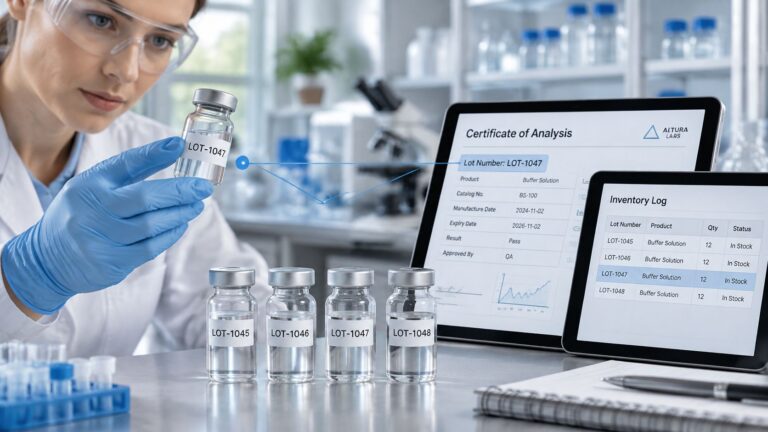
- Check the mg on the label and the batch COA.
- Let the vial and the water reach room temperature.
- Swab both stoppers and let them dry.
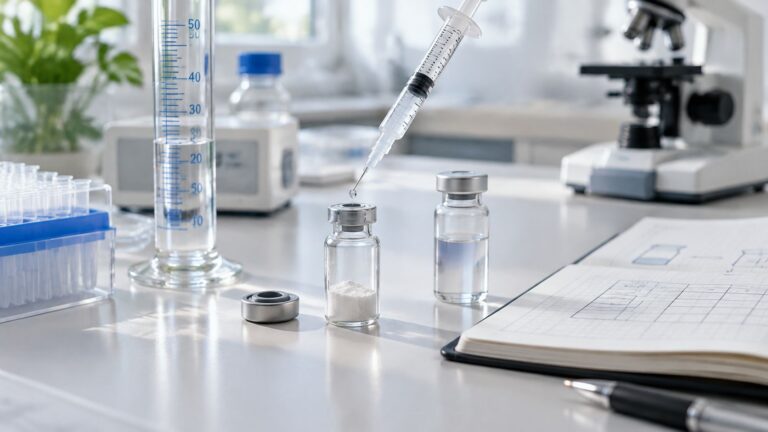
- Draw the water in steps if your syringe is smaller than the total volume. Use a fresh sterile needle and syringe.
- Add the water slowly down the vial wall.
- Swirl or roll gently until fully dissolved. Do not shake.
- Label with the date and concentration; store cold and dark.
NAD+ reconstitution calculator: worked example
500 mg vial + 5 mL bacteriostatic water: 500 ÷ 5 = 100 mg/mL. One unit (0.01 mL) holds 1 mg, and 10 units hold 10 mg. With 10 mL instead, every figure halves: 50 mg/mL, 0.5 mg per unit.
Bacteriostatic water for NAD+
Because an NAD+ vial is usually entered many times, a preserved diluent is the usual choice. Bacteriostatic water contains 0.9% benzyl alcohol to inhibit bacterial growth after the first puncture. Herbilabs bacteriostatic water comes in 10 mL vials and 10 × 10 mL kits, made in the EU with a COA for every batch.
FAQ
How much bac water to reconstitute NAD+ 1000 mg?
10 mL gives 100 mg/mL; 5 mL gives 200 mg/mL.
How much bac water for NAD+ 500 mg?
5 mL gives 100 mg/mL; 10 mL gives 50 mg/mL.
Why is my NAD+ solution slightly yellow?
A faint yellow tint can occur. Any particles, cloudiness or a strong colour change are a reason to check the COA and contact the supplier.
For research and laboratory use only. Not for human or veterinary use. Herbilabs supplies bacteriostatic water only.