TL;DR:
- Substandard reagents can lead to experimental failure and costly rework in peptide research.
- Ensuring reagents meet specific purity standards and maintaining traceability is essential for reproducibility.
- Rigorous supplier evaluation and thorough documentation review prevent compromised results and support compliance.
Substandard reagents are one of the most underestimated sources of experimental failure in peptide research. A single impure diluent or a poorly documented reconstitution solution can invalidate weeks of data, trigger compliance findings, and force costly repeat experiments. This guide addresses that problem directly, walking through a structured, compliance-friendly process for identifying, evaluating, and procuring laboratory reagents that meet the purity and traceability standards your work demands. Whether you are managing a university peptide synthesis program or sourcing reconstitution solutions for a contract research organization, the goal is the same: reproducible results and full confidence in every reagent on your bench.
Table of Contents
- Define your research needs and reagent requirements
- Evaluate supplier credibility and quality control
- Assess documentation, standards, and traceability
- Make the purchase: practical steps and common pitfalls
- Why conventional reagent selection shortcuts can undermine research integrity
- Connect with reliable reagent solutions for your lab
- Frequently asked questions
Key Takeaways
| Point | Details |
|---|---|
| Define research requirements | Clarify your study’s purity standards and documentation needs to select appropriate reagents. |
| Vetting suppliers is critical | Choose only those suppliers with validated quality controls and transparent audit histories. |
| Demand full traceability | Insist on Certificates of Analysis and robust documentation for every reagent purchase. |
| Follow a stepwise process | Prevent costly mistakes by using a systematic approach to procurement and inspection. |
Define your research needs and reagent requirements
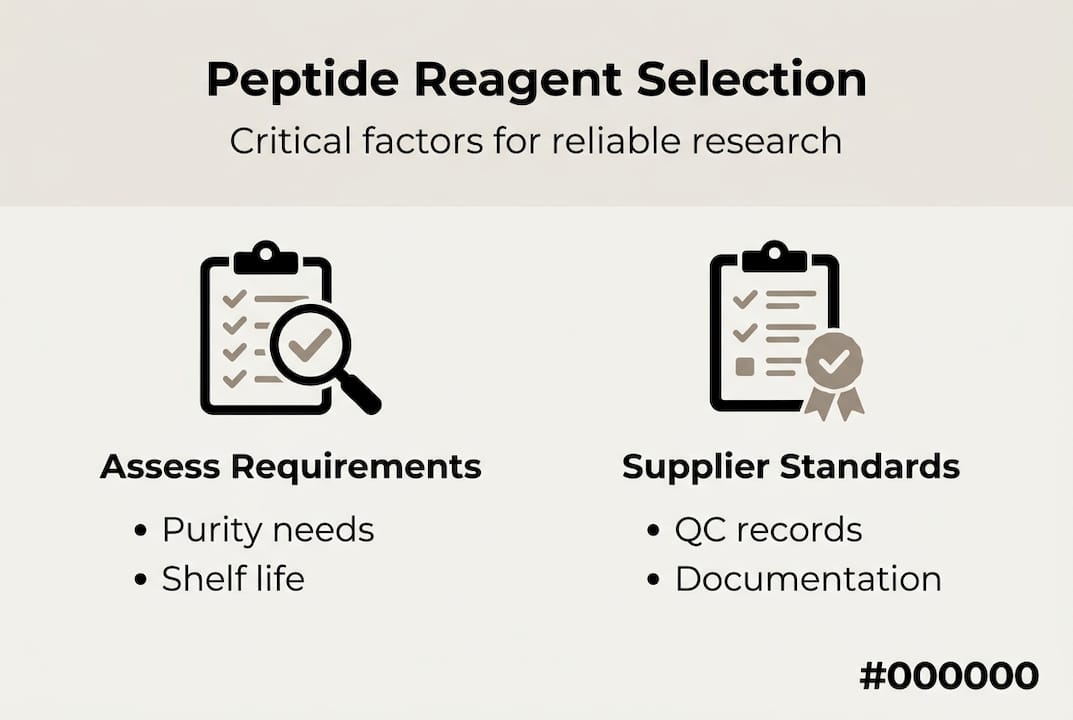
Having set expectations for robust and reliable research, first, get clear on your science and compliance needs. Before evaluating any supplier or product listing, you need a precise picture of what your workflow actually requires. Vague procurement briefs lead to mismatched specifications, which is how laboratories end up with research-grade solvents in applications that demand ACS or USP-grade purity.
Start by mapping your analytical goals. Peptide synthesis workflows, for example, require different reagent profiles than sample preparation for mass spectrometry or quality control testing of lyophilized peptide batches. Each application has its own tolerance for trace metal contamination, water content, and microbial load. Defining the application first prevents you from over-specifying (and overpaying) or, more dangerously, under-specifying and compromising data integrity.
Next, identify the relevant purity grade for each reagent:
- ACS grade: Meets ACS reagent specifications for purity and validated test methods; the standard for most analytical and quantitative work
- USP grade: Meets United States Pharmacopeia standards; required when reagents contact biological samples or when regulatory submissions are anticipated
- EP grade: European Pharmacopoeia equivalent; relevant for research targeting EU regulatory pathways
- Research grade: Suitable for non-critical applications where trace impurities will not affect outcomes
Note that reagent standards across ACS, USP, and EP are not interchangeable. Each defines distinct test methods and acceptance criteria, and high-purity reagents certified to one standard may not satisfy another. The ACS Reagent Chemicals standard sets official specifications for purity and validated test methods and complements USP and EP for analytical reagents, making it a useful benchmark even outside strictly regulated environments.
Also account for volume requirements, shelf-life constraints, and storage conditions. A reagent that degrades at room temperature within three months is a liability if your procurement cycle runs quarterly.
| Specification type | Primary application | Key documents required |
|---|---|---|
| ACS Reagent grade | Analytical chemistry, QC | CoA with ACS-compliant test results |
| USP grade | Biological sample handling | CoA, TDS, USP monograph reference |
| EP grade | EU regulatory research | CoA, EP monograph reference |
| Research grade | Exploratory, non-critical work | CoA, basic TDS |
| HPLC grade | Chromatographic separations | CoA with UV absorbance data |
Evaluate supplier credibility and quality control
With research needs defined, ensure your sources measure up by following a proven vetting process. Supplier credibility is not a soft criterion. It is a technical requirement, because the quality of a reagent is only as reliable as the quality system that produced it.
Use the following checklist when assessing any new supplier:
- Audit history: Has the supplier undergone third-party audits? Are audit reports available on request?
- Out-of-specification (OOS) investigation process: Does the supplier have a documented procedure for investigating and resolving OOS results before releasing product?
- Supply chain transparency: Can the supplier trace raw material origins and provide documentation for each production step?
- Certifications: ISO 9001 or ISO/IEC 17025 accreditation signals a functioning quality management system; GMP certification is critical for reagents used in regulated research
- Professional reputation: Established suppliers with long track records in the scientific community, such as Sigma-Aldrich/Merck or Thermo Fisher, carry reputational accountability that smaller distributors may not
The ACS analytical reagent guidelines recommend vetting suppliers for in-house QC capability, audit history, OOS investigation processes, and supply chain transparency, with a preference for established brands with independently verified quality systems.

Refer to consumables workflow tips and consumables comparison resources to benchmark supplier performance against practical laboratory criteria. For a structured view of how quality control integrates into procurement decisions, lab quality control frameworks provide useful reference points.
| Criterion | High-reliability supplier | Low-reliability supplier |
|---|---|---|
| QC documentation | Full CoA, TDS, MSDS on every batch | Generic or missing documentation |
| Audit readiness | Third-party audited, reports available | No audit history disclosed |
| OOS process | Documented, traceable investigations | Ad hoc or undisclosed |
| Certifications | ISO 9001, GMP, or equivalent | None or unverified |
| Supply chain | Fully traceable raw materials | Opaque sourcing |
Pro Tip: Prioritize suppliers whose in-house QC results are independently verified by a third-party laboratory. A supplier who can provide both internal and external test data for the same batch gives you two independent lines of evidence for reagent quality, which is particularly valuable when your own lab lacks the instrumentation to verify purity independently.
Assess documentation, standards, and traceability
After you shortlist reputable suppliers, dive into their documentation to confirm quality and compliance. A supplier’s reputation is a starting point, not a substitute for document review. Every reagent you bring into your laboratory should be supported by a complete documentation package, and you should know how to read it critically.
Follow these steps when reviewing reagent documentation:
- Request the Certificate of Analysis (CoA) for the specific batch you are purchasing. A generic CoA that is not batch-specific is insufficient for traceability purposes. Confirm that the lot number on the CoA matches the lot number on the container label.
- Review the Technical Data Sheet (TDS). The TDS should specify physical and chemical properties, recommended storage conditions, and known incompatibilities. Cross-reference storage requirements against your laboratory’s capabilities before ordering.
- Match CoA test results against the relevant standard. For ACS-grade reagents, ACS reagent standards align with validated test methods that define minimum purity thresholds and acceptable impurity profiles. Confirm that each listed parameter meets or exceeds the specification.
- Verify traceability records. Batch-to-batch traceability is essential for longitudinal studies and regulatory submissions. Confirm that the supplier retains production and testing records for a defined retention period, typically a minimum of five years for research applications.
- Confirm MSDS (or SDS) currency. Safety Data Sheets should reflect current regulatory classifications. An outdated SDS is a compliance risk.
Traceability is not a bureaucratic formality. In peptide research, where reconstitution conditions directly affect peptide stability and bioactivity, a documented chain of custody from raw material to final reagent is the only way to isolate variables when results are unexpected.
For practical guidance on sample traceability and water quality standards relevant to reconstitution workflows, additional resources are available. Researchers working with reconstitution solutions specifically will also benefit from reviewing reconstitution documentation requirements in detail.
Pro Tip: Always cross-check supplier-provided data against your laboratory’s internal specification sheets before approving a new reagent for use. Discrepancies between supplier claims and your own requirements are far easier to resolve before the reagent enters your workflow than after a failed experiment.
Make the purchase: practical steps and common pitfalls
Once you have confirmed compliance on paper, move confidently into the purchase and onboarding phase. The ordering process itself introduces risk if it is not managed systematically. The most common procurement failures occur not during supplier evaluation but during the transition from approved specification to physical receipt.
Follow this stepwise process:
- Pre-order confirmation: Verify that the batch available for purchase matches the specifications you reviewed. Batch-specific CoAs should be confirmed before the order is placed, not after delivery.
- Confirm expiry window: Calculate whether the reagent’s remaining shelf life accommodates your full intended use period, including any buffer for delays in consumption.
- Cold chain validation: For temperature-sensitive reagents, confirm that the supplier’s shipping method maintains required conditions throughout transit. Request cold chain documentation if your reagents require refrigeration or frozen shipping.
- Chain of custody documentation: Ensure that the supplier provides shipping manifests and chain of custody records that you can file alongside your batch CoA for complete traceability.
- Delivery inspection: Upon receipt, inspect all containers for seal integrity, label accuracy, and any signs of temperature excursion. Log lot numbers immediately into your laboratory management system.
- Quarantine protocol: Hold new reagent lots in quarantine until your laboratory has completed its own incoming inspection, even for suppliers with established track records.
A broken seal or a missing lot number is not a minor administrative issue. It is a traceability gap that can invalidate data generated with that reagent if your records are ever audited.
For detailed guidance on safe reagent handling and aseptic preparation procedures, consult the relevant protocols before onboarding any new reagent into active workflows. The ACS supplier vetting standards reinforce the importance of supply chain transparency and documented OOS processes, both of which should be confirmed at the point of purchase.
Pro Tip: Never accept unsealed or undocumented shipments, even from suppliers you have used for years. A single compromised delivery can introduce contamination or potency loss that is invisible to the naked eye but devastating to experimental reproducibility.
Why conventional reagent selection shortcuts can undermine research integrity
With practice, the steps outlined above become second nature. But the temptation to shortcut them, particularly under time pressure or budget constraints, is real and the consequences are consistently underestimated.
Choosing a lower-cost reagent without verifying documentation does not just risk a failed experiment. It risks a cascade of downstream costs: repeat assays, extended timelines, potential retraction of published data, and, in regulated environments, formal compliance findings. The unseen cost of a poorly documented reagent is almost always higher than the cost of the reagent itself.
We have seen laboratories rely on “the same supplier we always use” without reviewing updated CoAs, only to discover mid-study that a batch change had altered the impurity profile. Process discipline, applied consistently, is the only reliable safeguard. Reliability through high purity is not a marketing claim. It is a measurable outcome of systematic procurement practice. The researchers who treat every purchase as a new verification event are the ones whose data holds up under scrutiny.
Connect with reliable reagent solutions for your lab
For those who never want to worry if their next order will pass the test, here is where to go next.
Herbilabs supplies research-grade bacteriostatic water, sterile diluents, and reconstitution solutions manufactured to strict purity standards, with full documentation and batch traceability on every order. Our resources on high-purity reagent benefits and reagent safety protocols are available to support your team’s procurement and handling workflows. Whether you are equipping a university peptide research lab or managing wholesale supply for a contract organization, Herbilabs solutions are built around the quality standards this guide describes. Contact our team for product specifications, batch documentation samples, or wholesale pricing.
Frequently asked questions
What are the main standards used when selecting laboratory reagents?
ACS Reagent Chemicals, USP, and EP are the primary standards, each defining purity thresholds and validated test methods tailored to specific research and regulatory applications.
How do I verify a laboratory reagent supplier’s quality?
Review the supplier’s in-house QC, audit history, documented OOS investigation procedures, and supply chain transparency before approving any new source.
What documentation should come with a high-quality reagent?
A compliant reagent should include a batch-specific CoA, a current Technical Data Sheet, a Safety Data Sheet, and complete traceability records linking the batch to its raw material origins.
What’s the risk of choosing cheaper, undocumented reagents?
Undocumented or low-grade reagents introduce impurity variables that can cause failed experiments, unreliable datasets, and compliance breaches during regulatory audits or peer review of published findings.
Recommended
- Why Labware Purity Is Crucial for Peptide Research
- Why high-purity reagents ensure reliable research results
- Understand laboratory reagent standards for reliable results
- Laboratory reagent handling: best practices for safety
- How to Optimize Sample Preparation for Mass Spectrometry – Materials Metric | Advanced Materials Characterization, Analytical Testing and Scientific Consulting