Private Label, White Label, Wholesale partnerships available - EU, USA and UK - Free shipping from €75
Streamline lab consumables workflow: 40% less waste
Learn how European labs cut waste by 40% and streamline consumables workflows with digital tools, centralized procurement, and traceability best practices.
TL;DR:
- Poor consumables management causes costly waste, delays, and stock shortages in European laboratories.
- Digital tracking systems and centralized procurement improve efficiency, reduce errors, and lower costs.
- Monitoring high-value and hazardous items with traceability and approval processes enhances safety and compliance.
Expired reagents discovered mid-experiment, critical pipette tips out of stock on a Friday afternoon, and emergency orders that inflate procurement budgets by double-digit percentages. These are not hypothetical scenarios for most European laboratory managers; they are recurring operational failures with measurable financial and scientific consequences. Poor consumables management costs research institutions thousands of euros annually in waste, staff hours, and delayed results. This guide covers four essential areas: baseline assessment, digital versus manual tracking, centralized procurement, and traceability protocols, giving laboratory managers and procurement specialists the practical framework to build a genuinely efficient consumables workflow.
Table of Contents
- Assess your laboratory consumables landscape
- Set up efficient workflows: digital tools vs manual tracking
- Centralized procurement and shared facility best practices
- Mitigating risks: traceability, audits, and special-case consumables
- Our perspective: Why simplicity and flexibility beat complexity in lab consumables management
- Find the right tools and proven solutions for your consumables workflow
- Frequently asked questions
Key Takeaways
| Point | Details |
|---|---|
| Map needs first | Understanding your current consumables landscape is the foundation for successful workflow optimization. |
| Go digital for efficiency | Switching to digital tracking tools slashes waste and saves staff time versus manual methods. |
| Centralize for savings | Central procurement and shared resources cut costs and streamline consumable supply. |
| Prioritize traceability | Maintain robust tracking for high-value or hazardous consumables to meet compliance and quality requirements. |
| Keep it simple | The most efficient workflows are clear, flexible, and well-understood by the whole team. |
Assess your laboratory consumables landscape
Before any optimization effort can succeed, a laboratory must understand exactly what it consumes, how fast, and where the process breaks down. This means conducting a structured inventory mapping exercise that captures every consumable category in use, from lab consumables examples such as pipette tips, microcentrifuge tubes, and serological pipettes, to reagents, filters, and culture media.
The most common bottlenecks in laboratory consumables management fall into three categories:
- Approval delays: Purchase requests routed through multiple sign-off levels without a clear timeline, causing supply gaps.
- Tracking errors: Items logged incorrectly in spreadsheets or not logged at all, resulting in phantom stock or unexpected shortages.
- Supply shortages: Failure to anticipate consumption spikes during high-throughput experimental periods, leading to emergency orders at premium cost.
Establishing a baseline is the starting point for any meaningful improvement. Key metrics to capture include cost per experiment, monthly consumption rates per consumable category, waste rates (expired or unused stock), and the frequency of emergency procurement events. These numbers reveal where the workflow is losing efficiency and provide a reference point for measuring progress after changes are implemented.
| Metric | Baseline target | Optimized target |
|---|---|---|
| Emergency orders per quarter | Less than 5 | 0 to 1 |
| Expired stock rate | Less than 8% | Less than 2% |
| Staff time on inventory tasks | 6 hours/week | 3 hours/week |
| Cost per experiment variance | ±20% | ±5% |
A useful reference for laboratory stock management practices confirms that manual spreadsheets are inherently error-prone. Digital tools reduce waste 40% and cut staff time spent on inventory tasks by 25%, which represents a significant operational gain for any research facility.
Pro Tip: Before purchasing any software, build a detailed spreadsheet inventory first. Categorize every consumable by type, supplier, average monthly usage, and lead time. This exercise alone frequently reveals redundant stock and forgotten items that can be reallocated before new orders are placed. A well-structured spreadsheet also makes the transition to a digital system faster and more accurate, since the data architecture is already in place. You can use the workflow overview for lab managers as a structural reference when designing your initial mapping template.
Set up efficient workflows: digital tools vs manual tracking
Once the current consumables landscape is mapped, the next decision is how to manage ongoing tracking with maximum accuracy and minimum staff burden. Manual tracking systems, typically spreadsheets or paper-based logs, carry well-documented risks: missed expiry dates, delayed reorder triggers, transcription errors, and no audit trail for regulatory inspections.
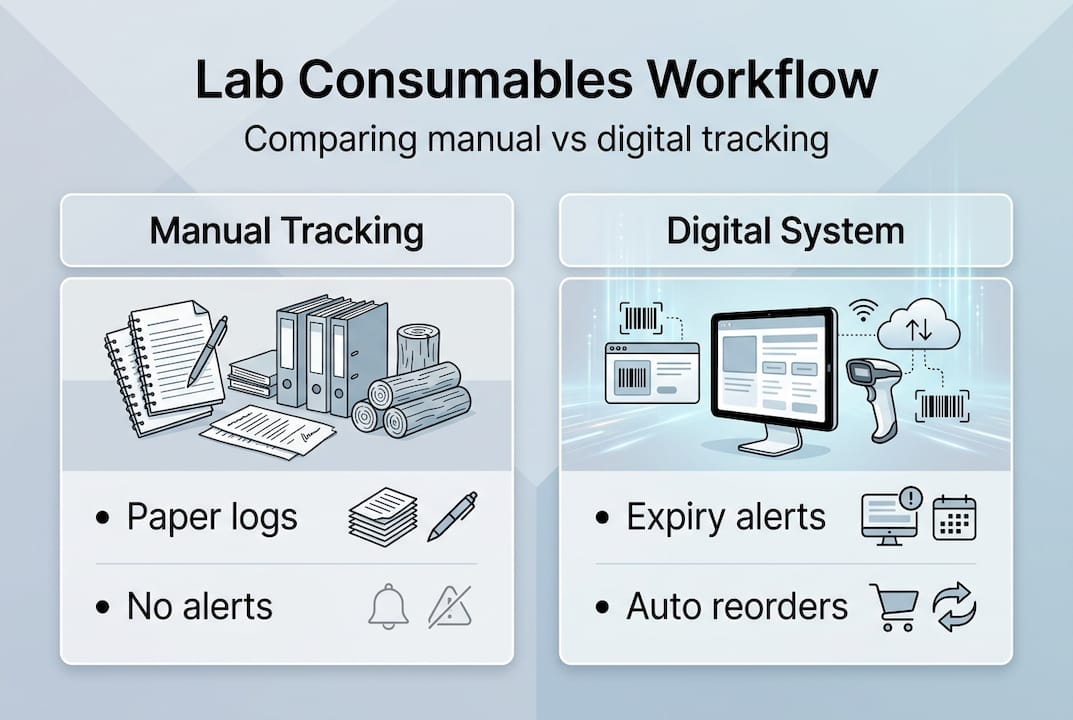
Digital systems address each of these failure points directly. Laboratory inventory automation through platforms such as LIMS (Laboratory Information Management Systems), ELN (Electronic Laboratory Notebooks), dedicated inventory software, and eProcurement tools automates tracking, generates low-stock alerts, records every transaction with a timestamp, and can integrate directly with supplier ordering portals.
The practical steps for transitioning to a digital workflow are:
- Audit your current tracking method and document every manual step that introduces delay or error.
- Define minimum stock thresholds for each consumable category based on your baseline data.
- Select a platform that integrates with your existing procurement system, such as SAP Ariba or similar ERP tools used across European institutions.
- Migrate your spreadsheet inventory data into the new system with validation checks.
- Train all relevant staff on the new system before going live, and assign a named inventory manager per department.
| Feature | Manual tracking | Digital system |
|---|---|---|
| Expiry date alerts | None | Automated |
| Reorder triggers | Manual check | Automated threshold |
| Audit trail | Paper-based | Timestamped log |
| Error rate | High | Low |
| Regulatory compliance | Difficult | Built-in |
| Staff time required | High | Reduced by 25% |
The workflow guide comparison provides additional context on selecting the right system for different lab sizes. For labs managing supply chain optimization across multiple departments, a system with multi-user access and role-based permissions is essential. Digital tools reduce waste by 40% and save 25% in staff time, making the return on investment for most research institutions measurable within the first two quarters of implementation.
Pro Tip: Choose a digital tool that integrates natively with your procurement system. Disconnected platforms create data silos where purchase orders exist in one system and inventory records in another, which defeats the purpose of automation and reintroduces manual reconciliation work.
Centralized procurement and shared facility best practices
Building on the tools selected for tracking, the next efficiency layer is procurement structure. Many European academic and private research institutions still operate with decentralized purchasing, where individual labs or departments order independently. This approach consistently results in duplicated supplier relationships, missed bulk discount opportunities, and inconsistent stock levels across the facility.
Centralized procurement consolidates ordering across departments through a single purchasing function, enabling bulk contracts, standing orders, and coordinated delivery schedules. Core facilities at institutions such as the Karolinska Institutet (KI) and the Deutsches Rheuma-Forschungszentrum Berlin (DRFZ) manage shared consumables through centralized ordering and tracking, demonstrating measurable cost and time savings at scale.
| Procurement model | Cost per unit | Order processing time | Stock visibility |
|---|---|---|---|
| Individual lab ordering | High | 3 to 5 days | Low |
| Centralized procurement | Reduced 15 to 30% | 1 to 2 days | High |
| Standing bulk contracts | Lowest | Same day | Full |
Key best practices for implementing centralized procurement include:
- Standing orders: Establish recurring delivery schedules for high-frequency consumables such as gloves, tubes, and culture media, eliminating repetitive purchase requests.
- Bulk contracts: Negotiate annual volume agreements with primary suppliers to secure preferential pricing and guaranteed availability.
- Inter-lab communication: Create a shared consumables request portal or a simple internal request form so all departments submit needs through one channel.
- Shared stock rooms: Designate a centrally managed storage area with clearly labeled sections and a check-out log for shared consumables.
“Institutions that implement centralized procurement for laboratory consumables consistently report bulk discounts of 15 to 30% and a significant reduction in administrative time spent on purchasing, while core facilities that manage shared consumables through coordinated ordering achieve higher stock visibility and fewer emergency procurement events.”
For a detailed consumables comparison across product categories and supplier tiers, reviewing structured data before negotiating bulk contracts helps procurement specialists identify where volume consolidation delivers the greatest savings. Maintaining labware integrity steps during centralized storage is equally critical, since bulk stock stored improperly can generate waste that offsets the savings from bulk pricing.
Mitigating risks: traceability, audits, and special-case consumables
With standard workflows in place, attention must turn to the consumables that carry elevated risk: high-value items, hazardous materials, and contamination-prone reagents. These categories require a level of control that goes beyond standard inventory tracking.
Traceability, defined as the ability to track every consumable from receipt through use to disposal, is the foundation of audit readiness and regulatory compliance. The SPD traceability model with item-level coding significantly improves traceability and reduces processing errors, and the same principles apply to laboratory consumables management. High-value items require explicit approval workflows before use, contamination-prone consumables require documented acceptance checks, and hazardous materials require verified storage condition logs.
Steps for audit readiness and exception management:
- Assign barcodes or QR codes to all high-value and hazardous consumables at the point of receipt.
- Log every item movement, from storage to bench to disposal, in the digital inventory system.
- Establish a tiered approval hierarchy: standard consumables require no approval, high-value items require department head sign-off, and hazardous materials require safety officer authorization.
- Conduct quarterly internal audits to verify physical stock against digital records.
- Document all exceptions, including damaged deliveries, contaminated stock, and out-of-specification items, with corrective action notes.
Additional risk controls for special-case consumables:
- High-value items: Maintain a separate secured storage area with access logs and dual-sign verification for withdrawal.
- Hazardous materials: Verify storage temperature, humidity, and segregation requirements at every stock check.
- Contamination-prone reagents: Implement acceptance inspection protocols at delivery, including visual checks and certificate of analysis (CoA) review.
“Storage failures and inadequate acceptance procedures for contamination-prone consumables represent the highest-risk failure points in laboratory supply chains, with consequences ranging from compromised experimental data to regulatory non-compliance and potential safety incidents.”
For guidance on ensuring labware safety and reagent safety practices, these resources provide specific protocols for handling sensitive materials within a compliant research environment.
Our perspective: Why simplicity and flexibility beat complexity in lab consumables management
The laboratory management industry has a persistent tendency to equate sophistication with effectiveness. Institutions invest in feature-rich LIMS platforms with capabilities that 80% of their staff never use, and then wonder why adoption rates are low and workflows remain inefficient. The uncomfortable truth is that the most efficient laboratories we observe are not necessarily the ones with the most advanced systems. They are the ones where every team member understands the workflow, knows their role in it, and has a contingency plan when something goes wrong.
A simple, well-trained team using a flexible, moderately featured tool consistently outperforms a poorly trained team using an enterprise-grade system. Clarity of process, clear communication channels, and genuine buy-in from bench scientists matter more than automation features. The practical workflow tips that deliver lasting efficiency gains are rarely technical. They are organizational: who owns the inventory, who escalates shortages, and who reviews the data monthly. Prioritize training and process clarity before adding technological complexity, and the efficiency gains will follow.
Find the right tools and proven solutions for your consumables workflow
Ready to upgrade your laboratory’s consumables workflow with battle-tested tools and expert support?
Herbilabs offers curated resources, structured comparison guides, and a portfolio of high-quality research consumables designed to support efficient, reproducible laboratory operations. Whether you are evaluating consumables for research workflows, working through a product comparison before a bulk procurement decision, or sourcing high-purity reagents that meet the strict quality standards your research demands, Herbilabs provides the product quality and procurement support that European research institutions rely on. Efficient workflows and reliable consumables are not separate goals. They are the same goal.
Frequently asked questions
How do digital inventory tools improve lab consumables management?
Digital tools reduce waste 40% and staff time by 25% by automating tracking, generating expiry warnings, and enabling predictive reordering based on historical consumption data.
What are the main benefits of centralized procurement in academic labs?
Centralized ordering delivers bulk discounts of 15 to 30%, reduces administrative time spent on purchasing, and provides full stock visibility across departments.
How do labs handle expensive or hazardous consumables differently?
High-value or hazardous items require tiered approval workflows, item-level barcoding for full traceability, and verified storage condition logs to prevent contamination and ensure audit compliance.
Recommended
- Streamline lab consumables workflow: a guide for managers
- Top lab consumables: key examples for efficient research
- Top 6 Lab Consumables Comparison Guide 2026
- Maintain labware integrity: practical steps for reliable research
- Guide lavage zéro déchet : efficacité et solutions belges – VØYA
- Streamline Your Inventory Management Workflow for Growth – Reddog Consulting Group