Most laboratory professionals assume that if a product is commercially available, it meets an acceptable quality threshold. This assumption is more dangerous than it appears. Low-quality consumables cause contamination, poor reproducibility, and experiment repetition costing up to 30 times more than certified alternatives. For independent researchers and laboratory teams working under regulatory scrutiny, the difference between certified and non-certified lab supplies is not a matter of preference. It is a matter of scientific integrity, financial efficiency, and compliance.
Table of Contents
- What does “certified” actually mean for lab supplies?
- Certified vs non-certified: What’s at stake?
- How certified supplies power research reliability and compliance
- Downsides and nuances: Is certification always the answer?
- Best practices for sourcing and verifying certified lab supplies
- Find reliable certified lab supplies at Herbilabs
- Frequently asked questions
Key Takeaways
| Point | Details |
|---|---|
| Certification defined | Certified lab supplies meet strict standards and come with traceable documentation. |
| Risk of non-certified | Using non-certified supplies increases contamination, experiment failure, and costs. |
| Regulatory compliance | Certified supplies streamline audit compliance for UKAS, MHRA, and similar bodies. |
| Smart sourcing | Always request and verify COAs, certificates, and supplier credentials. |
What does “certified” actually mean for lab supplies?
After recognizing the real risks, it is vital to clarify what certification specifically entails in laboratory supply contexts. The term is frequently misused, applied loosely to products that carry no independent verification whatsoever.
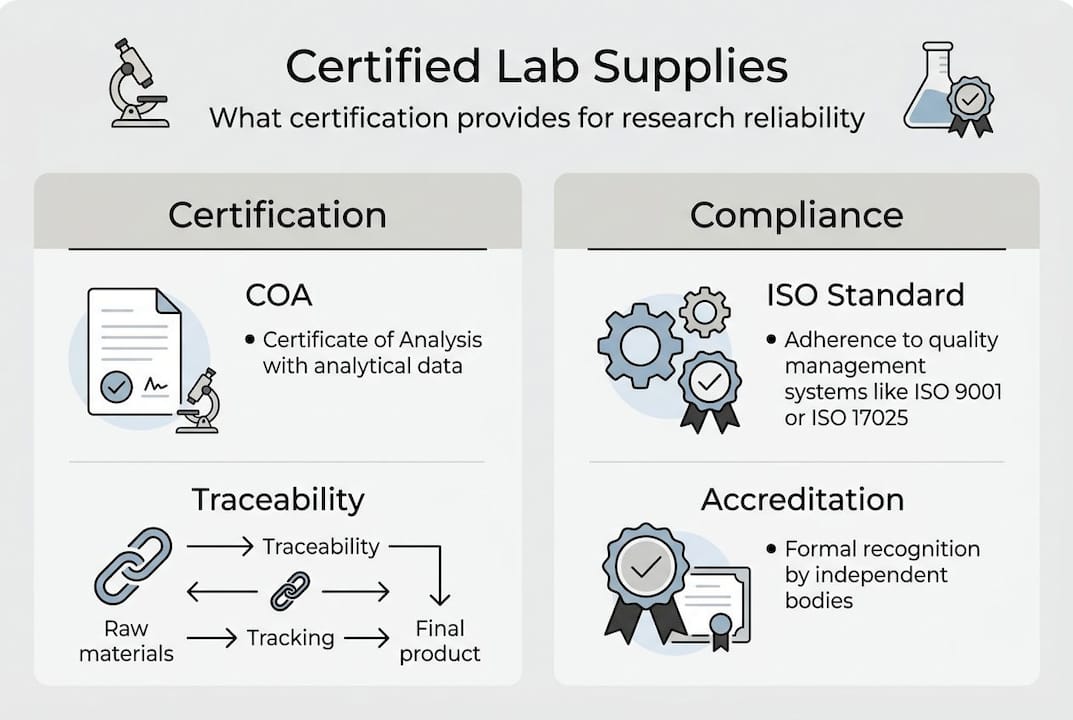
Certification, in a rigorous sense, means that a product or the facility producing it has been independently assessed against defined international or regional standards. The two most relevant frameworks for laboratory consumables and reagents are ISO 17025 (competence of testing and calibration laboratories) and ISO 17034 (reference material producers). ISO 17025 accredited supplies provide traceable, accurate results, reduce systematic errors, and ensure regulatory compliance across jurisdictions including the UK and EU.
In the UK and Europe, the key certifying and accrediting authorities include:
- UKAS (United Kingdom Accreditation Service): the national accreditation body for the UK, recognized under EU Regulation 765/2008
- MHRA (Medicines and Healthcare products Regulatory Agency): governs pharmaceutical-grade and clinical research materials
- DAkkS (Germany), COFRAC (France): equivalent national bodies within the EU
Certified supplies always come with supporting documentation. A certificate of analysis (COA) confirms the identity, purity, and test results for each batch, while traceable lot numbers allow any issue to be investigated back to its source. This documentation is not administrative formality. It is the evidentiary backbone of reproducible science.
| Standard | Scope | Issuing authority |
|---|---|---|
| ISO 17025 | Testing and calibration labs | UKAS, DAkkS, COFRAC |
| ISO 17034 | Reference material producers | National accreditation bodies |
| MHRA GMP | Pharmaceutical/clinical materials | MHRA (UK) |
Pro Tip: When evaluating a new supplier, request the COA and verify that the issuing laboratory holds current UKAS or equivalent accreditation. A COA from a non-accredited source carries significantly less evidentiary weight during regulatory review.
Maintaining consistency in lab water quality is one area where certification standards are particularly critical, since even minor ionic or microbial variation can skew downstream assay results.
Certified vs non-certified: What’s at stake?
Now that we understand what certification means, let us examine what happens when laboratories cut corners and when they do not.
The consequences of using non-certified or counterfeit consumables are well-documented and severe. Counterfeit filters failed filtration at rates up to 4% penetration against a required 99.97% efficiency, and chemical breakthrough occurred in under five minutes. In a research context, a single compromised filtration step can invalidate an entire experimental series.
“A single failed filter can invalidate months of work, and the financial and reputational cost of that failure far exceeds any savings made at procurement.”
The practical consequences of non-certified supplies include:
- Sample contamination from leaching plasticizers, residual solvents, or microbial ingress
- Poor reproducibility due to batch-to-batch variation in uncertified reagents
- Regulatory audit failures when documentation cannot be produced or traced
- Experiment repetition costs that can reach 30 times the original material cost
- Safety incidents from chemical breakthrough in protective or filtration equipment
By contrast, certified supplies provide a structured safety net. Reviewing examples of top lab consumables illustrates how certified products are designed with defined tolerances, validated manufacturing processes, and batch-specific testing that non-certified alternatives simply cannot match.
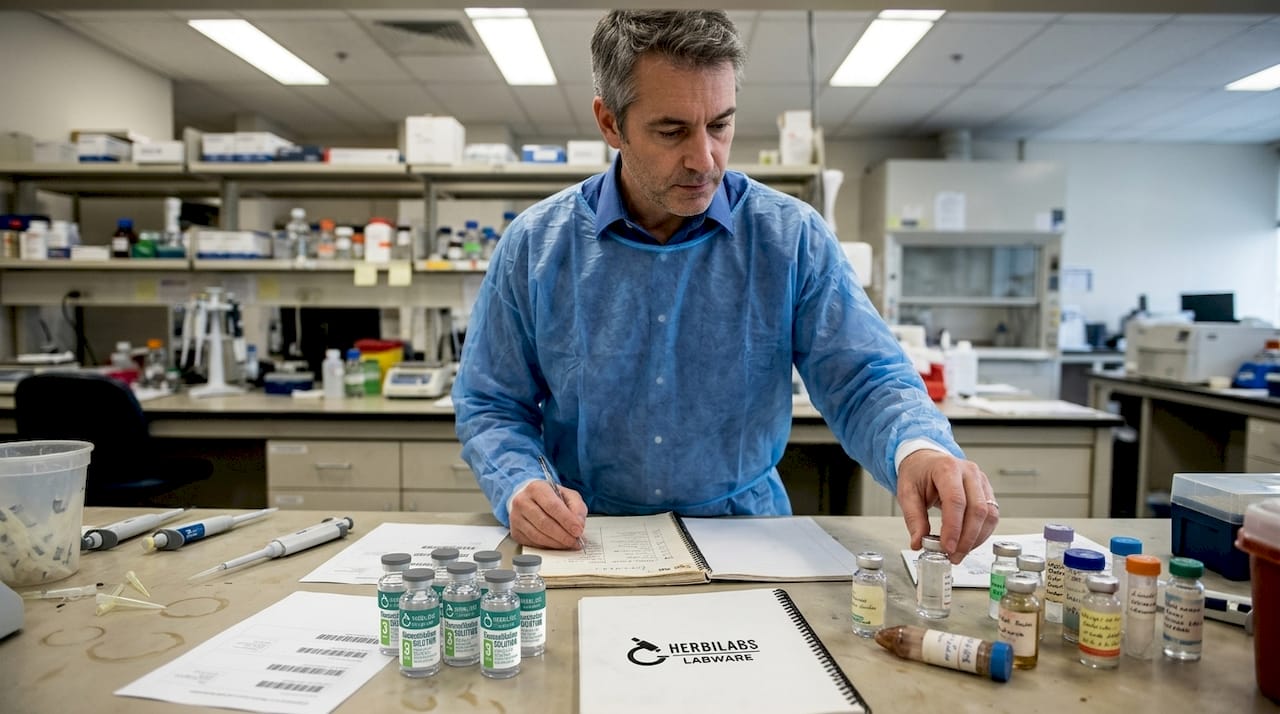
For peptide research specifically, where reconstitution accuracy and sterility are non-negotiable, the argument for certified reagents is even stronger. High-purity reagents ensure that observed biological activity reflects the peptide itself, not a contaminant introduced through a substandard diluent.
| Factor | Certified supplies | Non-certified supplies |
|---|---|---|
| Batch traceability | Full lot documentation | Often absent |
| Contamination risk | Minimized by validated process | Unpredictable |
| Regulatory compliance | Supported by COA and accreditation | Difficult to demonstrate |
| Long-term cost | Lower (fewer failed experiments) | Higher (repetition, remediation) |
| Audit readiness | High | Low |
How certified supplies power research reliability and compliance
With the risks clearly established, it is important to understand the practical upside: how certified supplies support both daily laboratory operations and longer-term compliance objectives.
Adopting ISO-accredited materials has a measurable effect on audit outcomes. ISO 17025 accredited supplies reduce audit nonconformities by providing an unbroken chain of evidence from manufacturer to end use. Inspectors from UKAS, MHRA, or equivalent bodies can verify each material’s provenance within minutes when documentation is properly maintained.
The steps for building a compliance-ready supply chain are straightforward:
- Establish a supplier qualification process that requires ISO or UKAS certification as a baseline criterion
- Collect and archive COAs for every batch received, indexed by lot number and receipt date
- Implement incoming inspection to verify that physical lot numbers match COA documentation before use
- Maintain a reagent log that records preparation dates, concentrations, and the lot numbers of all materials used in each experiment
- Review supplier certifications annually to confirm that accreditation remains current
In pharmaceutical cleaning validation, certified cleaning verification achieves greater than 90% sample recovery with a relative standard deviation of 4% or less. Uncertified surfaces and reagents produce erratic, non-reproducible recovery data that fails regulatory thresholds. The same principle applies to any high-stakes laboratory procedure.
Pro Tip: Organize COAs and lot numbers in a dedicated digital folder, structured by supplier and product category. During a MHRA or UKAS inspection, the ability to retrieve batch documentation within two minutes demonstrates a mature quality management system and significantly reduces inspector scrutiny.
Proper aseptic techniques during reagent prep and adherence to safe reagent handling best practices are most effective when the underlying materials are themselves certified, since procedural rigor cannot compensate for inherent material variability. For a detailed overview of accreditation requirements, the ISO/IEC 17025 framework provides a thorough reference.
Downsides and nuances: Is certification always the answer?
While the evidence for certification is strong, it is not a universal solution. Nuance and judgment remain essential.
Certification addresses material quality and traceability. It does not automatically improve laboratory culture, team communication, or workflow design. ISO 17025 implementation may increase administrative burden without improving dimensions such as interdepartmental collaboration or staff training quality. These are organizational challenges that certification alone cannot resolve.
Additional limitations worth acknowledging:
- Increased paperwork: Maintaining full traceability requires consistent documentation discipline across all staff
- Higher unit costs: Certified products carry a price premium that may strain budgets for low-risk, non-critical procedures
- Supplier dependency: Relying on a narrow pool of certified suppliers can create procurement bottlenecks
- Scope limitations: Certification covers the material as supplied, not how it is used after receipt
“Accreditation is a vital tool, but not a cure-all for every lab challenge. The greatest gains come when certified materials are paired with rigorous procedural standards and well-trained personnel.”
The practical guidance here is to prioritize certification for high-risk and critical procedures, such as sterile reconstitution, reference standard preparation, and any work feeding into regulatory submissions. For low-stakes, exploratory work, the cost-benefit calculation may differ. The key is deliberate, risk-based decision-making rather than blanket adoption or blanket avoidance.
Best practices for sourcing and verifying certified lab supplies
To conclude, we will equip you with a practical framework for obtaining and validating genuinely certified supplies to safeguard your research.
Verification begins before purchase. Certified cleaning processes in pharmaceutical settings achieve greater than 90% recovery with tightly controlled variability, a benchmark that only certified materials and validated procedures can reliably meet. Applying the same verification mindset to your procurement process is the logical extension of that standard.
Follow these steps when sourcing certified lab supplies:
- Request the COA before ordering: A reputable supplier provides batch-specific documentation without hesitation
- Verify accreditation status: Confirm that the issuing laboratory or manufacturer holds current ISO 17025, UKAS, or equivalent accreditation
- Inspect packaging on receipt: Check for ISO, UKAS, or MHRA marks and confirm that lot numbers on the label match the accompanying COA
- Cross-reference lot numbers: Before any use, verify that the physical product lot number matches the COA exactly. Discrepancies indicate a documentation error or, in worst cases, a counterfeit product
- Maintain a supplier audit trail: Record supplier certifications, renewal dates, and any quality incidents for reference during internal or external audits
Pro Tip: Always cross-check lot numbers between the product label and the COA before use. This single step takes under thirty seconds and is the most reliable early indicator of a documentation or supply chain problem.
When working with reconstitution solutions and sterile diluents, the stakes are particularly high. Reviewing guidance on how to avoid contamination mistakes during reconstitution reinforces why certified starting materials are the foundation of every reliable protocol.
Find reliable certified lab supplies at Herbilabs
Understanding the value of certification is the first step. Sourcing products that genuinely meet those standards is the next.
Herbilabs supplies fully certified bacteriostatic water, sterile diluents, and reconstitution solutions, each accompanied by clear COA documentation and manufactured to strict purity standards. For researchers working in peptide science, reagent preparation, or any protocol where contamination control is critical, Herbilabs provides the traceability and quality assurance that certified research demands. Explore high-purity reagents for research and review the full range of top research consumables available through Herbilabs, where every product is backed by the documentation your work requires.
Frequently asked questions
What makes lab supplies “certified”?
Certified supplies meet defined quality standards such as ISO 17025, verified by independent accreditation bodies and supported by traceable batch documentation including certificates of analysis.
Are certified lab supplies mandatory for all research?
Certified supplies are required for regulated and clinical research environments, but they represent best practice for any scientific work where reproducibility and data integrity are priorities.
How do I check if labware is genuinely certified?
Request a certificate of analysis with traceable lot numbers from the supplier, and verify that the issuing laboratory holds current ISO or UKAS accreditation.
Do non-certified supplies really increase costs and risk?
Yes. Experiment repetition costs from failed consumables can reach thirty times the original material cost, compounding the financial and reputational impact of a single supply chain failure.