
TL;DR:
- Independent research is conducted by individuals or small teams outside formal institutions, often self-funded and self-directed. It offers flexibility and originality but faces credibility challenges without institutional support and resources. Open practices, rigorous methodology, and transparency are essential for success and recognition in this field.
The assumption that all meaningful scientific discovery originates within university laboratories or well-funded research institutions is increasingly difficult to sustain. Independent researchers, working outside formal affiliations, have produced work that challenges established findings, fills gaps in overlooked fields, and accelerates innovation in ways that conventional academic pipelines often cannot. This guide covers what independent research actually means, how it differs from related concepts, the methodologies that make it rigorous, the ethical principles that sustain it, and the real challenges and opportunities researchers face when operating without institutional support.
Table of Contents
- What is independent research?
- Core methodologies and best practices
- Principles and ethics in the digital age
- Challenges and opportunities for independent researchers
- Why the future of innovation needs independent research
- Empower your independent research with trusted tools
- Frequently asked questions
Key Takeaways
| Point | Details |
|---|---|
| Independent research defined | It is self-directed inquiry conducted outside formal institutions, promoting flexibility and innovation. |
| Rigorous methodologies | Effective independent research follows structured academic methods from design to open dissemination. |
| Digital-age ethics | Transparency, data sharing, and ethical safeguards are crucial for reputable independent research. |
| Challenges and growth | Independents face unique barriers but are growing in influence as academic landscapes shift. |
| Path to recognition | Strategic documentation and collaboration increase visibility and credibility for independent researchers. |
What is independent research?
Independent research refers to research conducted by individuals or small teams without formal institutional affiliation, often self-funded and self-directed. This definition is precise and important, because it separates the practice from two concepts that are frequently confused with it.
Research independence refers to the freedom from bias or external influence within a formal institutional context, such as a university professor conducting a study without industry funding pressure. Independent study, on the other hand, is typically a structured academic arrangement where a student pursues a topic under faculty supervision. Neither of these is the same as independent research, which operates entirely outside institutional frameworks.
“Independent research complements institutional work with flexibility and originality but faces credibility hurdles without affiliation.” This tension is central to understanding how the field functions and where it is heading.
The contrast with institutional research is not simply about location or funding. It is about the entire structure of accountability, peer review access, and resource availability. Independent researchers typically lack access to institutional libraries, laboratory infrastructure, and the built-in credibility that comes with a university affiliation.
The following table summarizes the key distinctions between these three related concepts:
| Concept | Affiliation | Oversight | Funding source |
|---|---|---|---|
| Independent research | None | Self-directed | Self-funded or grants |
| Research independence | Institutional | Peer or ethics board | Institutional or external |
| Independent study | Institutional | Faculty supervisor | Institutional |
Who pursues independent research? The backgrounds are varied. Former academics who left institutional positions, industry professionals exploring adjacent questions, citizen scientists with domain expertise, and postdoctoral researchers who could not secure faculty positions all contribute to this growing community. Motivations are equally diverse: the desire to pursue niche topics that institutions consider too narrow or too risky to fund, the need for methodological flexibility, and the drive to publish findings without institutional gatekeeping.
The practical implication is that independent research is not a lesser form of inquiry. It is a structurally different one, with its own advantages and constraints that require deliberate strategies to navigate effectively.
Core methodologies and best practices
Successful independent research follows a structured process that mirrors institutional standards while adapting to the resource constraints of working outside formal systems. Key methodologies include self-directed topic selection, literature review, original data collection or experiments, analysis, and dissemination via publications or open platforms.
The following numbered sequence reflects the typical workflow applied by rigorous independent researchers:
- Topic selection and scoping: Define a research question that is specific, answerable, and positioned within existing literature. Overly broad questions are a common failure point.
- Literature review: Use open-access databases such as PubMed, arXiv, and Semantic Scholar to map existing knowledge. This step validates the novelty of the research question.
- Methodology design: Choose data collection or experimental methods appropriate to the question. For experimental work, sourcing certified lab supplies ensures reproducibility and data integrity.
- Data collection and documentation: Maintain detailed, timestamped records. Platforms like Zenodo and ORCID provide persistent identifiers that support traceability and recognition.
- Analysis and interpretation: Apply statistical or qualitative methods consistently and document all analytical decisions to support replication.
- Dissemination: Submit to peer-reviewed journals, post preprints, or publish on open platforms. Traceable sample storage and documentation practices strengthen the credibility of submitted work.
Academic standards apply equally to independent researchers. Ethical approval, where required, must be obtained through independent ethics boards or institutional review boards that accept external applicants. Data fabrication, selective reporting, and plagiarism carry the same consequences regardless of affiliation.
Pro Tip: One of the most significant challenges for independent researchers is the scarcity of peer feedback. To address this, actively participate in open peer review communities, preprint servers, and discipline-specific forums. Platforms like ResearchGate and specialized Slack communities allow independent researchers to receive structured critique before formal submission. Reviewing independent research steps from established frameworks can also provide a useful quality benchmark.
Documentation is not optional. An ORCID identifier, for example, creates a persistent, searchable record of all published outputs and affiliates them with a single researcher identity regardless of institutional changes. Zenodo downloads and citation counts serve as quantifiable evidence of impact, which becomes critical when applying for grants or collaborative opportunities.
Principles and ethics in the digital age
The digital environment has fundamentally changed what is possible for independent researchers, but it has also introduced new ethical responsibilities. Principles for independent research in digital contexts include access to public data, data sharing, no blocking of findings, institutional protection from legal risks, and ethical safeguards.
These principles translate into concrete practices:
- Open data sharing: Depositing datasets in public repositories such as Figshare or the Open Science Framework ensures findings are verifiable and reusable.
- Transparency in methodology: Detailed methods sections, including reagent specifications and experimental conditions, allow other researchers to replicate or challenge findings.
- No suppression of results: Negative results carry scientific value. Publishing null findings counters publication bias and strengthens the overall evidence base.
- Legal and ethical protection: Independent researchers operating without institutional legal support must understand data protection regulations, intellectual property rights, and research ethics requirements applicable in their jurisdiction.
- Collaboration through digital tools: Platforms like GitHub for code, OSF for project management, and Slack for community engagement enable independent researchers to collaborate at scale without physical co-location.
Pro Tip: Building credibility as an independent researcher depends heavily on transparent, open documentation. When preparing experimental work, clearly document every step, including avoiding contamination protocols and the specifications of reconstitution solutions used. Reviewers and collaborators are more likely to trust and engage with work that demonstrates procedural rigor at every stage.
The ethical dimension extends to data sourcing. Independent researchers accessing publicly available datasets must comply with the terms of use governing those datasets, even when no institutional compliance office is monitoring adherence. Self-regulation is not a weakness in this context. It is a professional standard that distinguishes credible independent work from informal inquiry.
Challenges and opportunities for independent researchers
The structural realities of independent research create both significant obstacles and distinctive opportunities. Understanding both sides of this equation is essential for anyone considering or currently pursuing this path.

Common challenges include:
Lack of funding, lab access, publication bias, feedback scarcity, and time management with other responsibilities represent the most frequently cited barriers across a review of 500 independent papers. Each of these challenges compounds the others. Limited funding restricts lab access, which constrains the scope of experimental work, which in turn limits the types of journals willing to consider submissions.
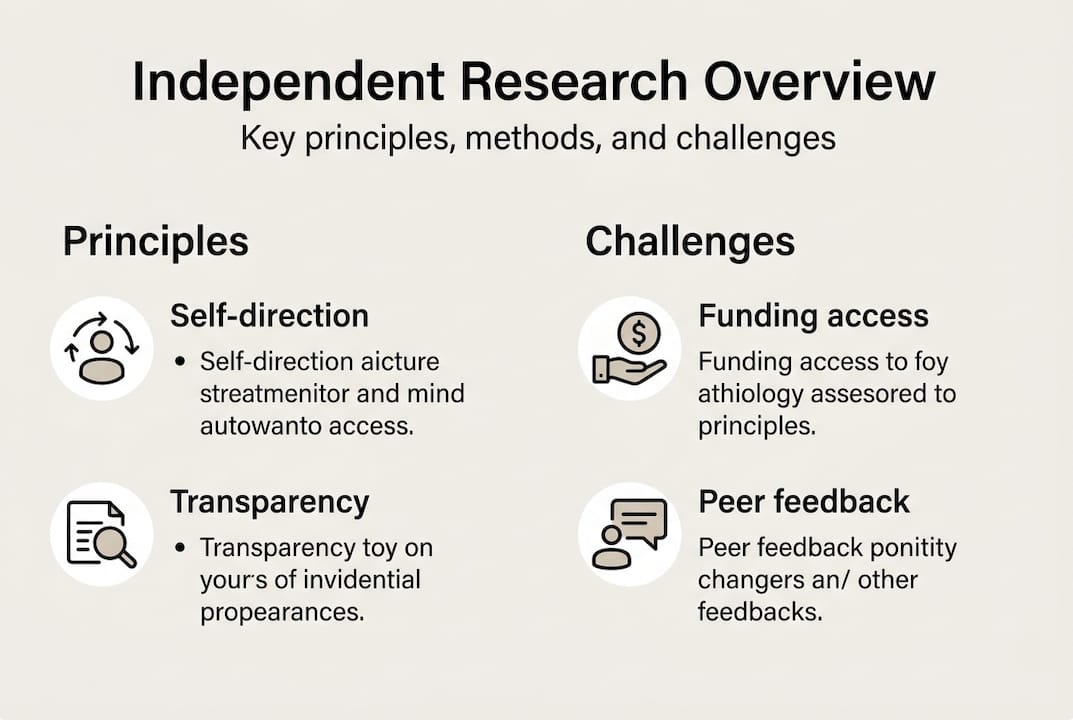
The following comparison table illustrates key differences between institutional and independent research workflows:
| Factor | Institutional researchers | Independent researchers |
|---|---|---|
| Funding access | Grants, departmental budgets | Self-funded, competitive grants |
| Lab infrastructure | Provided | Must source independently |
| Peer feedback | Built-in through departments | Requires active networking |
| Publication credibility | Affiliation-backed | Requires demonstrated rigor |
| Career recognition | Formal pathways | Non-linear, self-constructed |
Statistic callout: Some independent researchers outperform institutional averages in citation impact and output volume, with bibliographic data showing a small but measurably increasing percentage of high-impact publications originating from non-affiliated authors.
Opportunities are equally real. Independent researchers can pursue questions that institutional review processes would classify as too speculative or commercially unattractive. They can pivot methodology quickly without committee approval. They can collaborate across disciplines without departmental politics. Sourcing efficient research supplies through specialized suppliers reduces one of the most practical barriers, enabling experimental work that would otherwise require institutional infrastructure.
The landscape is also shifting. Open-access publishing, preprint culture, and digital collaboration tools have collectively reduced the credibility gap between affiliated and non-affiliated researchers. Funders including certain philanthropic organizations and government agencies have begun creating grant mechanisms specifically accessible to independent researchers, recognizing that institutional gatekeeping sometimes excludes valuable inquiry.
Why the future of innovation needs independent research
Conventional academic systems are optimized for incremental progress within established paradigms. Funding cycles, tenure requirements, and departmental priorities all create structural pressure toward safe, publishable, citation-generating work. This is not a criticism. It is a design feature that serves specific goals. But it means that genuinely disruptive questions often go unasked within institutions.
Independent researchers, precisely because they lack the constraints of affiliation, are better positioned to pursue those questions. The absence of institutional support, often framed as a disadvantage, can function as a creative forcing mechanism. When you cannot rely on departmental resources, you develop leaner, more adaptable methodologies. When you cannot appeal to affiliation for credibility, you build it through transparency and rigor.
The academic world would benefit from actively lowering barriers to collaboration with independent researchers, including offering institutional review board access, library privileges, and co-authorship opportunities without requiring full affiliation. Investing in examples of efficient research tools and making them accessible to non-institutional researchers is one practical step in that direction. The future of innovation is not exclusively institutional. It is distributed.
Empower your independent research with trusted tools
For independent researchers, the quality of every result depends directly on the quality of the materials and tools used throughout the experimental process. Cutting corners on reagent purity or reconstitution accuracy introduces variables that compromise reproducibility and weaken the credibility of findings.
Herbilabs supplies high-purity reagents and research-grade reconstitution solutions manufactured to strict quality standards, specifically designed to support rigorous, reproducible research. Whether you are setting up a home laboratory or scaling an independent project, knowing how to select lab reagents appropriate to your protocol is a foundational step. Explore the full range of products and technical resources available at Herbilabs labware to ensure your independent research is built on a reliable foundation.
Frequently asked questions
Can independent researchers publish in peer-reviewed journals?
Yes, independent researchers can publish in peer-reviewed journals, though publication bias against non-affiliated authors means that demonstrating methodological rigor and transparent documentation is especially important for acceptance.
What tools help independent researchers gain recognition?
ORCID and Zenodo downloads provide persistent, searchable records of research output, while active participation in open peer review communities and preprint servers increases visibility and citation potential.
How does independent research differ from research independence?
Independent research vs. research independence is a structural distinction: independent research means operating entirely outside institutional affiliation, while research independence refers to conducting unbiased inquiry within a formal institutional context.
Is independent research effective for career development?
Some independent researchers outperform institutional averages in output and citation impact, though formal career recognition and resource access typically lag behind those available through traditional academic or industry pathways.
Recommended
- Why high-purity reagents ensure reliable research results
- Why certified lab supplies are essential for reliable research
- How to select laboratory reagents for reliable peptide research
- Understand laboratory reagent standards for reliable results
- Master marketing research process steps for rapid insights